
Now Reading: Where will the annular solar eclipse be visible on Feb. 17?
-
01
Where will the annular solar eclipse be visible on Feb. 17?


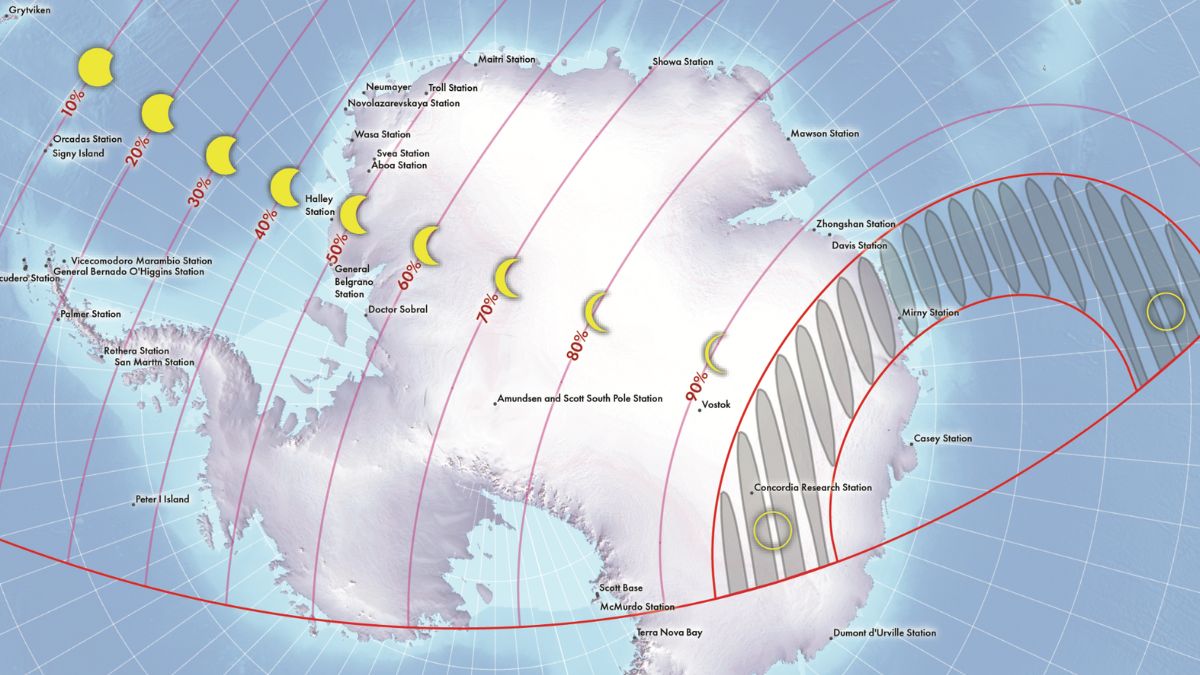
The first solar eclipse of 2026 will be a dramatic annular solar eclipse on Feb. 17. The downside for most of us is that the stunning ‘ring of fire’ will be witnessed by more penguins than people.
Stretching 2,661 miles (4,282 kilometers) long and 383 miles (616 km) wide, the path of annularity — where the ‘ring of fire’ will be visible — cuts across western Antarctica and skims the Davis Sea coast of the Southern Ocean.
Path of annularity
The eclipse will rise over mainland Antarctica and set off the Davis Sea coast of the Southern Ocean.

Where to see the partial solar eclipse
A far greater number of people will be able to witness the partial stage of the annular solar eclipse during which the moon appears to take a ‘bite’ out of the sun.
Remember that it’s unsafe to look directly at the sun during the partial phases of a solar eclipse. At all times, you must wear solar eclipse glasses. Read our guide on how to observe the sun safely.
|
Location |
Percentage of the sun’s disk covered |
|---|---|
|
Heard and McDonald Islands, Australia |
88% |
|
French Southern and Antarctic Lands, France |
88% |
|
Mascarene Islands, Mauritius/France |
35% |
|
Port Louis, Mauritius |
32% |
|
Saint-Denis, Reunion, France |
31% |
|
Antananarivo, Madagascar |
20% |
|
Durban, South Africa |
16% |
|
Maputo, Mozambique |
13% |
|
Maseru, Lesotho |
11% |
|
Gaborone, Botswana |
4% |
|
Harare, Zimbabwe |
3% |
|
Ushuaia, Argentina |
3% |
Next eclipse
Just two weeks after the annular solar eclipse, Earth will experience a total lunar eclipse on March 3-4, when Earth’s shadow will turn our lunar neighbor blood red.
The blood moon will be visible for about 58 minutes across western North America, Australia, New Zealand and East Asia.
Unlike the few people who will witness the annular solar eclipse, nearly 31% of the world’s population — around 2.5 billion people — will be able to see the eclipse in totality, when the moon turns blood red.

After the Feb. 17 ‘ring of fire’, the next annular solar eclipse will occur on Feb. 6, 2027, and will be visible from locations in Chile, Argentina, Uruguay, Brazil, Cote d’Ivoire, Ghana, Togo, Benin and Nigeria.










Related Posts


Stay Informed With the Latest & Most Important News
Previous Post
Next Post





Advertisement
-
 01Two Black Holes Observed Circling Each Other for the First Time
 -
 02From Polymerization-Enabled Folding and Assembly to Chemical Evolution: Key Processes for Emergence of Functional Polymers in the Origin of Life
 -
 03Astronomy 101: From the Sun and Moon to Wormholes and Warp Drive, Key Theories, Discoveries, and Facts about the Universe (The Adams 101 Series)
 -
 04True Anomaly hires former York Space executive as chief operating officer
 -
 05Φsat-2 begins science phase for AI Earth images
 -
 06Hurricane forecasters are losing 3 key satellites ahead of peak storm season − a meteorologist explains why it matters
 -
 07Binary star systems are complex astronomical objects − a new AI approach could pin down their properties quickly