
Now Reading: Why do Jupiter’s large moons outnumber Saturn’s?
-
01
Why do Jupiter’s large moons outnumber Saturn’s?


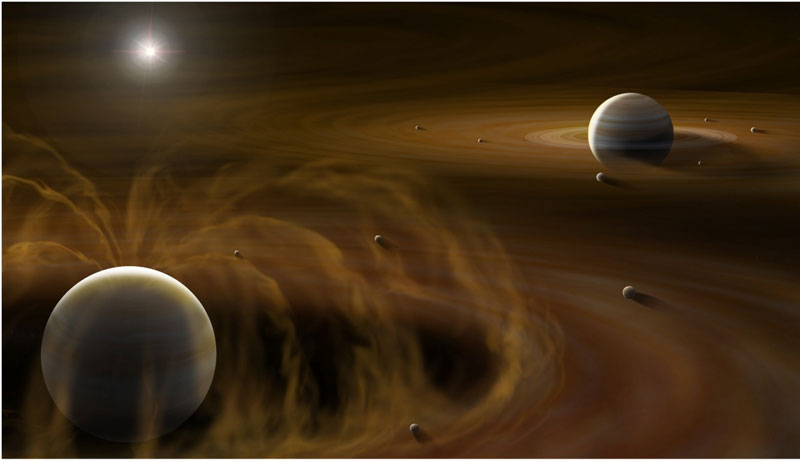

- Jupiter and Saturn both have many moons, with Saturn having nearly twice as many as Jupiter. But Jupiter has more large moons than Saturn. Why is that?
- The planets’ magnetic fields and disks of material that the moons were born in provide the answers, says a new study from researchers in Japan.
- Jupiter’s much stronger magnetic field created cavities in its disk for the large moons to grown in.
Jupiter’s large moons outnumber Saturn’s
In the last week, astronomers announced even more new moons for Jupiter and Saturn. As of now, Jupiter has 115 known moons and Saturn has a whopping 292. But Jupiter has four large moons – Ganymede, Callisto, Io and Europa – while Saturn has only one, Titan. Why the discrepancy? Researchers in Japan said on April 8, 2026, that the answer might have to do with the magnetic fields around both planets and the disks of material that the moons originally formed in.
This question has been the subject of long-running debate among astronomers. Now, the new findings show that scientists need to reevaluate their theories about the formation of moons around gas giant planets. This could also be extrapolated to possible moons around distant exoplanets as well.
Jupiter’s four large moons are known as the Galilean moons. They were named in honor of the Italian astronomer Galileo, who discovered them through his telescope in 1610.
The researchers published their peer-reviewed results in Nature Astronomy on April 2, 2026.


Magnetic fields and circumplanetary disks
The new findings involve both the magnetic fields of Jupiter and Saturn and the circumplanetary disks that surrounded them when they were first forming. Those disks contain the dust and gas that moons are born in.
And the researchers found something interesting. The structure of the disks of the two planets were different from each other. According to the new study, this difference originated from the strength of the planets’ magnetic fields.
Jupiter has a much stronger magnetic field than Saturn. This created magnetospheric cavities in the circumplanetary disk. These cavities then captured the forming moons Ganymede, Callisto, Io and Europa.
But Saturn’s magnetic field was too weak to create such cavities. Therefore, any larger moons that might have existed didn’t survive inside the disk. Except for Titan, of course.
National Astronomical Observatory of Japan: How Jupiter Cultivated More Large Moons Than Saturn — a Magnetospheric Cavity Explains the Difference www.nao.ac.jp/en/news/scie…
— AAS Press Office (@press.aas.org) 2026-04-08T17:50:35.051Z
Testing planet formation theories
The researchers wanted to test planet formations theories. Understanding how the planets – and moons – formed in our solar system could provide clues about planets and moons around other stars.
In particular, planets with multiple moons, like Jupiter and Saturn and others, might be analogs for other planetary and moon systems. As lead author Yuri I. Fujii at Kyoto University noted:
Testing planet formation theory is somewhat difficult because we have only our solar system for reference, but there are multiple satellite systems close to us whose detailed characteristics we can observe.
The researchers are confident that the new findings will indeed help astronomers identify exomoons. As of now, there are several candidates, but no confirmations yet. The paper states:
Our findings predict that compact exomoon systems – in cases of massive gas giants, and a couple of distant moons in cases of Saturn-sized gas giants – will be found in future surveys.
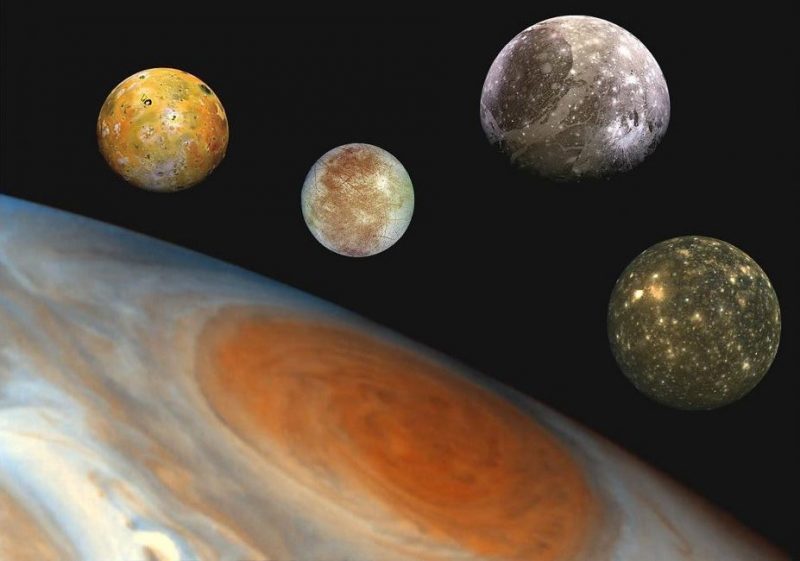
Bottom line: Jupiter’s large moons – Ganymede, Callisto, Io and Europa – number four. But Saturn has just one large moon, Titan. Why? It may be the planets’ magnetic fields.
Read more: More moons for Jupiter and Saturn! New totals here
Read more: New moons! Uranus now has 28 and Neptune 16
The post Why do Jupiter’s large moons outnumber Saturn’s? first appeared on EarthSky.










Related Posts
Stay Informed With the Latest & Most Important News
Previous Post
Next Post


Advertisement
-
 01Two Black Holes Observed Circling Each Other for the First Time
 -
 02From Polymerization-Enabled Folding and Assembly to Chemical Evolution: Key Processes for Emergence of Functional Polymers in the Origin of Life
 -
 03Astronomy 101: From the Sun and Moon to Wormholes and Warp Drive, Key Theories, Discoveries, and Facts about the Universe (The Adams 101 Series)
 -
 04True Anomaly hires former York Space executive as chief operating officer
 -
 05Φsat-2 begins science phase for AI Earth images
 -
 06Hurricane forecasters are losing 3 key satellites ahead of peak storm season − a meteorologist explains why it matters
 -
 07Binary star systems are complex astronomical objects − a new AI approach could pin down their properties quickly