
Now Reading: Why Estimating η⊕ Is Difficult: A Kepler-Centric Perspective
-
01
Why Estimating η⊕ Is Difficult: A Kepler-Centric Perspective


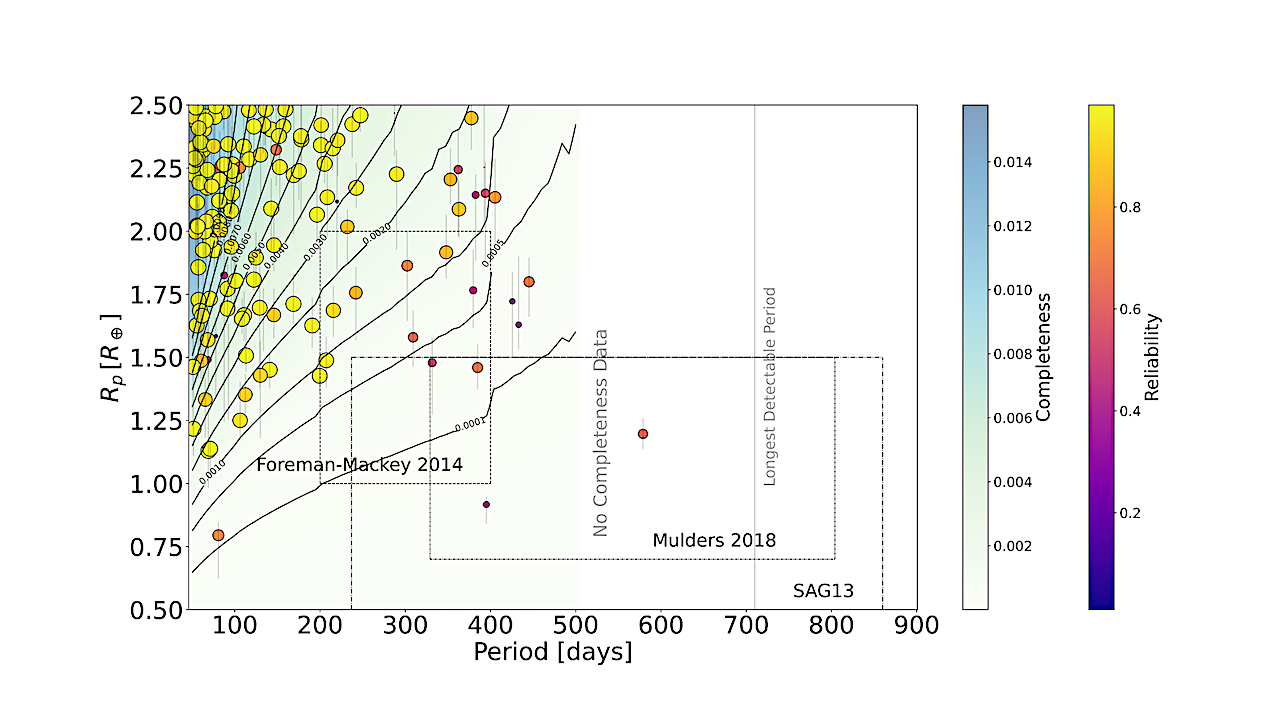
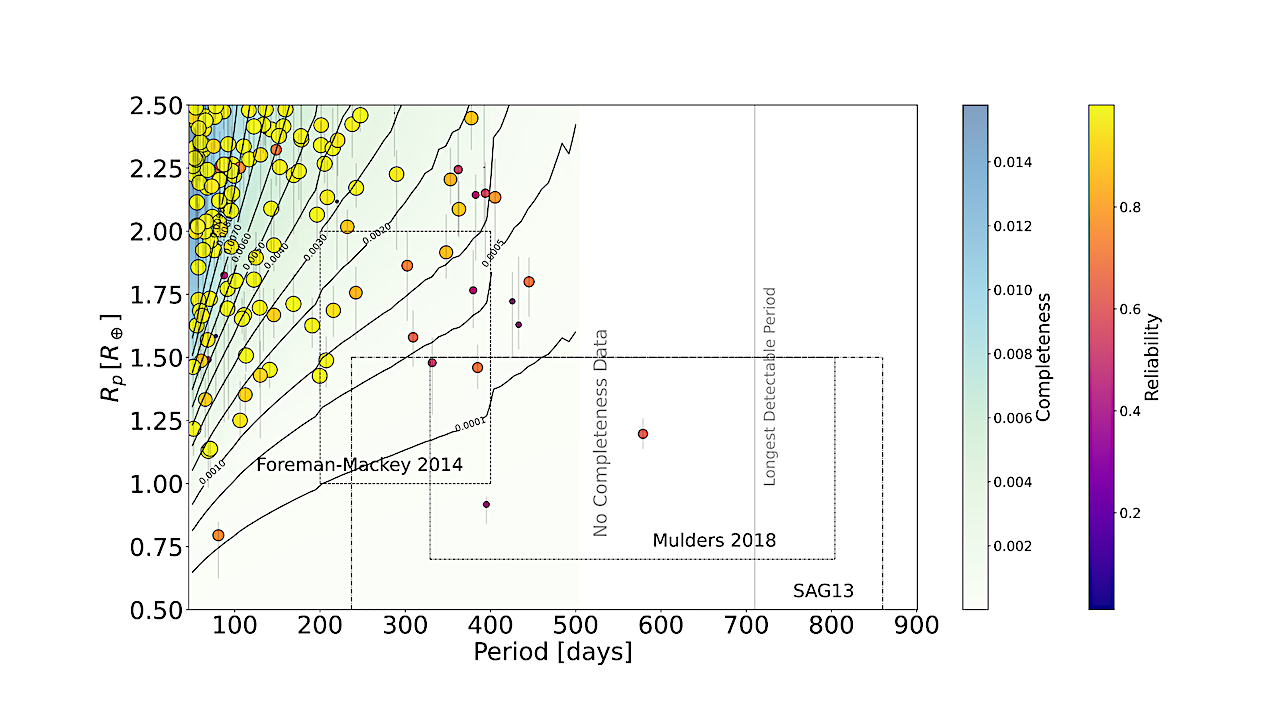
The Kepler exoplanet candidate population around FGK stars used in the analysis of S. Bryson et al. (2021), shown in period and radius, both colored and sized by catalog reliability with exoplanet radius error bars. The background color map and contours indicate detection completeness. The rectangles show example η⊕ definitions from different authors. Adapted from S. Bryson et al. (2020a). — astro-ph.EP
η⊕, the occurrence rate of rocky habitable zone exoplanets orbiting Sun-like stars, is of great interest to both the astronomical community and the general public. The Kepler space telescope has made it possible to estimate η⊕, but estimates by different groups vary by more than an order of magnitude.
We identify several causes for this range of estimates. We first review why, despite being designed to estimate η⊕, Kepler’s observations are not sufficient for a high-confidence estimate, due to Kepler’s detection limit coinciding with the η⊕ regime.
This results in a need to infer η⊕, for example extrapolating from a regime of non-habitable zone, non-rocky exoplanets. We examine two broad classes of causes that can account for the large discrepancy in η⊕ found in the literature: a) differences in definitions and input data between studies, and b) fundamental limits in Kepler data that lead to large uncertainties and poor accuracy.
We highlight the risk of large biases when using extrapolation to describe small exoplanet populations in the habitable zone. We discuss how η⊕ estimates based on Kepler data can be improved, such as reprocessing Kepler data for more complete, higher-reliability detections and better exoplanet catalog characterization. We briefly survey upcoming space telescopes capable of measuring η⊕, and how they can be used to supplement Kepler data.
Steve Bryson, Michelle Kunimoto, Ruslan Belikov, Galen J. Bergsten, Sakhee Bhure, William J. Borucki, Douglas A. Caldwell, Aritra Chakrabarty, Rachel B. Fernandes, Matthias Y. He, Jon M. Jenkins, Kristo Ment, Michael R. Meyer, Gijs D. Mulders, Ilaria Pascucci, Peter Plavchan
Comments: 24 pages, 9 figures, submitted to PASP
Subjects: Earth and Planetary Astrophysics (astro-ph.EP)
Cite as: arXiv:2511.05658 [astro-ph.EP] (or arXiv:2511.05658v1 [astro-ph.EP] for this version)
https://doi.org/10.48550/arXiv.2511.05658
Focus to learn more
Submission history
From: Michelle Kunimoto
[v1] Fri, 7 Nov 2025 19:00:05 UTC (1,908 KB)
https://arxiv.org/abs/2511.05658
Astrobiology,










Related Posts
Stay Informed With the Latest & Most Important News



Advertisement
-
 01Two Black Holes Observed Circling Each Other for the First Time
 -
 02From Polymerization-Enabled Folding and Assembly to Chemical Evolution: Key Processes for Emergence of Functional Polymers in the Origin of Life
 -
 03Astronomy 101: From the Sun and Moon to Wormholes and Warp Drive, Key Theories, Discoveries, and Facts about the Universe (The Adams 101 Series)
 -
 04True Anomaly hires former York Space executive as chief operating officer
 -
 05Φsat-2 begins science phase for AI Earth images
 -
 06Hurricane forecasters are losing 3 key satellites ahead of peak storm season − a meteorologist explains why it matters
 -
 07Binary star systems are complex astronomical objects − a new AI approach could pin down their properties quickly