
Now Reading: Why the Space Force says 2025 changes everything
-
01
Why the Space Force says 2025 changes everything


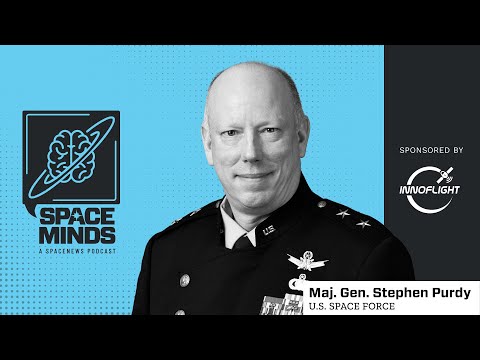

In this episode of Space Minds, host Mike Gruss sits down with Maj. Gen. Stephen Purdy, one of the U.S. Space Force’s most influential acquisition leaders and recipient of the SpaceNews Icon Award for Military Space Achievement.
Purdy discusses how 2025 is shaping up to be a defining year for Space Systems Command (SSC) and why this past year represented a major shift toward the “ground game”—software, training systems, and modernized infrastructure. He describes how Guardians are driving adoption of AI tools, how SSC is integrating commercial innovation at unprecedented speed, and why this current wave of acquisition reform may finally stick.
From meeting 160 companies in a single year to rethinking refueling, space mobility, and on-orbit servicing, Purdy details how commercial space, venture-backed startups, and emerging technologies—from space mining to in-space nuclear systems—are reshaping how the U.S. prepares for the future of space warfare.
This wide-ranging conversation explores the evolving national security space ecosystem and offers a candid look at how the Space Force is trying to move faster, innovate smarter, and ensure resilience in a contested domain.
sponsored by

Innoflight has been a trusted space avionics supplier for more than 20 years. Innoflight is AS9100D and ISO 9001 certified, and develops innovative, radiation tolerant by design, and integrated cyber secure space avionics solutions, suited for space vehicle buses and payloads. Innoflight’s cutting-edge and mission critical communications, networking, cyber security, processing, and integrated electronics solutions support the most advanced space missions. Innoflight continues to revolutionize the space industry and excels in modular, high performance, and low Size Weight and Power (SWaP) hardware and software solutions with successful flight heritage in multiple orbits.
Show notes and transcript
Click here for Notes and Transcript
Time Markers
00:00 – Episode introduction
01:06 – Guest introduction
02:06 – Highlights of 2025 for Space Systems Command
05:39 – What Guardians Need
08:03 – Why Acquisition Reform Is Different
12:13 – New DoD Reforms and Portfolio Thinking
14:21 – Visiting Nontraditional Space Companies
17:43 – Surprising Tech from Space Mining & Automation
19:43 – Dual-Use Technology and Commercial Integration
21:42 – On-Orbit Servicing, Refueling, and Space Mobility
23:58 – Breaking the Refueling Paradox
26:36 – Infrastructure Challenges Ahead
Transcript – Maj. Gen. Stephen Purdy Conversation
This transcript has been edited-for-clarity.
Mike Gruss – I had the pleasure of introducing General Purdy last week because he won the SpaceNews Icon Award for military space achievement. What I said then, and what many of you already know, is that General Purdy has been at the forefront of an effort to rewire how the military buys satellites, launches rockets, and, I think most importantly, how to partner with industry—private industry. Your approach has been to tap into these commercial companies. And I think the last we heard was, what, 160 meetings this year to outpace adversaries and deliver cutting-edge capabilities.
We’re gonna get right into it. I have a couple of real quick housekeeping things. One, thanks to the Space Force Association for hosting this conference. I’d also like to thank Redwire for producing the speakers we have lined up all day. It’s a fantastic lineup here at the Guardian Nexus stage. I’d also say for our Guardians who are readers out there, you can get free access to SpaceNews at spacenews.com/guardians.
So with that, let’s start with 2025—a big year for you all. What are the highlights for you? Where do you think the big successes in acquisition have been for your office?
Maj. Gen. Stephen Purdy – Hey, so first I want to pass on my congrats and thanks to all of you and all of the government personnel—the program management, the operations, the tests—and industry out there. This has been a joint effort. This past year, we have done an amazing amount of work collectively, and it really took everyone together to do all that. Not one group can be successful, and the purpose of acquisitions is to deliver integrated warfighting capability to the warfighter. I mean, that’s the fundamental purpose. It’s not to have program reviews, and it’s not to do analysis and risk, but that’s a function of it. Our mainline purpose is to deliver capability.
And so I’ll start there: an amazing amount. I actually have a cheat sheet, just because there’s so much stuff that we’ve done this last year.
What I found interesting is that traditionally, we’re the Space Force—we build satellites and whatnot. That’s actually been a side gig for us this year. I mean, we had some satellites that went operational—acceptance, EPS weather satellite, GPS satellites. But this year’s all really been about the ground game. A lot of ground hardware components and software. This has really been a year of software and kind of a change in software on the ground hardware components.
Quite a bit of activity. S2E2—we’ve done early use with DARC and G-BOSS. We’ve had quite a bit of success with CCSS, which is the Counter-Comm Systems electronic warfare. And we’ve had some really innovative cultural successes, and I’ll use that one as an example.
We have delivered product on CCSS, but I think more importantly, we pivoted in the middle of the year and instead halted delivering product because the warfighters wanted some additional training systems and supply to meet their warfighting needs. And so we pivoted with industry and delivered that instead. Being able to pivot during the year to meet warfighter needs—be it actual capability, training systems, or supply parts, etc.—I think was a real key innovation. Those were conversations we weren’t having in previous years, and that’s been enhanced by improved communication over this last year.
And then the software game—quite a lot of activity going on in software. Battle management, command and control, KRONOS had a couple of software drops. I think this is really the year of OTTE, though, which is our test and training architecture. We pushed a lot of bodies into that. Last year, General Guetlein reorganized some elements at SSC. The result of that was seen this year because they had the manpower to really work with STARCOM and the test deltas and the training deltas.
As a result, over the year, I would say, a stream of various trainers, hardware, and software—the SWORD system, which is a war-gaming software system. We’ve injected AI in terms of augmenting Red in the war games. Just a lot of that work. Previously, we haven’t really talked about a lot of that activity. So all of that software, all of that training—just really proud of the entire team.
Mike Gruss – I was going to ask this later, but you mentioned it, so let’s get back to it. What do you hear from Guardians that they want—that they need to do their job better? And you gave an example of how that’s changed how you’re thinking, but talk to me about the consistent feedback you’re getting from them.
Maj. Gen. Stephen Purdy – Yeah, absolutely. And I think the answer to what our Guardians are asking for varies based on which Guardians are asking, what organization they come from, what mission they’re dealing with, and also what level.
So I think our youngest Guardians are coming in and they are hyper-aware of modern technology, of AI. They’re using LLMs and AI like just normal course of business. They went through school using that—quite a bit of press on that topic—and they’re coming in hungry to use these tools. And that is something you’ve seen just within the last couple of weeks: major movements at the Department of the Air Force level. S1 and S6—the Space Force S6—have been working cooperatively to push out a bunch of AI tools. We had a mandate from S1: “Hey, we want you to be using AI tools in your acquisition program offices,” for example.
So I think you see that at the younger levels. Then you see a hunger for training and knowledge about how to do their business. As you get higher up, they’re looking for more operational effects on the warfighter side, and we’re looking for better knowledge within our SPO systems—of industry, industry trends, technology—and to be able to inject those in. And then, of course, expertise in our functional support so that we have the tools to bring those in.
At the highest levels—my level, the PEO levels—we’re dealing with venture capital. We’re trying to understand where their thinking is, where industry’s massive trends are. We’re trying to push these trends in certain directions that help us. We’re trying to leverage those billions of dollars of private equity funds so that we can benefit because we’ve got a smaller budget.
So it really depends who you’re talking to. But overall, you’re seeing a hunger for change, innovation, delivering—hunger for action and movement. And I think you see not only that hunger, but actual delivery of that this last year.
Mike Gruss – Yeah, and that segues nicely into acquisition reform. That’s been a big topic the last, let’s say, six, eight weeks. You and I have talked, and I told you I get a little skeptical when you hear about acquisition reform, because every couple of years there’s another cycle and it’s like, “No, no—this time it’s going to be different. This time we’re really going to move faster. This time speed matters.” So talk to me about why this time is different, or how you can point to an example where you can say, “Hey, we might not have done it this way five or ten years ago,” and you feel you can see the change.
Maj. Gen. Stephen Purdy – Yeah, that’s a perfect question, because we’ve talked acquisition reform for 50 years, and it’s almost a joke among our communities. I would say there are a couple of aspects.
Number one, I would say the Space Force—its existence is credited in part based on acquisition reform. We stood up in a true shift of the space domain from benign to warfighting. And we had the advantage of shifting some movement happening in the Department of the Air Force to support the Space Force. We set up with some of that early thinking of reform and different ways to do business. We set up with a passion for technology and closer integration with industry.
There are several other elements that play into why I think this time is legitimately different. So building upon the success of the last several years, particularly this year—we came out strong. The last couple of years, as Col. Valley came on as the first Space SAE, he laid down the groundwork: a back-to-basics program management 101 perspective. We killed some programs. We set new culture. That stuff took and we’ve been building on it ever since.
I would argue much of the activity we’ve done last year and this year was a precursor to SecAF’s and DoD’s major acquisition reform efforts—and particularly Congress. The NDAA, which just came out, is filled with that language. Additionally, you have the Secretary of the Air Force and the Department of Defense talking about acquisition reform and major changes.
So while we’ve talked about it before, I think there’s an unreal amount of senior-leader involvement, pressure, and push on the subject. Couple that with the fact that we’ve been working culture pieces, organizational pieces, and—critically—the benefit of the space industry.
The space industry is our secret to success. Unlike all others, there are billions of dollars of private equity and venture capital pouring into the commercial market that we’re able to leverage. We’ve been leveraging SBIRs and STRATFI to cross the valley of death, and we’ve done that for years. Many of the companies competing for modern programs are products of that.
Step-by-step, brick-by-brick, we’ve built our path, and I think we’re on a really good path to reform. There is still a lot to do, but history of success across the enterprise shows we’re on the right track.
Mike Gruss – There’s a lot to unpack there. I want to back up to the Secretary’s new reforms. Is there anything you’ve seen there that directly impacts space or thinks about space differently, where you said, “Hey, I can see how we can apply this, and I can see that something I did two years ago—there’s maybe a better way to do it now”?
Maj. Gen. Stephen Purdy – So, from the SecAF’s piece? I think what they’ve done is added additional elements. Some of those things we were already doing. For example, Space Development Agency long ago built a plan where you had multiple winners in the end game, and they pioneered a lot of that really fast, rapid acquisition contracting. We have adopted that across Space RCO and SSC. It’s a matter of course—it’s how we treat rapid acquisition: multiple winners in the end game.
But they have added extra elements—some influenced from the Hill and some they’ve added on their own. So the construct of moving from PEOs to PAEs—truly thinking and treating it like a portfolio level—is another level of thinking.
For those trying to visualize what that looks like, I think in space we have another model: the National Reconnaissance Office. If you look at the towers, those are kind of an idealized goal of PAEs and acquisition reform. Those tower directors have the ability to trade back and forth within their portfolios, moving between exquisite and commercial and proliferated as they need. They also have funding flexibility, and all those authorities reside within those towers.
So we’re using those as a guide star, and we’re marching to that plan. SecAF has indicated that’s his vision. And so SecAF’s directions and the acquisition reform directions are a set of helpers that allow us to move along that path. They establish the PAE construct, establish speed as a relevant and primary function, double down on commercial and industry elements. All that pressure and push helps a lot to validate that we’re on the right path.
Mike Gruss – I want to ask a little bit about your visits with industry throughout the past year. You’ve gone to companies that maybe traditionally haven’t been thought of as national security space companies. One example that’s gotten attention has been Vast, the commercial space station builder. But we just saw in the last couple weeks that more than 1,000 companies were on the IDIQ with SHIELD. So there are a lot of folks out there interested in this space. Tell me: when you go to a company that maybe isn’t traditionally thought of as a military space company, what are you looking for, and why is that a good use of your time? What do you get out of that?
Maj. Gen. Stephen Purdy – Yeah, this is an area I feel particularly passionate about. I’ve told our program management teams—and I’ve told industry—particularly the PM teams and the PEOs: it is your job to get out to industry regularly and repeatedly. And it’s not just to visit the same couple of companies that you have on contract. It’s your job to manage that contract, but it’s also your job to get out there.
And I’ll reference back to a point I made earlier: the vibrant space industrial base. And I would add the vibrant IT space out of Silicon Valley. There is a lot of work going on there. And if we just myopically look at the world from the couple of folks that are on contract and neglect all that other work, that’s to our disadvantage. Our job is to deliver capability. You can’t possibly know what’s out there without getting out and seeing it yourself.
So I’ve tried to lead by example. And you’re right—it’s been about 150, 160—probably 180 or 190—companies visited this year by myself, driving a lot of work to the team. But we do that because I’m trying to understand what’s happening in commercial industry that we don’t know and we’re not absorbing yet. And you find there is an amazing amount of capability out there.
I have this internal drive to find this tech and get it out to our PEOs and PMs—“Go look at this. Make sure you’re understanding this,” so that as you build these next acquisition plans, you’re keeping it all in mind.
The end goal is this: if we can slightly modify some of this traditional non-defense space tech and get it into warfighter hands, and that gives them an edge in the war fight, that’s the goal.
Mike Gruss – Is there—and I’m putting you on the spot a little here—is there an example of a company you’ve been to and you said, “Hey, I didn’t think there was something here, but there was”?
Maj. Gen. Stephen Purdy – Well, there have been quite a few. A couple come to mind. I would almost call them mission areas.
So the commercial space station market—you’re vaguely aware of it, but it’s not really our mainline business. Although, from a futurist perspective, I have half a foot in the future a lot of times, thinking about what the Space Force might want to go to. So I’m trying to think about what tech might be out there and get our folks thinking about it in case that comes down the pike.
Space station tech and how far they’ve come along—commercial space stations—is surprising. There is a lot of build happening in that area. The level of automation in space has also been surprising.
And then I’ll tell you a particular community of interest: the space mining community. That was a community I didn’t really pay attention to a couple of years ago. Now I’m paying attention. They’ve been doing deep thinking about dim objects, cis-lunar and past-lunar areas. They’ve brought up national security thoughts and ideas to us, and I’m like, “That’s a really good point.”
There was one particular company that hit me with three different aha moments in the same meeting. They were the winner by far for the year—it was pretty amazing. It was like, “Oh my gosh, we are not even thinking about these strategic effects.”
And then I’d give a nod to the space nuclear community as well. That was an area I was aware of early in the year, but I had not really thought much about. I’ve now become much more interested in the potential benefits they provide.
Mike Gruss – Let’s pivot slightly to this phrase that’s been very popular this year: dual-use technology. I don’t think we heard it as much in the first six months of the year as we’ve heard it in the last six months. And I think particularly there’s interest in Europe about it. How are you thinking about dual-use technology in your role?
Maj. Gen. Stephen Purdy – Yeah, so the term “dual use” is not something we naturally tend to use in S1 and acquisitions. I would translate dual use to “commercial.” That’s kind of how I’m thinking about it. I translate it to: how can I leverage capability and technology that’s in the commercial realm for national security needs?
We’ve been talking about commercial for a long time. But I feel like this year we started really moving the ball forward in many different acquisitions. It’s one thing to talk about it and have strategies and say you’re going to do it. It’s a whole other thing for the program managers and the PEOs to say, “Okay, how are we going to actually incorporate this?” and get into the discussions with industry about what they’re willing to do on a contract and what they’re not willing to do.
That’s why a lot of this year has been taken up with RFIs and draft RFPs—multiple rounds of them—as we look for ways to sort of thread the needle between traditional defense companies and this newer commercial space. They both have different ways they do funding and accounting, different approaches—fixed price versus cost-plus, classic example.
So the process is one aspect—setting up conditions for the PMs and PEOs to get after the process and establish approaches that allow those competitions. And then there’s the tech side itself—what tech is out there? That ties back to that earlier question about making sure we’re at least open to grabbing that tech.
Mike Gruss – I wanted to talk a bit about on-orbit servicing, because that’s also an area that’s gotten a lot of attention this year. Explain to me how you see that evolving and why that needs to be just a requirement going forward for Space Force satellites—or satellites to work with the Space Force, right?
Maj. Gen. Stephen Purdy – So, I’m a big believer in space mobility and logistics. When we were here at Launch, we established a conference—Space Mobility and Logistics Conference—to really get after it. One of my famous quotes on that stage was, “Well, we don’t have any money, but we’ll provide the leadership,” right? So we’re going to get everyone together because we knew we had to get after standards and discussions, technology, what’s out there, what can we do, what are the problems.
We had to have those discussions quite a bit to sort of figure out this whole mission space. It’s a complicated set of factors. You have LEO versus GEO and MEO. You have a host of commercial companies getting after this area. And I would say that over time—China, all over the world—yes, absolutely.
This has been an area where I would give a lot of props to the acquisition community. The Space Force hasn’t yet firmed up its definite requirements. We’ve talked about it in the commercial space strategy. We’ve referenced that this will clearly be a commercial kind of mission. We don’t have funding specifically in this direction yet.
So the acquisition community has done a really good job of pulling together SBIRs and STRATFI, pulling together some lab money, DIU, and other external elements. We’ve made deals with them and pooled our money together. There have been some congressional adds in this area, and they’ve gotten some nice plans in place that piece together multiple threads.
So we’ve got a space mobility thread to look at maneuvering objects. We’ve got a refueling thread to look at refueling objects. That’s all great work to exercise contracts and establish relationships with this entirely new mission area.
Meanwhile, we’ve been working from the acquisition strategy side—my office—on: “Are there processes? Are there programs coming up?” When an acquisition strategy comes up—“Hey, we’re looking at a new strategy for X, Y, or Z”—it’s now one of the items on our list: “Is there a refueling strategy? Why not? What’s your plan?”
The most public version of that was the RGX discussion this year about, “Hey, this seems ideally suited for it.” We don’t know exactly what the plans are—the requirements space, the funding space—but we’re going to put that element on there, put that demand signal out. We’re trying to break the chicken-and-egg paradox. We’re trying to push through it so we can sort of cheat a fait accompli on the subject, so that then we can execute. And we’ll see how that goes. We know it’s important.
Mike Gruss – You say that—what does that look like? Is there a demonstration planned? Or when you say “execute,” how?
Maj. Gen. Stephen Purdy – So our current thinking on that—using RGX as an example. Really excited about that whole program. We’re looking to really proliferate across multiple industries.
But here’s a problem: if we do that—which we absolutely want to do—multiple industry partners and multiple buses are on different fuels. So how do I build a fueler to go take care of that?
We kind of moved away from a single refueler, government-owned, to: “Okay, RGX—how can you put the conditions in so that we are not only requesting that you have a refueling capability, but also asking the complicated question: Can you bring a refueler yourself? Can you bring a commercial entity? Or do I just have a requirement that you have to refuel this, and I’m not going to provide it? I need your help with that because you own your own fuel.”
That’s allowed us much more detailed conversations with different potential bidders. You balance a government fueler—much like the Air Force has—with privatized, commoditized, commercial-based fueling. We’re trying to thread the needle to figure out what’s the easiest way to handle that.
Because again, I’m trying to create that space for a capability while being mindful that I don’t want to burn a bunch of operations Guardians managing refueling. I need them focused on the war fight. So we’re trying to figure out a way to bring that capability to the warfighter without burdening them with unneeded tasks.
Mike Gruss – We have about a minute left, so I’m going to put you on the spot with a tough question. There’s a lot that the Space Force wants to do, but a lot of it requires infrastructure—whether that’s software, whether it’s launch, a whole host of areas. What are you concerned about when it comes to infrastructure and the Space Force succeeding?
Maj. Gen. Stephen Purdy – You’re going to ask me a launch question with one minute left? Where are my launch bros out there? They’re all out there.
So there’s a host of infrastructure concerns. It’s very easy and tempting to look at an end effector and not look at the infrastructure. We’ve got a lot of infrastructure things to look at—launch, spaceports, SCN talking to our satellites, the comm networks, etc.
I would argue we’re in a decent place for now. But when you look at where we’re trying to go—true warfighting effects, resiliency—there’s a lot more work we probably need to do.
On the launch side—very passionate about that area with Launch—and we’re a bit disaggregated. We’ve got federal Space Force, state spaceports, private spaceports. We have multiple federal agencies. So I’m really working behind the scenes to push, “Hey, we kind of need national leadership in this particular area to take a holistic approach.”
And then on the other internal infrastructure items—we have a lot of work. Shannon Palone is working a lot with JAM and SCN to get after commercial aspects. Everywhere where we have commercial potential needs, or we need augmentation, we’re looking at commercial aspects to sort of fill in those elements.
Mike Gruss – Well, like I said, that’s all the time we have. Thank you, General Purdy. I want to recognize the Space Force Association for hosting this. I’d again like to thank Redwire for producing the great speakers here on the Guardian Nexus stage. I also want to let everyone know this conversation will be available online with support from Innoflight at SpaceNews.com as part of our Space Minds podcast. Thanks everyone, and thank you, General Purdy.
Maj. Gen. Stephen Purdy – Thank you all. Thanks a lot.
About Space Minds
Space Minds is a new audio and video podcast from SpaceNews that focuses on the inspiring leaders, technologies and exciting opportunities in space.
The weekly podcast features compelling interviews with scientists, founders and experts who love to talk about space, covers the news that has enthusiasts daydreaming, and engages with listeners. Join David Ariosto, Mike Gruss and journalists from the SpaceNews team for new episodes every Thursday.
Watch a new episode every Thursday on SpaceNews.com and on our YouTube, Spotify and Apple channels.
Be the first to know when new episodes drop! Enter your email, and we’ll make sure you get exclusive access to each episode as soon as it goes live!
Space Minds Podcast
“*” indicates required fields
Note: By registering, you consent to receive communications from SpaceNews and our partners.










Related Posts

Stay Informed With the Latest & Most Important News
Previous Post
Next Post




Advertisement
-
 01Two Black Holes Observed Circling Each Other for the First Time
 -
 02From Polymerization-Enabled Folding and Assembly to Chemical Evolution: Key Processes for Emergence of Functional Polymers in the Origin of Life
 -
 03Astronomy 101: From the Sun and Moon to Wormholes and Warp Drive, Key Theories, Discoveries, and Facts about the Universe (The Adams 101 Series)
 -
 04True Anomaly hires former York Space executive as chief operating officer
 -
 05Φsat-2 begins science phase for AI Earth images
 -
 06Hurricane forecasters are losing 3 key satellites ahead of peak storm season − a meteorologist explains why it matters
 -
 07Binary star systems are complex astronomical objects − a new AI approach could pin down their properties quickly