
Now Reading: Wobbling exoplanet hints at a hidden exomoon so massive it could redefine the word ‘moon’ altogether
-
01
Wobbling exoplanet hints at a hidden exomoon so massive it could redefine the word ‘moon’ altogether

Wobbling exoplanet hints at a hidden exomoon so massive it could redefine the word ‘moon’ altogether


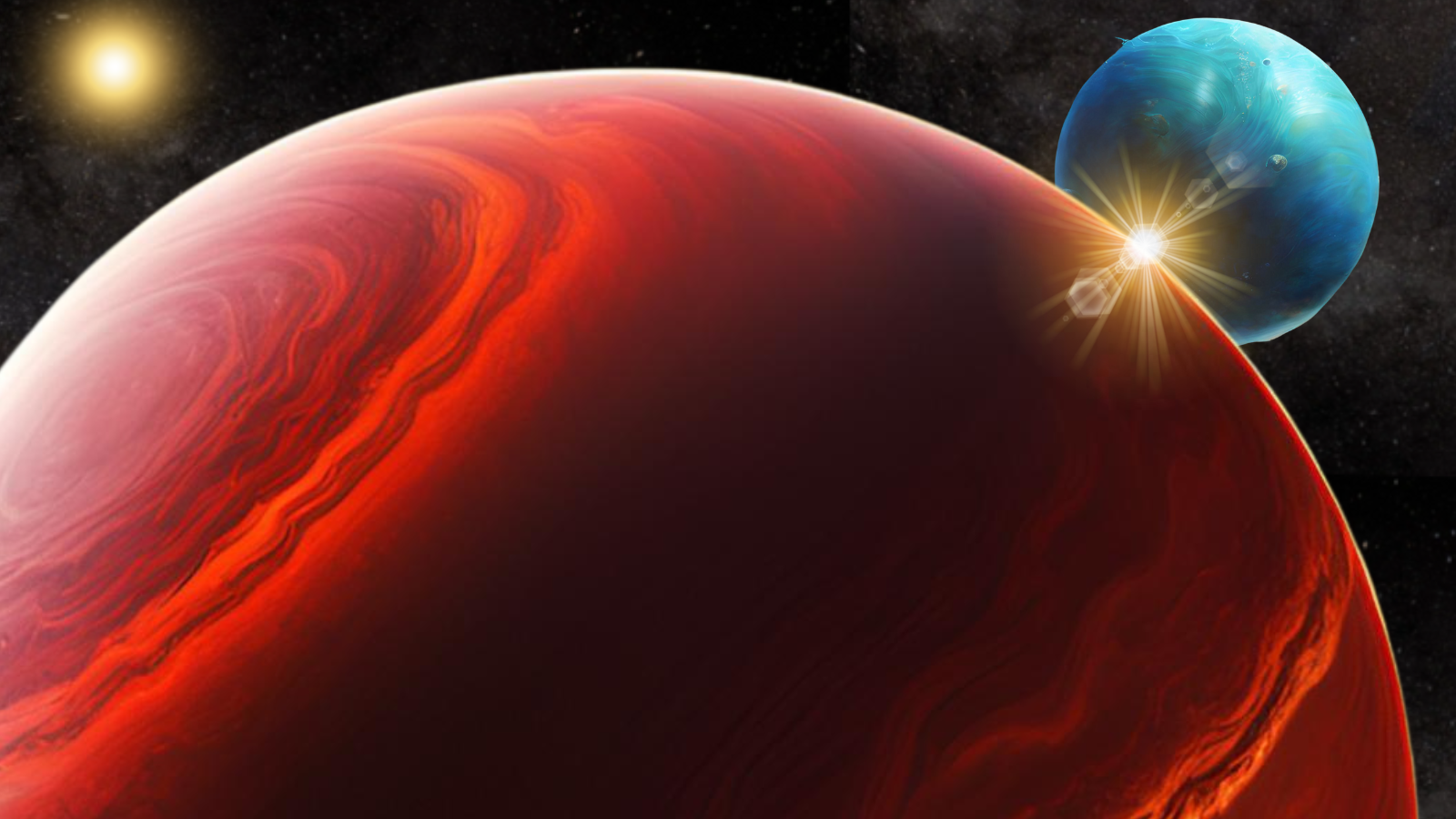
A gas giant planet beyond the solar that wobbles as it circles its star, hinting to astronomers that it is orbited by its own moon. To make this suspected discovery even more remarkable, if this moon exists it would be absolutely massive, comparable to around half the mass of Jupiter. That would make it thousands of times more massive than any moon orbiting a solar system plane — so massive it could make astronomers reconsider what constitutes a moon.
The extra-solar planet, or “exoplanet,” suspected to host this tremendous exomoon is HD 206893 B, a gas giant with 28 times the mass of Jupiter, which orbits a young star located around 133 light-years from Earth. The team behind this research detected signs of the potential exomoon while investigating HD 206893 B with the GRAVITY instrument at the Very Large Telescope (VLT) located in the Atacama desert region of northern Chile.
“What we found is that HD 206893 B doesn’t just follow a smooth orbit around its star. On top of that motion, it shows a small but measurable back-and-forth ‘wobble’. The wobble has a period of about nine months and a size comparable to the Earth–moon distance,” team leader and University of Cambridge astronomer Quentin Kral told Space.com. “This kind of signal is exactly what you would expect if the object were being tugged by an unseen companion, such as a large moon, making this system a particularly intriguing candidate for hosting an exomoon.”
The GRAVITY instrument allowed the team to use a technique called astrometry, which precisely measures the positions of stars and other astronomical bodies over time. This allows astronomers to detect tiny aberrations in motion that are the result of a gravitational “tug” from an unseen body.
“This technique has previously been used to measure the long, slow orbits of massive exoplanets and brown dwarfs, where observations spaced years apart are sufficient,” Kral said. “In our study, we pushed this approach much further by monitoring the object over much shorter timescales, from days to months. What we found is that HD 206893 B doesn’t just follow a smooth orbit around its star. On top of that motion, it shows a small but measurable back-and-forth ‘wobble.'”
The result of this investigation was the inference of a companion body orbiting HD 206893 B around once every nine months at a distance of around one-fifth the distance between Earth and the sun. The orbit of this potential exomoon is tilted at around 60 degrees relative to the orbital plane of its parent planet, potentially indicating some type of interaction has disturbed this system at some point in its history.
Of course, what would be really extraordinary about this exomoon, if confirmed, is its absolutely tremendous mass, around 40% of Jupiter’s mass, or around nine times the mass of the ice giant Neptune! That is so big it could call into question the definition of the word “moon.”
“In our solar system, the most massive moon is Ganymede, which is still extremely small compared to what we are inferring here. Ganymede is thousands of times less massive than Neptune, so there is an enormous gap in mass between the largest moons we know and this potential exomoon candidate,” Kral said.
“This naturally raises the question of whether such an object should even be called a moon. At these masses, the distinction between a massive moon and a very low-mass companion becomes blurred. However, there is currently no official definition of an exomoon, and in practice, astronomers generally refer to any object orbiting a planet or substellar companion as a moon.”
Though astronomers believe that several exomoons have been detected in the past, all of these possible detections have been controversial. Thus, the team is hoping that the exomoon of HD 206893 B can be the first to be officially confirmed.
“Exomoons are difficult to detect because they produce signals that are extremely small compared to those of planets, and those signals depend very strongly on both the observing technique and the system’s geometry,” Kral explained.
The most successful method of exoplanet detection thus far has been the transit method, which measures the dip in light caused as a planet crosses, or “transits”, the face of its parent star.
However, this technique hasn’t been nearly as successful at detecting exomoons.
“The transit method — which has been the most successful technique for finding exoplanets — can, in principle, detect moons comparable in size to Jupiter’s largest moons. However, it is most sensitive to planets orbiting very close to their stars, and theoretical studies suggest that such close-in planets are unlikely to retain large moons over long periods of time,” Kral said.
“Astrometry, the technique we use, is sensitive to longer-period moons orbiting planets or substellar companions far from their stars. This makes it particularly promising for detecting exomoons in regions where they are expected to be stable — at least for the most massive moons, which are likely to be the first ones we can find.”
In addition to hopefully confirming the presence of this exomoon, Kral and colleagues think this research and the technique they used lay down a future roadmap for exomoon discovery in other planetary systems.
“It’s important to keep in mind that we are likely only seeing the tip of the iceberg,” Kral concluded. “Just as the first exoplanets discovered were the most massive ones orbiting very close to their stars — simply because they were the easiest to detect — the first exomoons we identify are expected to be the most massive and extreme examples.
“As observational techniques improve, our definitions and understanding of what constitutes a moon will almost certainly evolve.”
The team’s research is available as a pre-peer-reviewed paper on the repository site arXiv, and accepted for publication in Astronomy & Astrophysics










Related Posts



Stay Informed With the Latest & Most Important News
Previous Post
Next Post



Advertisement
-
 01Two Black Holes Observed Circling Each Other for the First Time
 -
 02From Polymerization-Enabled Folding and Assembly to Chemical Evolution: Key Processes for Emergence of Functional Polymers in the Origin of Life
 -
 03Astronomy 101: From the Sun and Moon to Wormholes and Warp Drive, Key Theories, Discoveries, and Facts about the Universe (The Adams 101 Series)
 -
 04True Anomaly hires former York Space executive as chief operating officer
 -
 05Φsat-2 begins science phase for AI Earth images
 -
 06Hurricane forecasters are losing 3 key satellites ahead of peak storm season − a meteorologist explains why it matters
 -
 07Binary star systems are complex astronomical objects − a new AI approach could pin down their properties quickly