
Now Reading: XMM-Newton sees comet 3I/ATLAS in X-ray light
-
01
XMM-Newton sees comet 3I/ATLAS in X-ray light


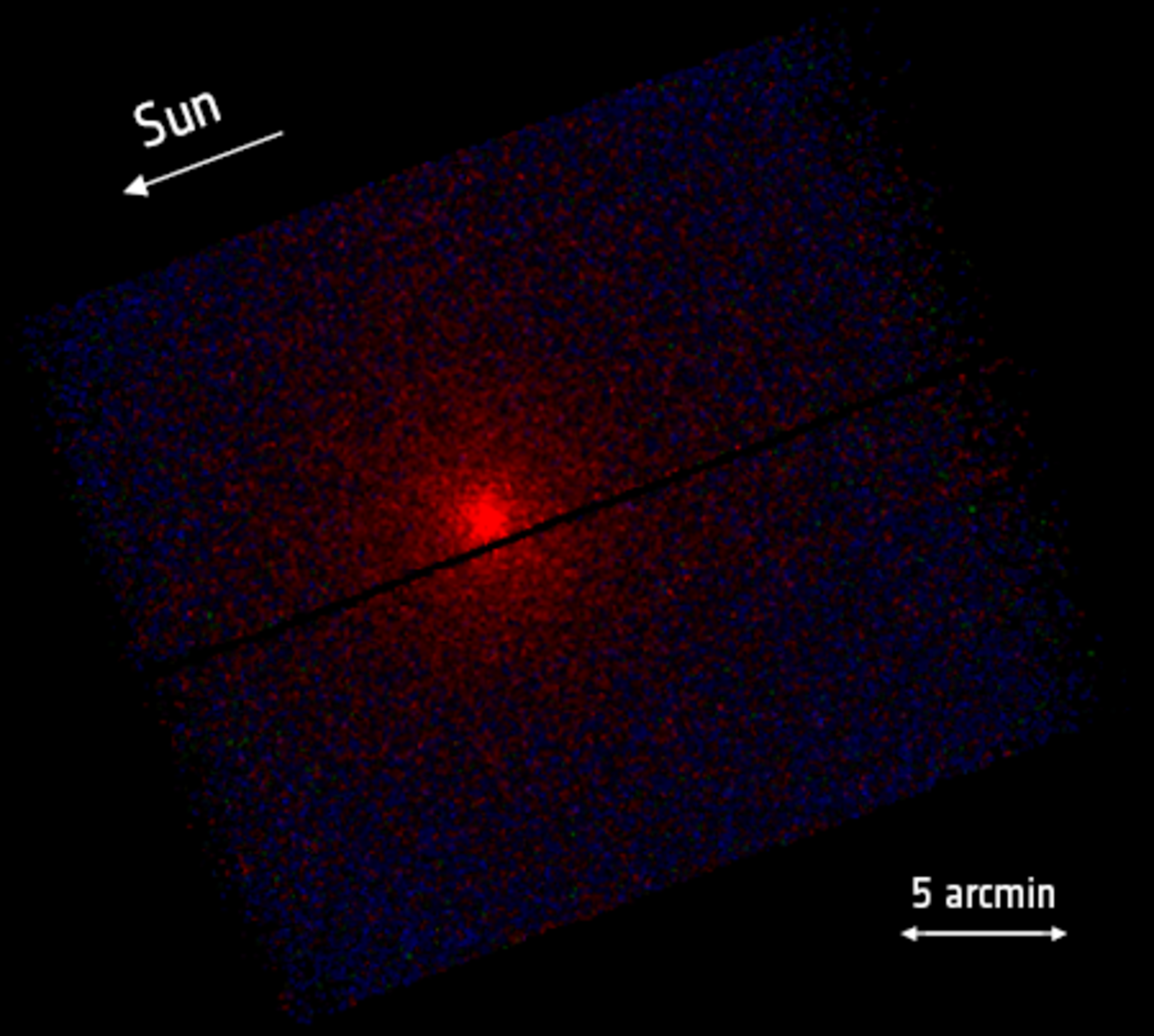

The European Space Agency’s X-ray space observatory XMM-Newton observed interstellar comet 3I/ATLAS on 3 December for around 20 hours. During that time, the comet was about 282–285 million km from the spacecraft.
XMM-Newton observed the comet with its European Photon Imaging Camera (EPIC)-pn camera, its most sensitive X-ray camera.
This image shows the comet glowing in low-energy X-rays: blue marks empty space with very few X-rays, while red highlights the comet’s X-ray glow. Astronomers expected to see this glow because when gas molecules streaming from the comet collide with the solar wind, they produce X-rays.
These X-rays can come from the interaction of the solar wind with gases like water vapour, carbon dioxide, or carbon monoxide – which telescopes such as the NASA/ESA/CSA James Webb Space Telescope and NASA’s SPHEREx have already detected. But they are uniquely sensitive to gases like hydrogen (H₂) and nitrogen (N₂). These are almost invisible to optical and ultraviolet instruments, such as the cameras on the NASA/ESA Hubble Space Telescope or ESA’s JUICE.
This makes X-ray observations a powerful tool. They allow scientists to detect and study gases that other instruments can’t easily spot.
Several groups of scientists think that the first detected interstellar object, 1I/’Oumuamua (found in 2017), may have been made of exotic ice like nitrogen or hydrogen.
While 1I/’Oumuamua is too far away now, 3I/ATLAS presents a new opportunity to study an interstellar object, and observations in X-ray light will complement other observations to help scientists figure out what it is made of.
For the latest updates and FAQs related to comet 3I/ATLAS, see esa.int/3IATLAS.
[Image description: This image shows an X-ray view of interstellar comet 3I ATLAS, captured by ESA’s XMM-Newton spacecraft. At the centre of the image, a bright red spot stands out against a dark background, like a fiery beacon. Starting from this core, faint gradients of purple and blue spread outward, creating a slightly rotated rectangular frame, divided by a thin horizontal line, the detector gap. The red colour shows low-energy X-rays, blue marks empty space with very few X-rays. A yellow arrow labelled “Sun” points left, indicating the comet’s orientation in the Solar System. At the bottom right, a scale marker reads “5 arcmin”, providing a sense of spatial dimension.]










Related Posts

Stay Informed With the Latest & Most Important News
Previous Post
Next Post




Advertisement
-
 01Two Black Holes Observed Circling Each Other for the First Time
 -
 02From Polymerization-Enabled Folding and Assembly to Chemical Evolution: Key Processes for Emergence of Functional Polymers in the Origin of Life
 -
 03Astronomy 101: From the Sun and Moon to Wormholes and Warp Drive, Key Theories, Discoveries, and Facts about the Universe (The Adams 101 Series)
 -
 04True Anomaly hires former York Space executive as chief operating officer
 -
 05Φsat-2 begins science phase for AI Earth images
 -
 06Hurricane forecasters are losing 3 key satellites ahead of peak storm season − a meteorologist explains why it matters
 -
 07Binary star systems are complex astronomical objects − a new AI approach could pin down their properties quickly