
Now Reading: ‘You need competent people in the government to direct and make decisions.’
-
01
‘You need competent people in the government to direct and make decisions.’


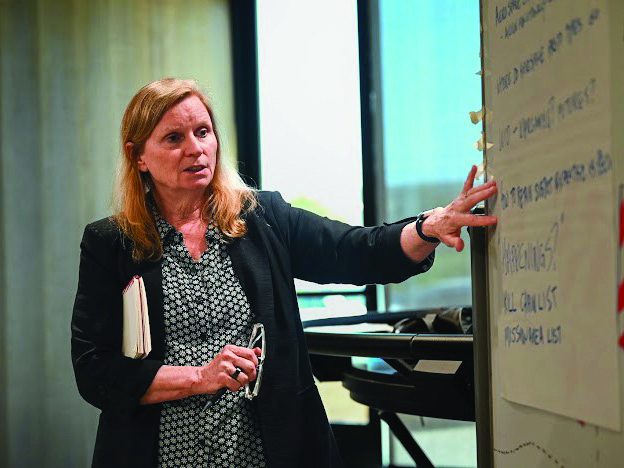

In 2025, more than 322,000 civil servants left jobs voluntarily or were dismissed out of a workforce of roughly 2.4 million. The 13% drop in staffing is the largest single-year decline since the end of World War II. In total, more than 5,000 people who were part of the federal space workforce left their positions. Senior executives with decades of experience retired alongside younger staffers whose posts were eliminated or who sought opportunities in the private sector or academia. This is one of eight conversations with some of the remarkable people who recently left the federal workforce.
Claire Leon
Last position: Space Systems Command Space Systems Integration Office Director
As the inaugural director of the Space Systems Command’s Space Systems Integration Office, Claire Leon spent three years building an organization to enhance the resilience of space capabilities across mission areas. Working closely with the Missile Defense Agency, National Reconnaissance Office (NRO), Space Development Agency and other government, commercial and international partners, SSIO analyzed potential threats and evaluated strategies to safeguard and extend the Space Force capabilities to launch satellites, communicate during peacetime and conflict, monitor the space domain, defend against missile threats, coordinate military activities and train guardians.
It was a challenging job, but one appropriate for Leon, who was known at Boeing for her ability to turn around troubled programs like Wideband Gapfiller Satellite (WGS) program, a short-term effort to bridge the gap between the Defense Satellite Communications System and the Transformational Satellite Communications System.
Leon, who earned a master’s in business administration at the University of California, Los Angeles, and a PhD in executive management from Claremont Graduate University, accepted her first government job in 2013, after retiring as Boeing’s vice president for national programs.
The job was U.S. Air Force launch enterprise director. In that role, Leon helped shape the request for proposals (RFP) for the second phase of the Evolved Expendable Launch Vehicle (EELV) program. Throughout her career, Leon also taught systems engineering at Loyola Marymount University.
You had a career in the private sector, why did you want to work for the government?
The decision to retire from Boeing was humbling, because I was leaving my safe spot. I was eligible to retire at 55 and I wondered what it would be like to work for the government. I thought I could add value because I worked many Air Force programs and some NRO programs. I wanted to contribute.
I thought I knew exactly what it was going to be like to work for the government because when I was running WGS, I had a team of government and Aerospace people co-located with me. But fundamentally, the job is different. As a contractor, you’re designing, building, launching, doing analysis, running a team. The government side is all about acquisition. I was required to become level three acquisition certified, which for launch was important because the program of record was a $60 billion program.
What I enjoyed, and I think what the government folks appreciate about me, is that I understood the industry side. We were getting ready for the EELV phase two RFP release. I was able to contribute an understanding of how to incentivize industry properly. In the government, there’s this perception that industry just wants money. But really, they want a chance at a fair profit, and they want to balance risk. We carefully crafted the Phase 2 RFP. Years later, after the contracts were done, [ULA CEO] Tory Bruno pulled me aside at a conference and said, “You guys did that really well.” That was gratifying. It was a good time for me to move to the government and to help set that up because SpaceX was a new entrant and in their formative stage. SpaceX had two mission failures that we had to work through to allow them to compete. SpaceX iterated their designs so quickly, it was challenging for the government team to keep up.
What were some career highlights?
There’s a mix of programmatic accomplishments. One of my claims to fame at Boeing was turning troubled programs around. I took over the Wideband Gapfiller Satellite when it was in trouble. We got WGS back on track and launched. Then, actually turning it into Wideband Global SATCOM, a core program, was huge.
I worked some classified programs, and again, was asked to take on a very troubled program. We got that back on track, launched and working. It’s still operational today. That was a big accomplishment.
On the industry side, I appreciated being in a position to give people challenging jobs and see them grow. I put a number of people in starter positions who, over the next 10 years, became leaders in the company. That was incredibly gratifying.
On the government side, I walked into the Space Systems Integration Office as an HQE, highly qualified engineer, during COVID and the Space Systems Command reorganization. We moved from being relatively formative to having an effective organization and hitting milestones.
What challenges did you face?
There are times in one’s career when you have good top cover and advocacy. That can free you up to go fast and to be effective. When I was at Hughes, and then Hughes was bought by General Motors, GM kept their hands off. Then, there was an interim period when GM brought in an executive who brought in a team to get Hughes ready for sale. It was one of the most dysfunctional times, and I did not have good top cover. I ended up moving to the classified side. Then, Boeing came in and one of my previous bosses brought me back to run WGS.
Why was your government work important?
The two jobs are very different. The launch enterprise was trying to move from a monopolistic world to a competitive world and to set up the contracts to allow a new entrant to come in. We were blazing new territory. I do not want to take credit for all of that, but I did help structure the RFP and incentives to let ULA be successful with what they’re good at and SpaceX be successful with what they’re good at.
And then Space Systems Integration Office was not something that had ever been done before: trying to get lots of SSC programs not only working together but with mission partners, primarily MDA and NRO, to think through mission threads.
What prompted you to leave your job at Space Systems Command?
I was an HQE. It was a three-year position. It could have been extended. I thought it would be. I wanted at least one more year, but they decided to go a different way.
What are you doing now?
A whole host of different things. From a paid standpoint, I’m working with two different consulting agencies helping companies understand how they can take their capabilities and be successful in getting either new government work or more government work. Having worked in the Space System Integration Office, I have a pretty good view across the domains of who’s been doing what. Of course, it’s very dynamic.
It’s also good for me, personally, to not be working full time, to not be driving two hours a day. We live in Southern California, in the Portuguese Bend Landslide area. We have daily challenges with shifting land, so we are putting our house on steel. Also, my older daughter who lives about a half mile away has five kids. I have more flexibility to help out here and there.
Is there anything else you want to say?
I am concerned about what the administration is doing in terms of personnel policy. There’ is risk of causing good people to leave government service. I have concerns that the government will not be able to attract the right talent. I’ve had a good run, career-wise, but it’s the young folks I am concerned about. I had some phenomenal people on my team that have left the government. Some are still supporting the Space Force as Systems Engineering and Technical Assistance contractors. But you need competent people in the government to direct and make decisions.
An abridged version of this article first appeared in the February 2026 issue of SpaceNews Magazine.










Related Posts



Stay Informed With the Latest & Most Important News



Advertisement
-
 01Two Black Holes Observed Circling Each Other for the First Time
 -
 02From Polymerization-Enabled Folding and Assembly to Chemical Evolution: Key Processes for Emergence of Functional Polymers in the Origin of Life
 -
 03Astronomy 101: From the Sun and Moon to Wormholes and Warp Drive, Key Theories, Discoveries, and Facts about the Universe (The Adams 101 Series)
 -
 04True Anomaly hires former York Space executive as chief operating officer
 -
 05Φsat-2 begins science phase for AI Earth images
 -
 06Hurricane forecasters are losing 3 key satellites ahead of peak storm season − a meteorologist explains why it matters
 -
 07Binary star systems are complex astronomical objects − a new AI approach could pin down their properties quickly