
Now Reading: yieldplotlib: A Unified Library For Exoplanet Yield Code Visualizations
-
01
yieldplotlib: A Unified Library For Exoplanet Yield Code Visualizations



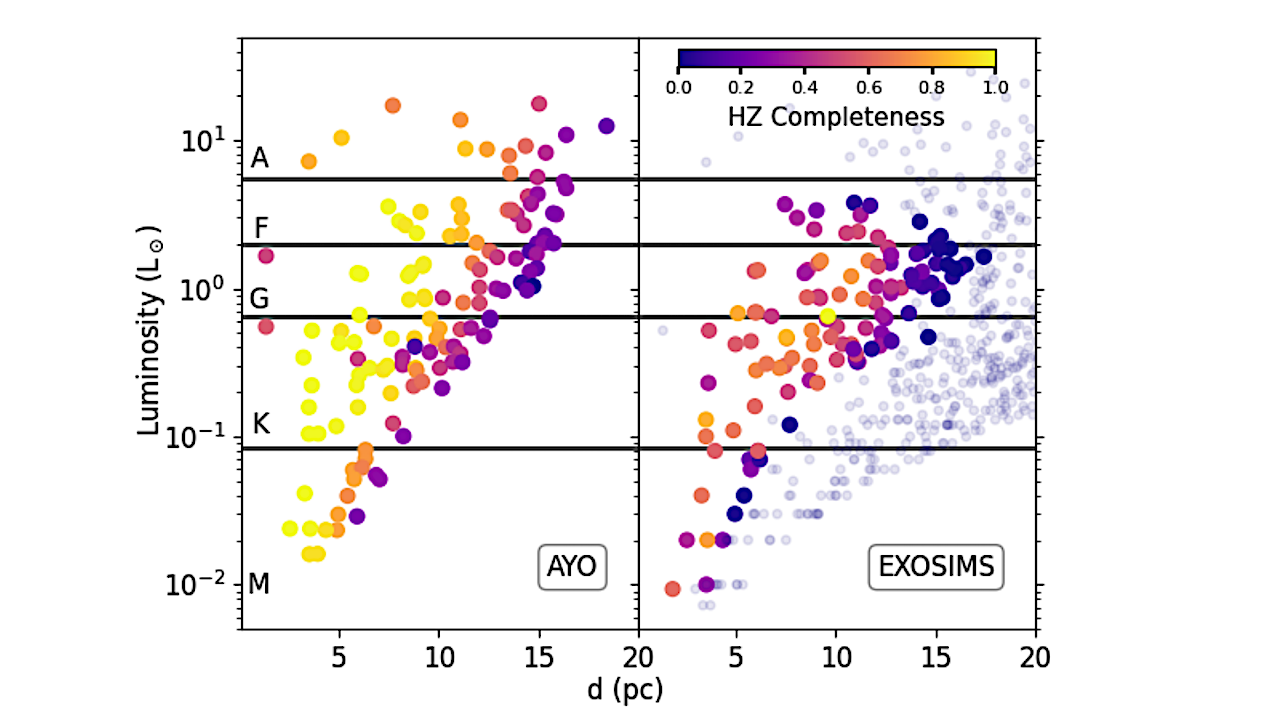
Plot of the Habitable Zone (HZ) completeness as a function of host star luminosity (in units of Solar luminosity) and distance (in parsecs). Here the AYO results are on the left and the EXOSIMS results are on the right. — astro-ph.IM
NASA’s next flagship observatory, the Habitable Worlds Observatory (HWO), aims to detect and characterize ~25 habitable zone planets.
The total number of habitable zone planets detected is referred to as the exo-Earth “yield” and accurate yield estimates will be critically important to the mission’s success.
Tools like the Altruistic Yield Optimizer (AYO) and EXOSIMS provide these yield estimates but differ in language, methods, and outputs. yieldplotlib provides a unified library that can visualize the inputs and outputs of these yield codes in a complete, descriptive, and accessible way.
Corey Spohn, Sarah Steiger, Alex R. Howe
Comments: 6 pages, 4 figures, submitted to the Journal of Open Source Software (JOSS)
Subjects: Instrumentation and Methods for Astrophysics (astro-ph.IM); Earth and Planetary Astrophysics (astro-ph.EP)
Cite as: arXiv:2512.06149 [astro-ph.IM] (or arXiv:2512.06149v1 [astro-ph.IM] for this version)
https://doi.org/10.48550/arXiv.2512.06149
Focus to learn more
Related DOI:
https://doi.org/10.5281/zenodo.17822644
Focus to learn more
Submission history
From: Sarah Steiger
[v1] Fri, 5 Dec 2025 20:58:15 UTC (559 KB)
https://arxiv.org/abs/2512.06149
Astrobiology,











Related Posts

Stay Informed With the Latest & Most Important News
Previous Post
Next Post




Advertisement
-
 01Two Black Holes Observed Circling Each Other for the First Time
 -
 02From Polymerization-Enabled Folding and Assembly to Chemical Evolution: Key Processes for Emergence of Functional Polymers in the Origin of Life
 -
 03Astronomy 101: From the Sun and Moon to Wormholes and Warp Drive, Key Theories, Discoveries, and Facts about the Universe (The Adams 101 Series)
 -
 04True Anomaly hires former York Space executive as chief operating officer
 -
 05Φsat-2 begins science phase for AI Earth images
 -
 06Hurricane forecasters are losing 3 key satellites ahead of peak storm season − a meteorologist explains why it matters
 -
 07Binary star systems are complex astronomical objects − a new AI approach could pin down their properties quickly