
Now Reading: Hubble Observes Ghostly Cloud Alive with Star Formation
-
01
Hubble Observes Ghostly Cloud Alive with Star Formation


2 min read
Hubble Observes Ghostly Cloud Alive with Star Formation

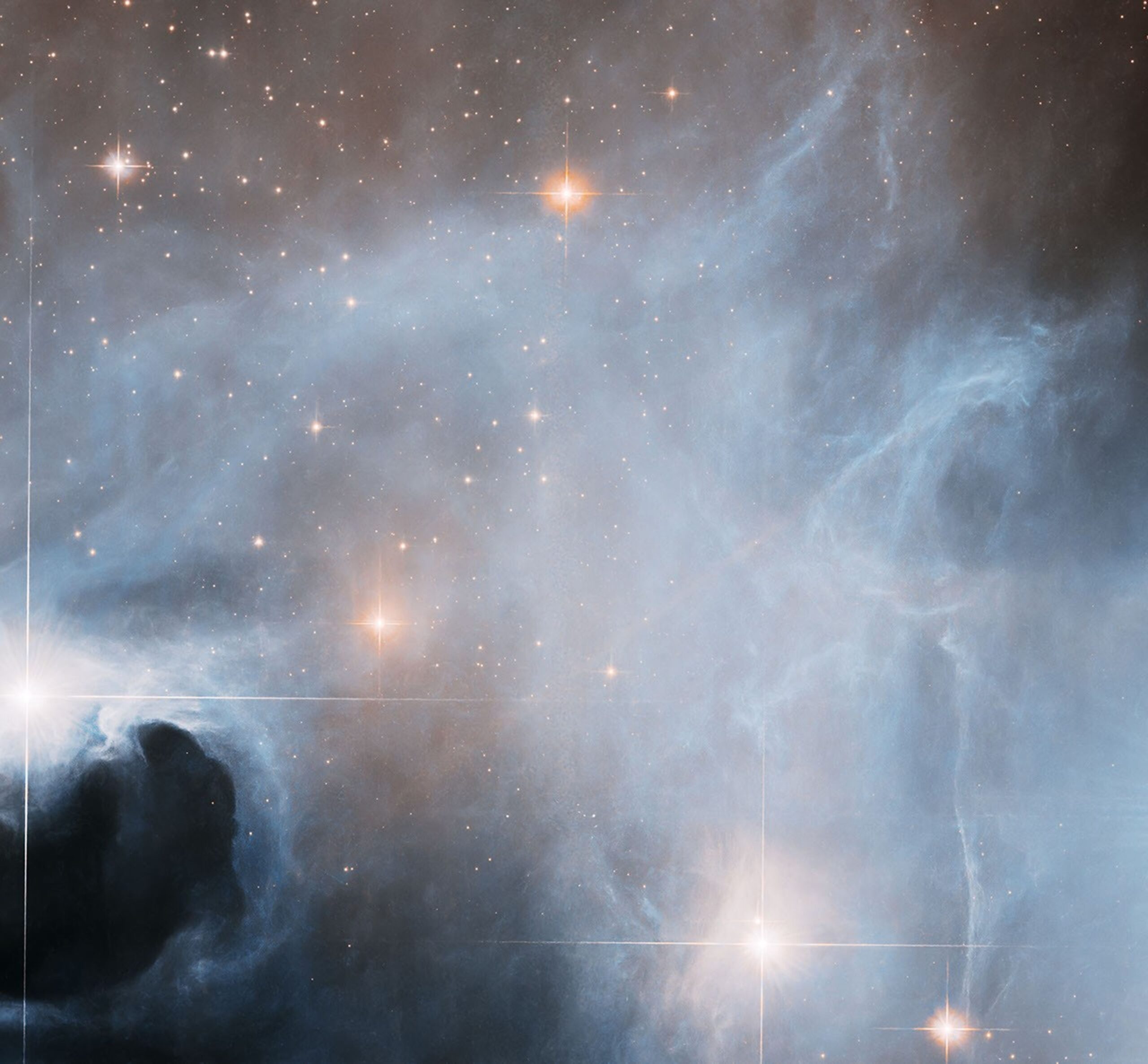
While this eerie NASA Hubble Space Telescope image may look ghostly, it’s actually full of new life. Lupus 3 is a star-forming cloud about 500 light-years away in the constellation Scorpius.
White wisps of gas swirl throughout the region, and in the lower-left corner resides a dark dust cloud. Bright T Tauri stars shine at the left, bottom right, and upper center, while other young stellar objects dot the image.
T Tauri stars are actively forming stars in a specific stage of formation. In this stage, the enveloping gas and dust dissipates from radiation and stellar winds, or outflows of particles from the emerging star. T Tauri stars are typically less than 10 million years old and vary in brightness both randomly and periodically due to the environment and nature of a forming star. The random variations may be due to instabilities in the accretion disk of dust and gas around the star, material from that disk falling onto the star and being consumed, and flares on the star’s surface. The more regular, periodic changes may be caused by giant sunspots rotating in and out of view.
T Tauri stars are in the process of contracting under the force of gravity as they become main sequence stars which fuse hydrogen to helium in their cores. Studying these stars can help astronomers better understand the star formation process.
New images added every day between January 12-17, 2026! Follow @NASAHubble on social media for the latest Hubble images and news and see Hubble’s Stellar Construction Zones for more images of young stellar objects.
Explore More
Media Contact:
Claire Andreoli
NASA’s Goddard Space Flight Center, Greenbelt, MD
claire.andreoli@nasa.gov












Leave a reply
You must be logged in to post a comment.
Related Posts
Stay Informed With the Latest & Most Important News
Previous Post
Next Post




Advertisement
-
 01Two Black Holes Observed Circling Each Other for the First Time
 -
 02From Polymerization-Enabled Folding and Assembly to Chemical Evolution: Key Processes for Emergence of Functional Polymers in the Origin of Life
 -
 03Astronomy 101: From the Sun and Moon to Wormholes and Warp Drive, Key Theories, Discoveries, and Facts about the Universe (The Adams 101 Series)
 -
 04True Anomaly hires former York Space executive as chief operating officer
 -
 05Φsat-2 begins science phase for AI Earth images
 -
 06Hurricane forecasters are losing 3 key satellites ahead of peak storm season − a meteorologist explains why it matters
 -
 07Binary star systems are complex astronomical objects − a new AI approach could pin down their properties quickly