
Now Reading: Do aliens and fireflies communicate similarly?
-
01
Do aliens and fireflies communicate similarly?


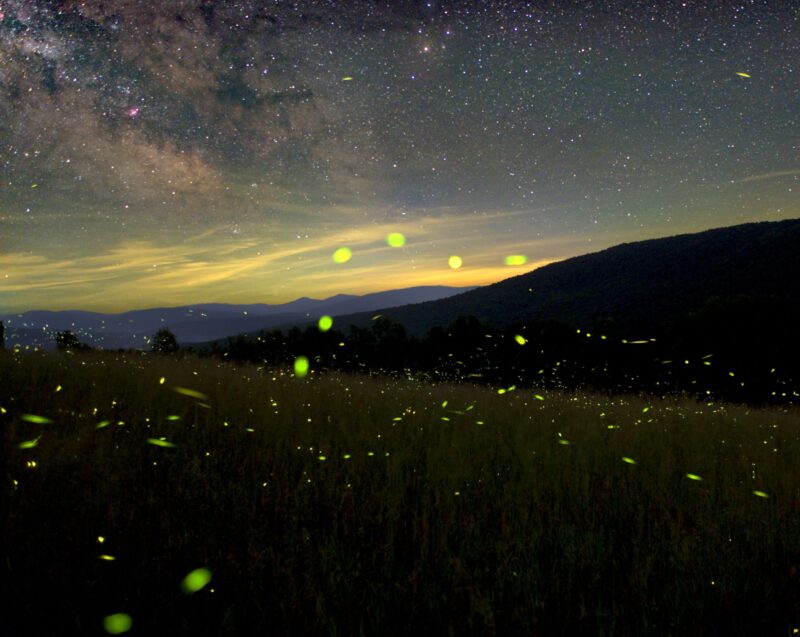

- Searches for extraterrestrial intelligence (SETI) have typically looked for radio signals. And in recent years researchers have looked for laser signals or megastructures, aka Dyson spheres.
- But are all those searches too Earth- and human-biased? After all, aliens might communicate with each other in ways that humans don’t or can’t.
- Now, trying to think outside the box, researchers hypothesize that alien civilizations might communicate with each other using light pulses, much as fireflies do.
Might aliens and fireflies communicate similarly?
If advanced alien civilizations exist on multiple planets in our home galaxy, the Milky Way, how would they communicate? A new paper suggests they might do so in a manner similar to the way fireflies signal each other. That is, they might use subtle flashes of light, in this case visible across vast distances of interstellar space. That’s the new idea of a research team from Arizona State University. The team said this month that – as we on Earth pursue more traditional SETI, searching for radio signals or alien megastructures, this flashing from alien beings might be happening around us.
As of now, the hypothesis is a thought experiment, but it’s a fascinating one.
Harry Baker wrote about the intriguing concept for Live Science on January 6, 2026.
And the researchers published the preprint version of their new paper, not yet peer-reviewed, on arXiv on November 8, 2025. It is now awaiting publication in the journal Proceedings of the National Academy of Sciences (PNAS).
An Earth-based bias
To date, the search for alien intelligence, collectively known as SETI, has focused on more human-esque types of searches. These include radio signals, laser pulses or even physical megastructures such as Dyson spheres. But as the researchers note, however, that might not be the best strategy. Those searches could be prone to anthropocentric bias, or anthropocentrism, meaning they are based simply on how humans communicate on Earth. A highly advanced alien civilization might be completely different.
And if they wanted to communicate over vast interstellar distances, ordinary radio signals, for example, might not be the most efficient choice.
The paper states:
The Search for Extraterrestrial Intelligence (SETI) is, historically, a search for aliens like us, inspired by human-centric ideas of intelligence and technology. However, humans are not the only instance of an intelligent, communicating species on Earth, and thus not the only guide to how we might think about ETI. Here, we explore the potential for the study of non-human species to inform new approaches in SETI research, using firefly communication patterns as an illustrative example.

Interstellar light signals
Instead, the researchers propose an alternative method: using flashes of light similar to fireflies on Earth. As Baker wrote in Live Science:
In the new study, uploaded November 8, 2025, to the preprint server arXiv, researchers proposed a new way that an alien civilization could communicate: by flashing to one another like fireflies. These flashing signals could be used for specific and complex communications. However, the researchers argue that they are more likely being widely broadcast to other civilizations, like a luminous repeating beacon.
The flashes of light would be a rather simple method of communication. As the researchers surmise, they might simply be a way to say “here we are.”
Analyzing pulsars
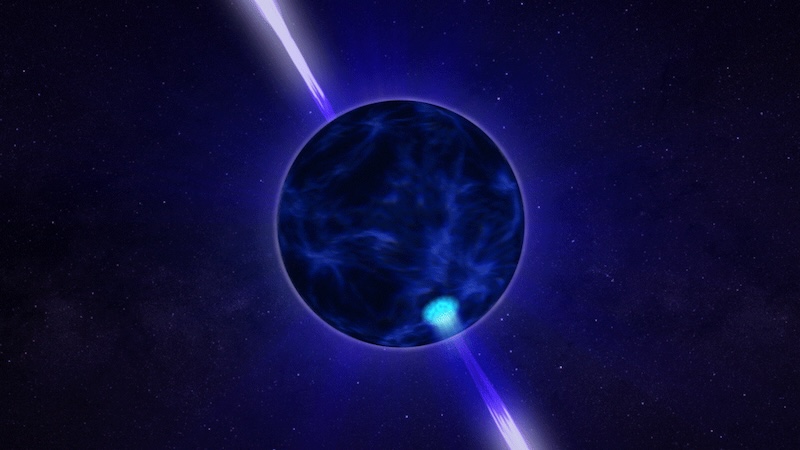
The universe has many natural beacons too, called pulsars. They are rapidly spinning, highly magnetized neutron stars, the dense remaining cores of exploded massive stars. They also emit regular beams of radiation, kind of like cosmic lighthouses. In fact, when astronomers first discovered them, they wondered if they could be intelligent signals. In this case, no, they are a natural – if rather bizarre – natural phenomenon.
Firefly signals, however, might have some similarities to pulsars. They could repeat in regular pulses to attract attention. Unlike pulsars, though, they would be artificial signals from civilizations that are likely older and more advanced than us. As co-author Estelle Janin at Arizona State University said to Live Science:
Communication is a fundamental feature of life across lineages and manifests in a wonderful diversity of forms and strategies. Taking non-human communication into account is essential if we want to broaden our intuition and understanding about what alien communication could look like, and what a theory of life ought to explain.
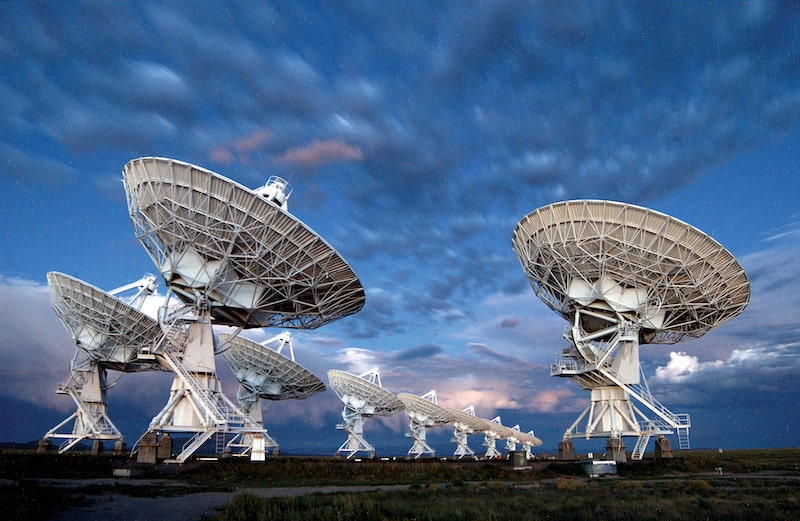
The researchers studied 158 pulsars, out of an initial dataset of 3,724, to test the idea of aliens using similar types of light signals.
Aliens and fireflies: Thinking outside the box
Overall, the new study is a thought experiment designed to challenge existing ideas of how alien civilizations might communicate. Janin said:
Our study is meant as a provoking thought-experiment and an invitation for SETI and animal communication research to engage more directly and to draw more systematically on each other’s insights.
As the paper states:
The toy model presented here is not intended as a fully realistic or empirically predictive framework; rather, it presents a thought experiment imagining what kinds of alien intelligences may be possible and illustrates the potential to develop new strategies for the search for extraterrestrial intelligence (ETI) by extending communication models beyond human paradigms to include non-human species.
Bottom line: Advanced aliens and fireflies on Earth might communicate in similar ways, by using signals of flashing light, a new theoretical study suggests.
Source (preprint): A Firefly-inspired Model for Deciphering the Alien
Read more: How fireflies glow and what signals they’re sending
Read more: Galaxies look like fireflies
The post Do aliens and fireflies communicate similarly? first appeared on EarthSky.










Related Posts

Stay Informed With the Latest & Most Important News
Previous Post
Next Post





Advertisement
-
 01Two Black Holes Observed Circling Each Other for the First Time
 -
 02From Polymerization-Enabled Folding and Assembly to Chemical Evolution: Key Processes for Emergence of Functional Polymers in the Origin of Life
 -
 03Astronomy 101: From the Sun and Moon to Wormholes and Warp Drive, Key Theories, Discoveries, and Facts about the Universe (The Adams 101 Series)
 -
 04True Anomaly hires former York Space executive as chief operating officer
 -
 05Φsat-2 begins science phase for AI Earth images
 -
 06Hurricane forecasters are losing 3 key satellites ahead of peak storm season − a meteorologist explains why it matters
 -
 07Binary star systems are complex astronomical objects − a new AI approach could pin down their properties quickly