
Now Reading: A Cool Earth-sized Planet Candidate Transiting a Tenth Magnitude K-dwarf From K2
-
01
A Cool Earth-sized Planet Candidate Transiting a Tenth Magnitude K-dwarf From K2


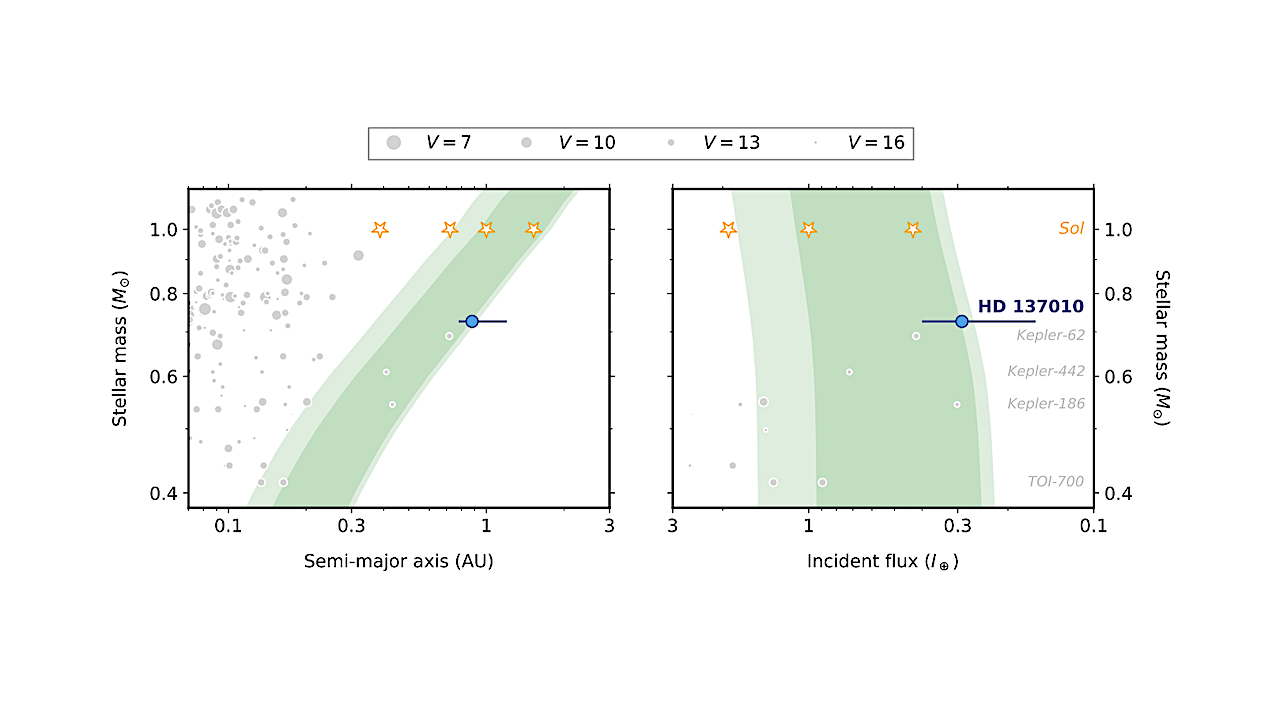
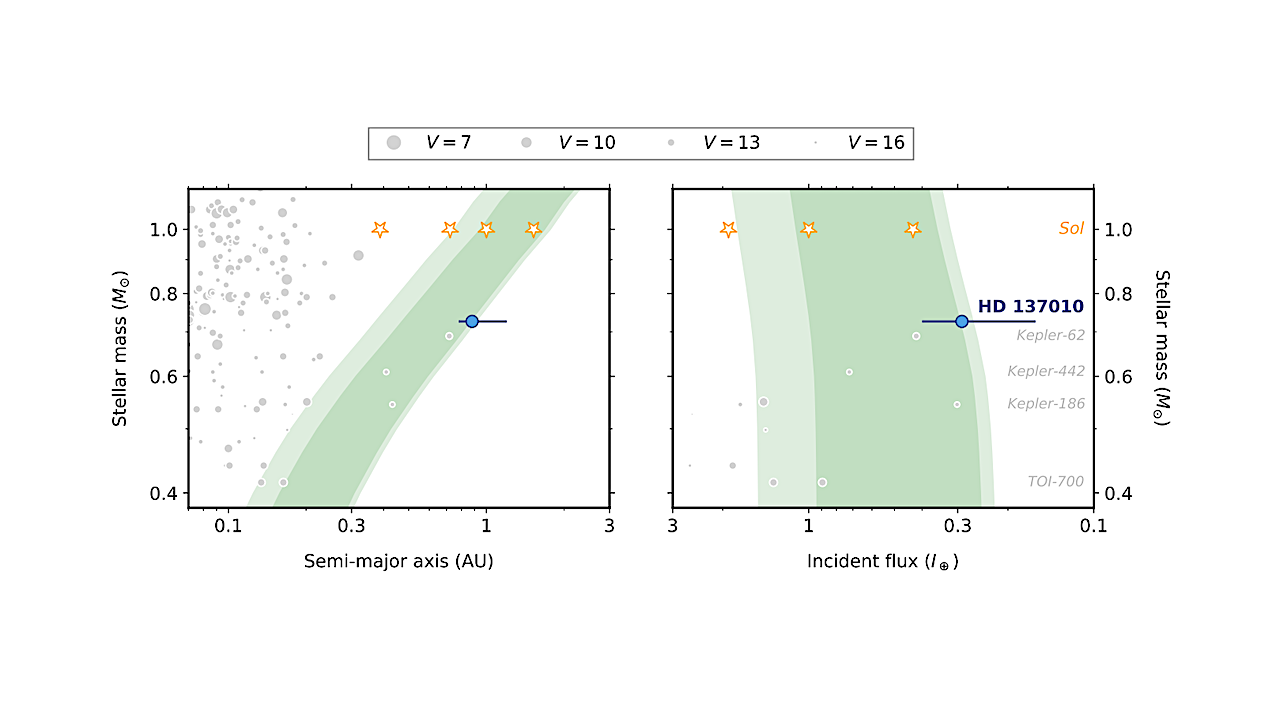
HD 137010 b in context. We plot known transiting planets smaller than 1.6 R⊕ orbiting 0.4 − 1.2 M⊙ stars with grey points in semi-major axis (left) and incident flux (right) space, with host star masses on the y-axis and point sizes scaled to V -band magnitude. We additionally highlight the solar system terrestrial planets using orange stars and mark the Kopparapu et al. (2013) habitable zone limits in green. Systems mentioned in the text are labelled on right. HD 137010 b is an exceptional example of an Earth-sized planet orbiting around the outer edge of the habitable zone of a bright Sun-like star. — astro-ph.EP
The transit method is currently one of our best means for the detection of potentially habitable “Earth-like” exoplanets.
In principle, given sufficiently high photometric precision, cool Earth-sized exoplanets orbiting Sun-like stars could be discovered via single transit detections; however, this has not previously been achieved.
In this work, we report a 10-hour long single transit event which occurred on the V=10.1 K-dwarf HD 137010 during K2 Campaign 15 in 2017. The transit is comparatively shallow (225±10 ppm), but is detected at high signal-to-noise thanks to the exceptionally high photometric precision achieved for the target.
Our analysis of the K2 photometry, historical and new imaging observations, and archival radial velocities and astrometry strongly indicate that the event was astrophysical, occurred on-target, and can be best explained by a transiting planet candidate, which we designate HD 137010 b.
The single observed transit implies a radius of 1.06+0.06−0.05 R⊕, and assuming negligible orbital eccentricity we estimate an orbital period of 355+200−59 days (a=0.88+0.32−0.10 AU), properties comparable to Earth.
We project an incident flux of 0.29+0.11−0.13 I⊕, which would place HD 137010 b near the outer edge of the habitable zone. This is the first planet candidate with Earth-like radius and orbital properties that transits a Sun-like star bright enough for substantial follow-up observations.
Alexander Venner, Andrew Vanderburg, Chelsea X. Huang, Shishir Dholakia, Hans Martin Schwengeler, Steve B. Howell, Robert A. Wittenmyer, Martti H. Kristiansen, Mark Omohundro, Ivan A. Terentev
Comments: 22 pages, 7 figures, 6 tables. Published in ApJL
Subjects: Earth and Planetary Astrophysics (astro-ph.EP)
Cite as: arXiv:2601.19870 [astro-ph.EP] (or arXiv:2601.19870v1 [astro-ph.EP] for this version)
https://doi.org/10.48550/arXiv.2601.19870
Focus to learn more
Related DOI:
https://doi.org/10.3847/2041-8213/adf06f
Focus to learn more
Submission history
From: Alexander Venner
[v1] Tue, 27 Jan 2026 18:30:01 UTC (740 KB)
https://arxiv.org/abs/2601.19870
Astrobiology,










Related Posts
Stay Informed With the Latest & Most Important News


Advertisement
-
 01Two Black Holes Observed Circling Each Other for the First Time
 -
 02From Polymerization-Enabled Folding and Assembly to Chemical Evolution: Key Processes for Emergence of Functional Polymers in the Origin of Life
 -
 03Astronomy 101: From the Sun and Moon to Wormholes and Warp Drive, Key Theories, Discoveries, and Facts about the Universe (The Adams 101 Series)
 -
 04True Anomaly hires former York Space executive as chief operating officer
 -
 05Φsat-2 begins science phase for AI Earth images
 -
 06Hurricane forecasters are losing 3 key satellites ahead of peak storm season − a meteorologist explains why it matters
 -
 07Binary star systems are complex astronomical objects − a new AI approach could pin down their properties quickly