
Now Reading: Formation And Trapping Of CO2 From Cryogenic Irradiation Of Carbonate
-
01
Formation And Trapping Of CO2 From Cryogenic Irradiation Of Carbonate


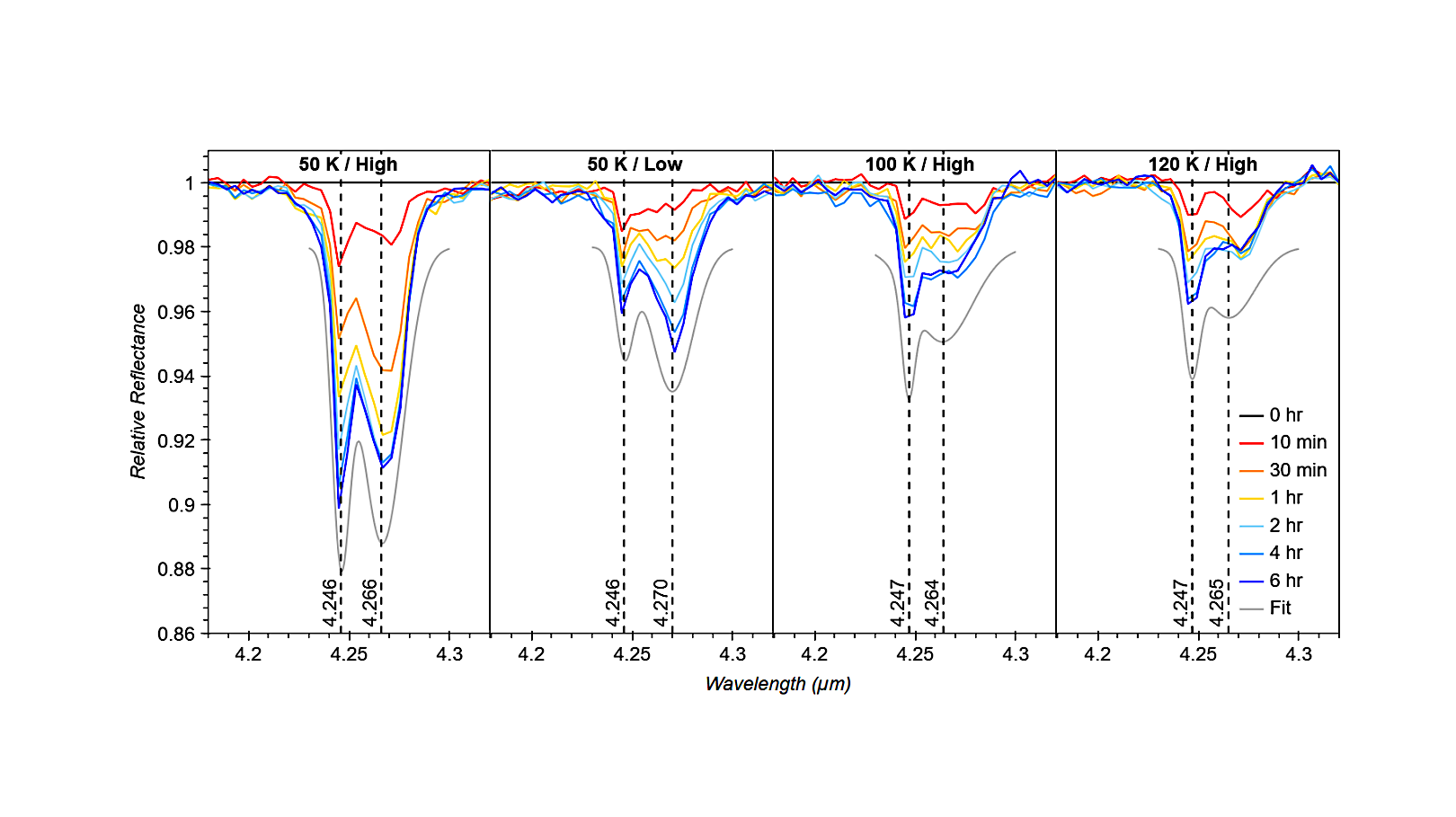

Time-resolved IR spectra from electron irradiation of CaCO3 at 50, 100, and 120 K under two electron fluxes, normalized to the preirradiation CaCO3 baseline and truncated to the 4.2–4.3 μm region to highlight the CO2 ν3 band. Vertical dashed lines mark the central wavelengths of the CO2 doublet, determined from double Gaussian fits to the continuum-removed spectra (gray). CO2 absorptions appear upon irradiation and gradually saturate. The strongest absorptions occur at 50 K under high flux. At higher temperatures, the absorptions are weaker, but radiolytic CO2 production is still apparent. — astro-ph.EP
The detection of CO2 on the Jovian satellite Europa by Galileo NIMS and recent mapping of the leading side by JWST has revealed that it is most concentrated in geologically young terrains, and its v3 asymmetric stretch appears as a spectral doublet centered at 4.25 and 4.27 um.
Since crystalline CO2 is unstable at Europan surface conditions, this observation implies an active source and a trapping medium, which may be separate. To this end, several hypotheses have been proposed, but no laboratory work has successfully reproduced the spectral features of CO2 on Europa so far.
Radiolyzed carbonates have also been discussed as plausible precursors and host materials for CO2, though their role has not been experimentally validated in a Europa-like environment. Here, we report the first laboratory experiments investigating CO2 production from carbonate salts exposed to 10 keV electron irradiation at 50, 100, and 120 K in ultrahigh vacuum.
Using diffuse reflectance FTIR spectroscopy, we observe the emergence, growth, and saturation of an absorption doublet centered near 4.25 and 4.27 um, consistent with the CO2 v3 band. Postirradiation thermal desorption studies using residual gas analysis reveal that the radiolytically formed CO2 is stable at temperatures beyond Europa’s surface.
This work provides the first experimental evidence that low-energy electron irradiation of carbonates in cryogenic, vacuum conditions can produce and retain CO2, and suggests that carbonates can serve as endogenous reservoirs of CO2 on irradiated icy bodies in the outer solar system.
Ashma Pandya, Swaroop Chandra, Michael E. Brown
Subjects: Earth and Planetary Astrophysics (astro-ph.EP); Chemical Physics (physics.chem-ph)
Cite as: arXiv:2604.27177 [astro-ph.EP] (or arXiv:2604.27177v1 [astro-ph.EP] for this version)
https://doi.org/10.48550/arXiv.2604.27177
Focus to learn more
Journal reference: The Planetary Science Journal, 7:93 (7pp), 2026 April
Related DOI:
https://doi.org/10.3847/PSJ/ae595b
Focus to learn more
Submission history
From: Ashma Pandya
[v1] Wed, 29 Apr 2026 20:26:46 UTC (961 KB)
https://arxiv.org/abs/2604.27177
Astrobiology, astrochemistry,










Related Posts
Stay Informed With the Latest & Most Important News
Previous Post
Next Post

Advertisement
-
 01Two Black Holes Observed Circling Each Other for the First Time
 -
 02From Polymerization-Enabled Folding and Assembly to Chemical Evolution: Key Processes for Emergence of Functional Polymers in the Origin of Life
 -
 03Astronomy 101: From the Sun and Moon to Wormholes and Warp Drive, Key Theories, Discoveries, and Facts about the Universe (The Adams 101 Series)
 -
 04True Anomaly hires former York Space executive as chief operating officer
 -
 05Φsat-2 begins science phase for AI Earth images
 -
 06Hurricane forecasters are losing 3 key satellites ahead of peak storm season − a meteorologist explains why it matters
 -
 07Binary star systems are complex astronomical objects − a new AI approach could pin down their properties quickly