
Now Reading: Why don’t more Tatooine-like exoplanets exist in our Milky Way galaxy? Astronomers might have an answer
-
01
Why don’t more Tatooine-like exoplanets exist in our Milky Way galaxy? Astronomers might have an answer

Why don’t more Tatooine-like exoplanets exist in our Milky Way galaxy? Astronomers might have an answer

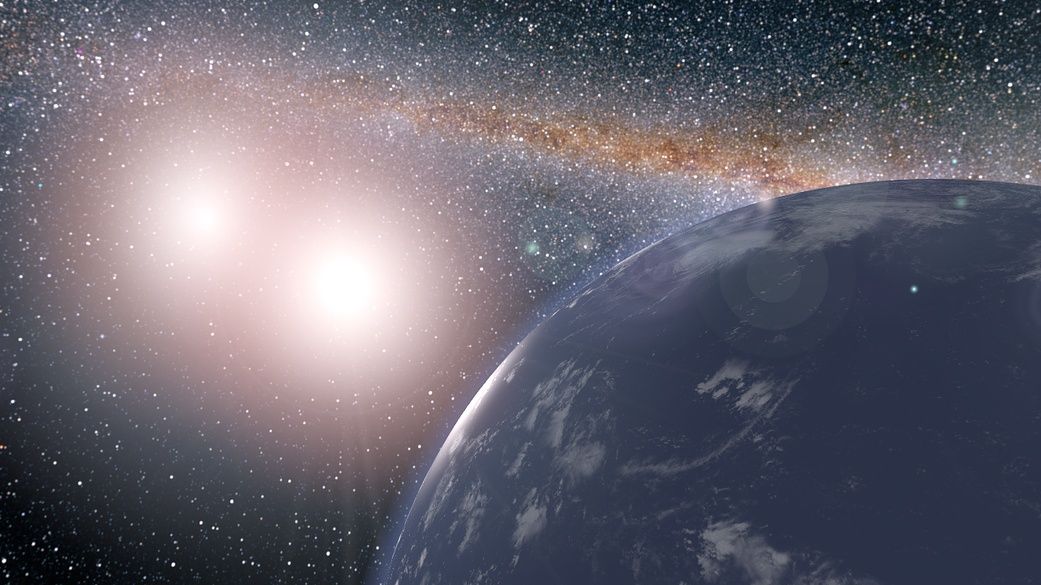
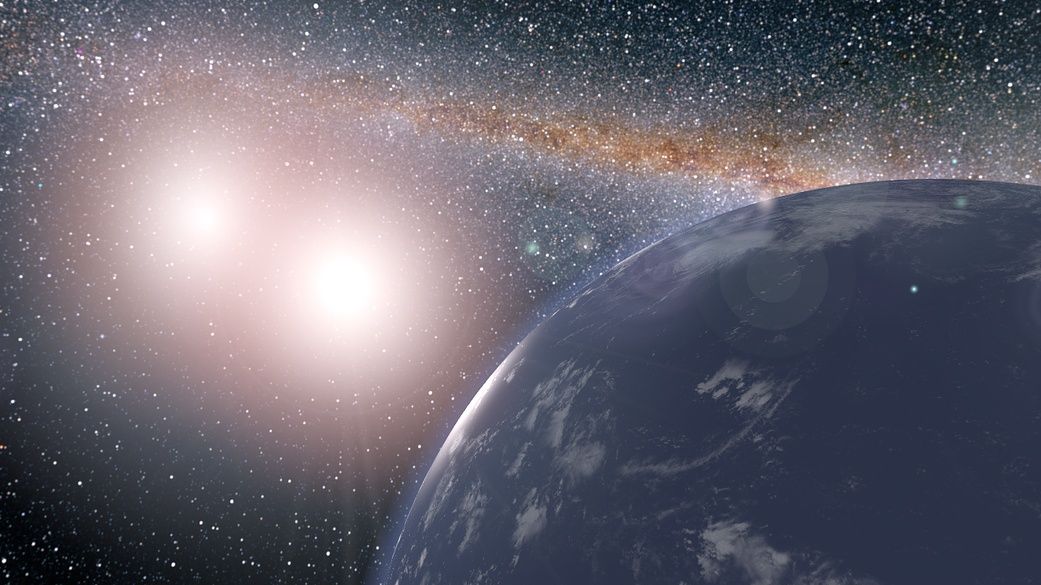
It’s one of the most instantly recognizable scenes in cinematic history: Luke Skywalker gazes at a double sunset to the haunting melody of a mournful French horn. And while “Star Wars” may take place in a galaxy far, far away, planets orbiting binary stars actually do exist in the Milky Way. Yet mysteriously, there are not as many as scientists expect — and new research might explain why.
Of the thousands of single-star systems in our galaxy, around 10% are known to have planets. Scientists thus expected about 10% of the 3,000 known binary star systems in our galaxy to have them, too. But of the more than 6,000 confirmed exoplanets in the Milky Way, just 14 confirmed planets have been found around pairs of stars.
In most binary star systems, two stars orbit each other in elliptical paths. A planet caught in that dance feels gravitational forces from both stars, causing its orbital orientation to slowly rotate in a process known as precession. Meanwhile, the binary stars‘ own orbits also precess due the rules of general relativity. As time progresses, tidal forces between the stars can draw them closer, accelerating their precession and causing an orbiting planet’s precession to slow.
When the precession rates align, the planet’s orbit becomes highly stretched. According to lead author Mohammad Farhat of the University of California, Berkeley, this resonance can destabilize the planet’s path. “Either the planet swings too close to the stars and is torn apart, or its orbit is so perturbed that it’s ejected from the system,” he said in a statement.
The team’s models suggest that in tight binaries — those with orbital periods of a week or less — such disruptions are common. These systems also happen to be the ones most likely to be monitored by missions like NASA’s Kepler and TESS, which detect planets by watching for starlight dimming as a planet passes in front of them. That could partly explain the surprisingly low number of circumbinary planets in observational data.
Ultimately, there might be hundreds or thousands of Tatooines in the Milky Way — we just aren’t sure how to look for them yet.
The team’s findings were published in The Astrophysical Journal Letters on December 8, 2025.










Related Posts

Stay Informed With the Latest & Most Important News
Previous Post
Next Post



Advertisement
-
 01Two Black Holes Observed Circling Each Other for the First Time
 -
 02From Polymerization-Enabled Folding and Assembly to Chemical Evolution: Key Processes for Emergence of Functional Polymers in the Origin of Life
 -
 03Astronomy 101: From the Sun and Moon to Wormholes and Warp Drive, Key Theories, Discoveries, and Facts about the Universe (The Adams 101 Series)
 -
 04True Anomaly hires former York Space executive as chief operating officer
 -
 05Φsat-2 begins science phase for AI Earth images
 -
 06Hurricane forecasters are losing 3 key satellites ahead of peak storm season − a meteorologist explains why it matters
 -
 07Binary star systems are complex astronomical objects − a new AI approach could pin down their properties quickly