
Now Reading: Starlight warped in the fabric of spacetime could help us find hidden black holes dancing together
-
01
Starlight warped in the fabric of spacetime could help us find hidden black holes dancing together

Starlight warped in the fabric of spacetime could help us find hidden black holes dancing together

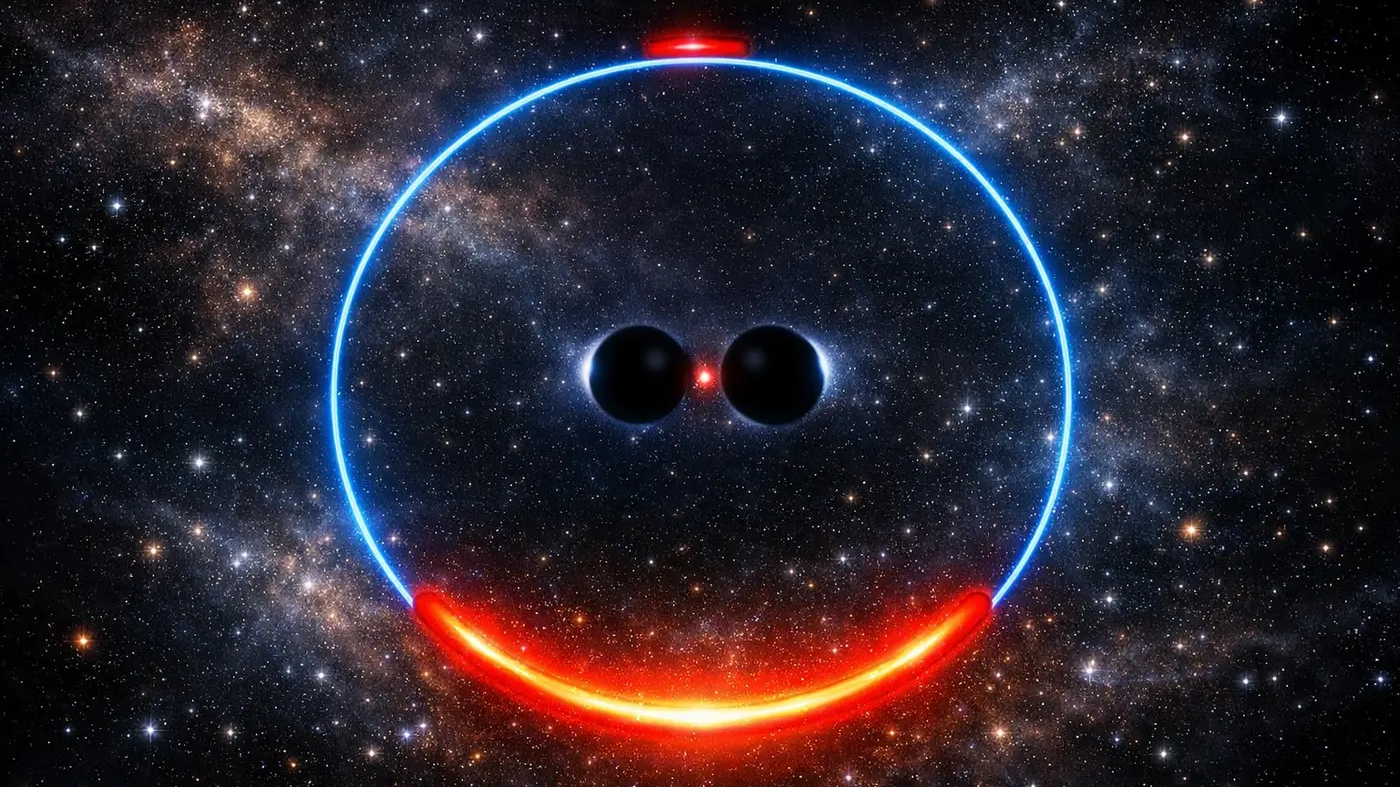
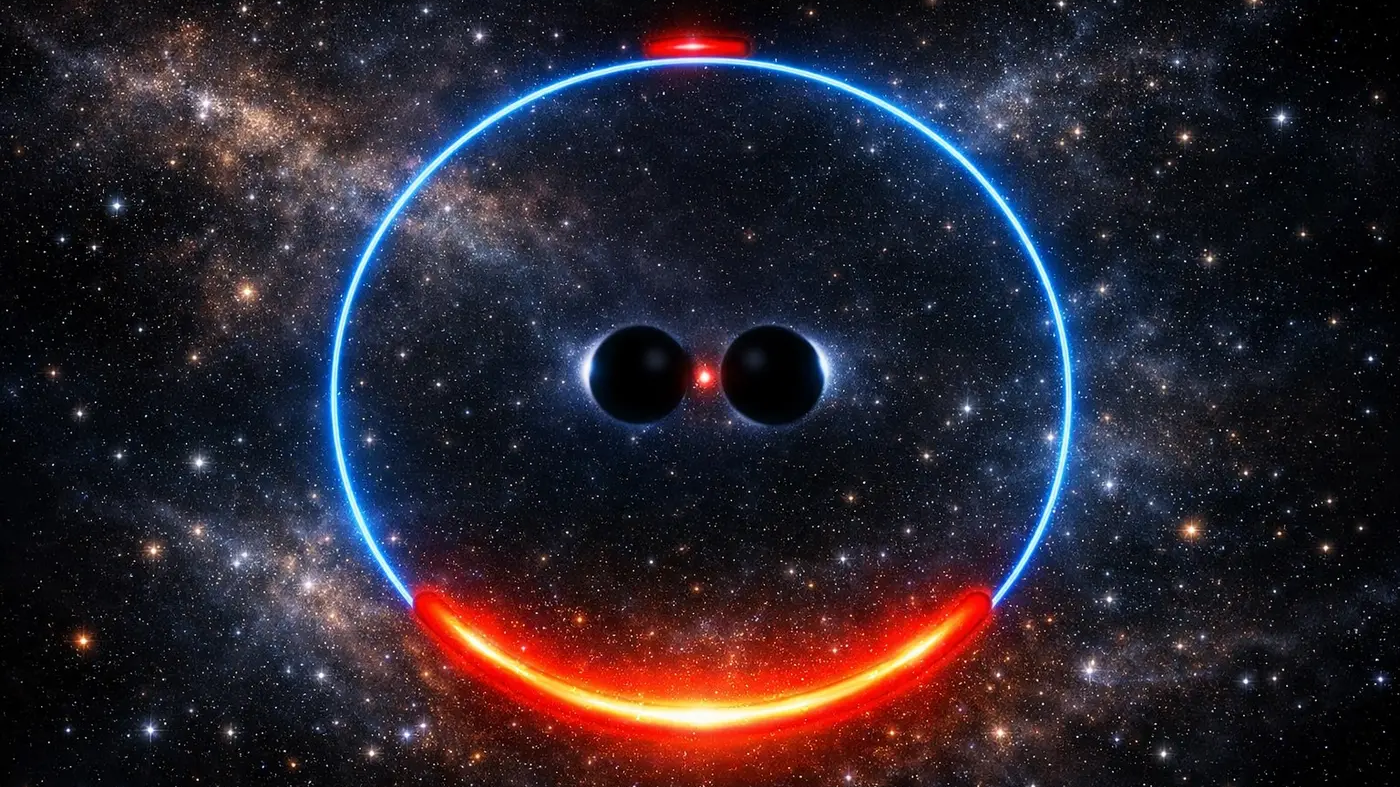
Two supermassive black holes on a dizzying death spiral could soon become visible to astronomers after researchers worked out how, while rotating around each other, these dark, massive behemoths could gravitationally lens the stars behind them.
Pretty much every large galaxy hosts a supermassive black hole, ranging in mass from millions of times that of our sun (for example the black hole in our Milky Way galaxy, Sagittarius A*) to billions of solar masses. Ordinarily, galaxies have just one supermassive black hole at their hearts, but when two galaxies merge, their black holes can fall towards each other, eventually coming into each other’s orbit and, long after that happens, merging in a burst of gravitational waves.
So far, the only binary supermassive black holes that astronomers have identified are widely separated by hundreds or thousands of light-years. For the future, the European Space Agency has planned a space-based gravitational-wave detector called LISA, the Laser Interferometer Space Antenna, to detect the low frequency gravitational waves emitted by merging supermassive black hole binaries. Chinese scientists have also proposed a similar mission called TianQin. But there has been no other known way of spotting such binaries — until now, perhaps.
“The prospect of identifying in-spiraling supermassive black hole binaries years before future space-based gravitational-wave detectors come online is extremely exciting,” said Bence Kocsis of the University of Oxford in a statement. “It opens the door to true multi-messenger studies of black holes, allowing us to test gravity and black-hole physics in entirely new ways.”
Kocsis is part of a team of astronomers from Oxford and the Max Planck Institute for Gravitational Physics in Germany who have shown how gravitational lensing by binary black holes can reveal their presence in distant galaxies.
Gravitational lensing is a phenomenon caused by massive objects bending the fabric space-time around them due to the impact of their gravitational pull, altering the path of light moving along this warped fabric such that background objects can appear magnified, or sometimes even split into multiple images.
When there is just a single black hole, a background star has to be perfectly aligned with it in order to be lensed. However, for a binary black hole, the situation changes.
“The chances of starlight being hugely amplified increases enormously for a binary compared to a single black hole,” said Kocsis.
A binary black hole acts like a pair of rotating lenses, as the black holes orbit their common center of mass. This produces a diamond-shape zone of quasi-periodic lensing events called the ‘caustic curve’, and along this curve, the lensing is amplified in intensity.
The result is that background stars aligned with the caustic curve will periodically appear to flash, as their light is amplified on timescales of several years corresponding to the orbital period of the black holes. We probably will not even see the star at other times, so distant are the galaxies hosting binary supermassive black holes.
“As the binary moves, the caustic curve rotates and changes shape, sweeping across a large volume of stars behind it,” said Hanxi Wang, a Ph.D. student at Oxford, in the statement. “If a bright star lies within this region, it can produce an extraordinarily bright flash each time the caustic passes over it. This leads to repeating bursts of starlight, which provide a clear and distinctive signature of a supermassive black-hole binary.”
However, this situation doesn’t remain unchanged forever, because the orbits of the black holes are shrinking.
The black holes lose orbital energy to each other, and this energy is transported away as gravitational waves. As they get closer to each other, the black holes begin to orbit faster and faster. It takes millions of years for two black holes to lose enough orbital energy for them to merge, but this shortening of their orbits could become apparent in changes to the caustic curve. These changes would modify the modulation of the frequency of the lensing events and their peak brightness. The mass of the two black holes could also be encoded into the caustic curve.
The modulation to the frequency and peak brightness of the lensing events would take thousands or millions of years to become noticeable. At best, astronomers can only take a snapshot of any given binary supermassive black hole system. However, observe enough similar systems at different stages in their orbital evolution and the snapshots could be put together to tell a larger story.
Fortunately, the forthcoming detailed surveys of the night sky by the Vera C. Rubin Observatory in Chile and the Nancy Grace Roman Space Telescope that is set for launch in 2027 should be powerful enough to spot many lensing events from binary supermassive black holes in faraway galaxies. Then, when it is operational, hopefully some time in the 2030s, LISA could partner with the survey telescopes to perform a detailed multi-messenger (electromagnetic waves and gravitational waves) census of black holes in the universe that are spiraling to an inevitable merger.
The research was published on Feb. 12 in the journal Physical Review Letters.










Related Posts

Stay Informed With the Latest & Most Important News
Previous Post
Next Post

Advertisement
-
 01Two Black Holes Observed Circling Each Other for the First Time
 -
 02From Polymerization-Enabled Folding and Assembly to Chemical Evolution: Key Processes for Emergence of Functional Polymers in the Origin of Life
 -
 03Astronomy 101: From the Sun and Moon to Wormholes and Warp Drive, Key Theories, Discoveries, and Facts about the Universe (The Adams 101 Series)
 -
 04True Anomaly hires former York Space executive as chief operating officer
 -
 05Φsat-2 begins science phase for AI Earth images
 -
 06Hurricane forecasters are losing 3 key satellites ahead of peak storm season − a meteorologist explains why it matters
 -
 07Binary star systems are complex astronomical objects − a new AI approach could pin down their properties quickly