
Now Reading: LambdaVision books space on Starlab commercial space station
-
01
LambdaVision books space on Starlab commercial space station


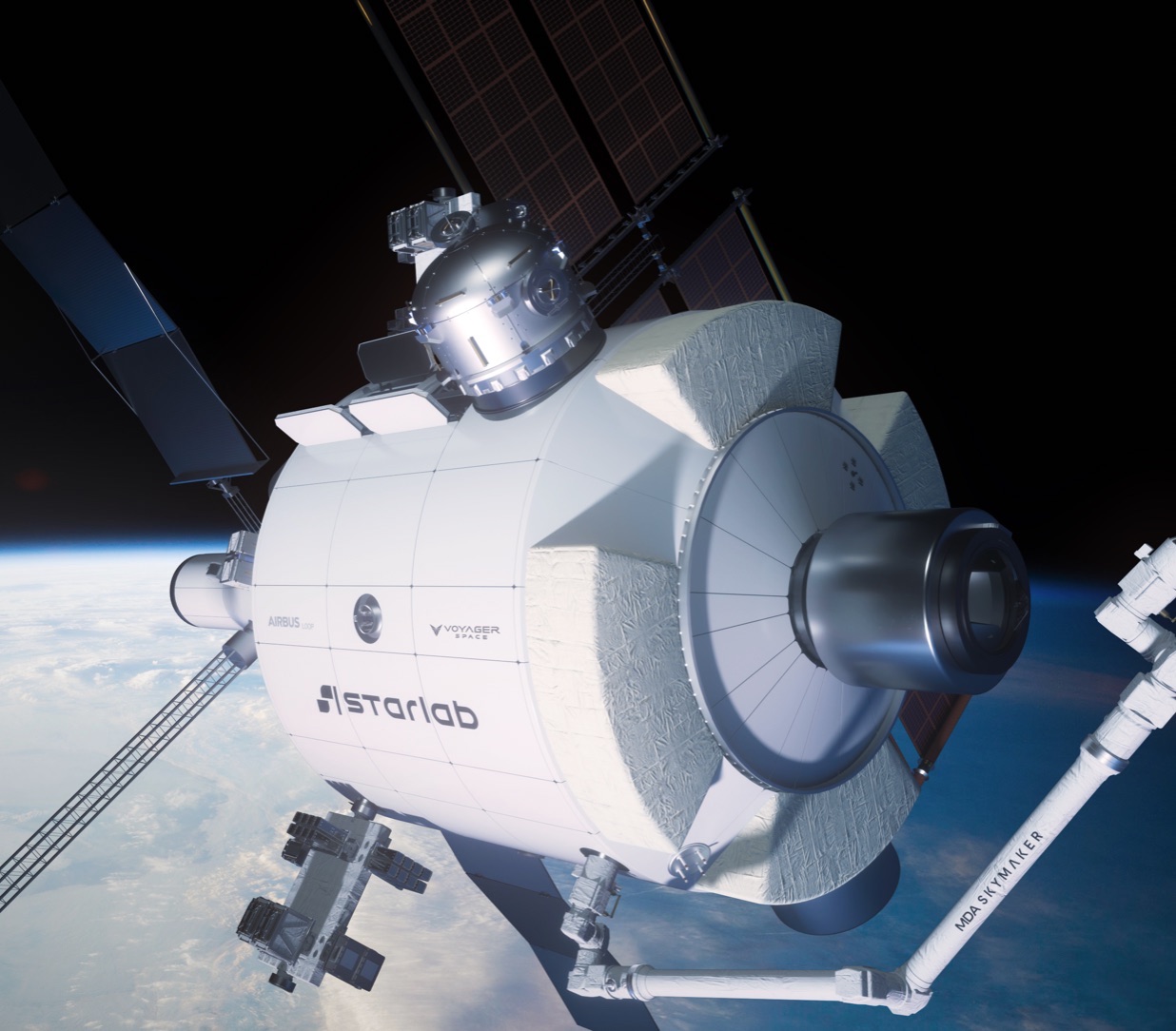

WASHINGTON — LambdaVision, a company that has used microgravity experiments on the International Space Station to develop an artificial retina, has booked space on a planned commercial successor.
LambdaVision announced Feb. 24 that it reserved payload space on Starlab, the commercial space station under development by the Starlab Space joint venture. The company did not disclose the amount of payload space reserved or the value of the contract.
Connecticut-based LambdaVision has worked for several years to develop artificial retinas, testing the production of protein thin films in microgravity through experiments flown on the ISS. The microgravity environment enables the creation of layers of thin films needed to produce the artificial retinas, which the company plans to test in patients with advanced retinitis pigmentosa.
“This partnership with Starlab will allow us to continue to build on the significant momentum we have created toward our long- and short-term goals of leveraging LEO for both advancing our protein-based artificial retina toward commercialization and laying the groundwork for other potential commercial efforts in LEO,” Nicole Wagner, chief executive of LambdaVision, said in a statement.
The company raised a $7 million seed round in November led by Seven Seven Six and Aurelia Foundry Fund, with additional support from Seraphim Space. In an interview at the time, Wagner said most of that funding would go toward ground-based testing and clinical trials. However, she said the company planned additional ISS experiments and was evaluating options for future commercial stations or other platforms.
LambdaVision’s agreement with Starlab “enables the transition from demonstration to scalable, sustainable manufacturing, unlocking exponential growth while delivering meaningful benefits to patients on Earth,” said Luis Zea, chief scientist at Starlab Space, in the statement.
The announcement comes as Starlab Space, a joint venture led by Voyager Technologies with participation from Airbus, Mitsubishi, MDA Space and other companies, refines the design of the station and competes for the next round of NASA’s Commercial Low Earth Orbit Destinations, or CLD, program, which supports development of commercial successors to the ISS.
Starlab Space announced Feb. 23 that it completed a commercial critical design review, or CCDR, for the station, one of the milestones in a funded NASA Space Act Agreement awarded under the first phase of the CLD program. The review confirmed the station’s design is technically mature and executable, allowing the company to move into full-scale production.
“This confirms Starlab is executable at scale and that our timeline aligns with ISS transition requirements,” Marshall Smith, chief executive of Starlab Space, said in a statement. “Equally important, our CCDR business plan review demonstrates that Starlab is being built around a real, diversified commercial market — one that supports sustained human presence and research in low Earth orbit.”
“As investors in both LambdaVision and Voyager, we’re excited to see LambdaVision’s innovative artificial retina technology combined with Voyager’s Starlab platform,” said Rob Desborough, a partner at Seraphim Space. “Together, they are demonstrating how orbital research can accelerate new therapies and expand the possibilities for commercial science in low Earth orbit.”










Related Posts
Stay Informed With the Latest & Most Important News
Previous Post
Next Post



Advertisement
-
 01Two Black Holes Observed Circling Each Other for the First Time
 -
 02From Polymerization-Enabled Folding and Assembly to Chemical Evolution: Key Processes for Emergence of Functional Polymers in the Origin of Life
 -
 03Astronomy 101: From the Sun and Moon to Wormholes and Warp Drive, Key Theories, Discoveries, and Facts about the Universe (The Adams 101 Series)
 -
 04True Anomaly hires former York Space executive as chief operating officer
 -
 05Φsat-2 begins science phase for AI Earth images
 -
 06Hurricane forecasters are losing 3 key satellites ahead of peak storm season − a meteorologist explains why it matters
 -
 07Binary star systems are complex astronomical objects − a new AI approach could pin down their properties quickly