
Now Reading: China launches PRSC-EO3 for Pakistan, lofts internet test and environment monitoring satellites
-
01
China launches PRSC-EO3 for Pakistan, lofts internet test and environment monitoring satellites

China launches PRSC-EO3 for Pakistan, lofts internet test and environment monitoring satellites

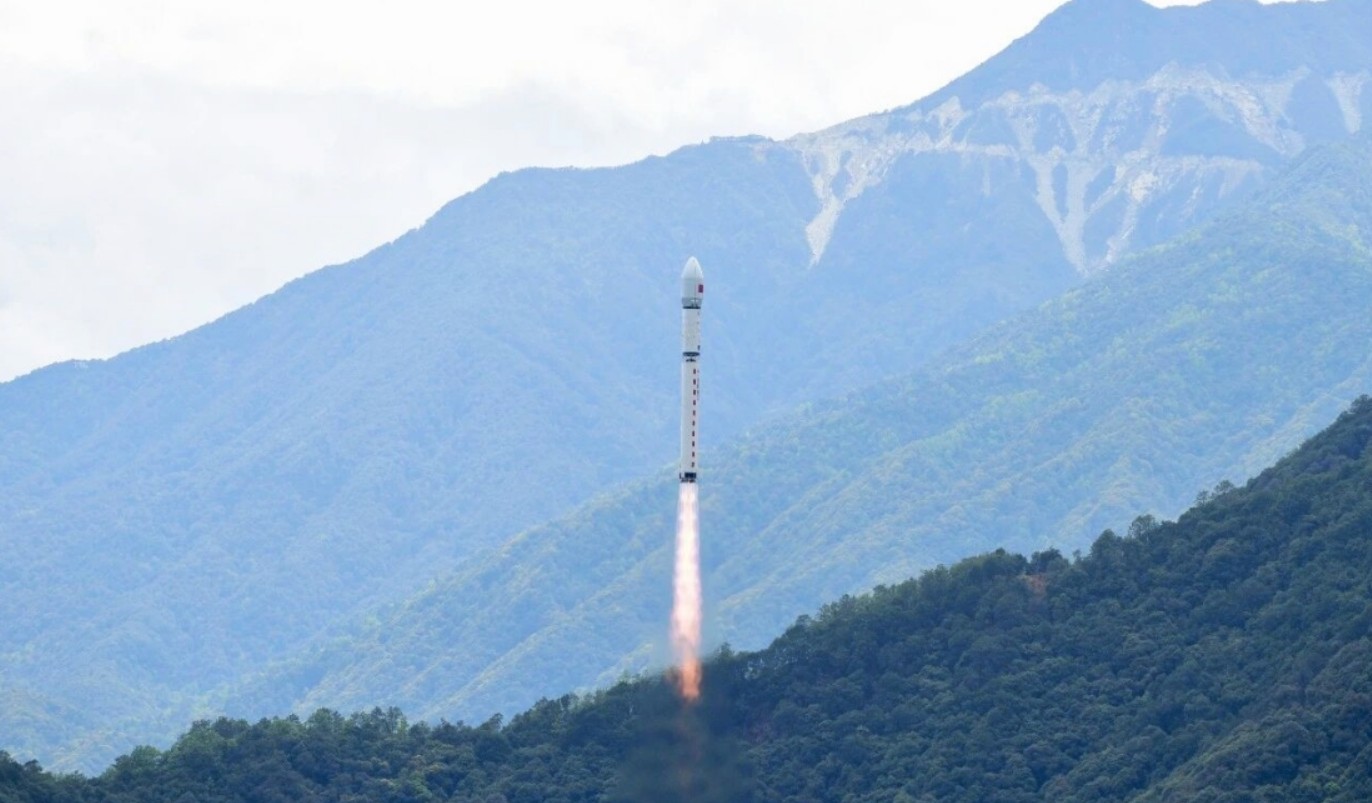

HELSINKI — China took its total launches this year to 26 over the weekend, with a trio of flights of legacy and newer Long March rocket models.
The activity saw the launch of a remote sensing satellite for Pakistan, the lofting of four new satellite internet technology test satellites, and a further launch carrying an environment monitoring satellite.
A Long March 6 rocket lifted off at 8:15 a.m. Eastern (1215 UTC) April 25 from Taiyuan Satellite Launch Center, northern China. Aboard was the PRSC-EO3 satellite equipped with a high-resolution optical payload, developed by the Pakistan Space and Upper Atmosphere Research Commission (SUPARCO). Propulsion systems were provided by the Beijing Institute of Control Engineering (BICE) under China Academy of Space Technology (CAST).
The launch was facilitated by China Great Wall Industry Corporation (CGWIC), a subsidiary of the China Aerospace Science and Technology Corporation (CASC), as part of a multi-launch service agreement with SUPARCO. China launched the PRSC-EO1 and PRSC-EO2 remote sensing satellites for Pakistan in January 2025 and February 2026 respectively.
The mission is also indicative of deepening China–Pakistan space cooperation, with the latter participating in China’s moon exploration plans, including signing up to the International Lunar Research Station (ILRS) moon base project in October 2023, and an agreement which will see one Pakistani astronaut make a short term visit to the Tiangong space station. Two candidate astronauts, Muhammad Zeeshan Ali and Khurram Daud, arrived in Beijing for training April 24.
The mission was the 15th launch of the Long March 6, which had its debut flight in 2015, marking the debut of China’s new generation of kerosene-liquid oxygen launch vehicles, developed in parallel with the Long March 5 and 7 series. It is based in part on the boosters for the Long March 5, using a YF-100 engine and was designed to provide a fast response option. The much larger Long March 6A uses a pair of YF-100s on its first stage and features four solid side boosters.
Satellite internet test satellites
The PRSC-EO3 launch followed another just over a day earlier. A Long March 2D rocket lifted off at 2:35 a.m. Eastern (0635 UTC) April 24 from Xichang Satellite Launch Center, southwest China.
The satellite internet technology test satellite is mainly used to conduct technical experiments and verifications on technologies such as direct broadband connection to satellites for mobile phones and the convergence of space and ground networks, according to the CASC statement.
Further statements reveal that the launch carried four satellites, with one developed by commercial satellite maker GalaxySpace and another two from Changguang Satellite Technology (CGST), a remote sensing satellite maker and constellation operator, with participation of the Beijing University of Posts and Telecommunications, and another developed by the Harbin Institute of Technology Satellite Technology Co., Ltd.
Four satellites were tracked in near-circular, 505-kilometer-altitude orbits inclined by 55 degrees.
The launch is part of a series of satellite internet technology test satellite launches dating back to 2023, and including a satellite launched by a Jielong-3 rocket earlier this month. The test satellites relate to China’s plans to build its own communications megaconstellations in low Earth orbit.
The test satellite launch also coincided with China’s national space day, first held in 2016, which was chosen for the anniversary of China’s first orbital launch on April 24, 1970, when a Long March 1 sent the DFH-1 satellite into orbit.
Daqi-2 greenhouse gas monitoring satellite
China’s previous launch saw a Long March 4C lift off at 12:10 Eastern (0410 UTC) April 17 from Jiuquan Satellite Launch Center, northwest China.
CASC confirmed launch success, revealing the payload to be the Daqi-2 satellite, also called Atmospheric Environment Monitoring Satellite-2 (AEMS-2) for monitoring atmospheric aerosol and carbon dioxide. Daqi-2 carries five payloads, including an Aerosol and Carbon Detection Lidar, and follows the launch of Daqi-1 in April 2022. That LIDAR was observed from the ground. Daqi-2 was sent into a near-polar, 700-km altitude orbit.
The Long March 2D and 4C are part of China’s older, hypergolic series of launch vehicles. China has since developed a range of larger cryogenic, kerosene and methane-fueled launchers and is attempting to recover and reuse first stages.
The launches were China’s 24th, 25th and 26th orbital launch attempts of 2026, including three failures. The country could be aiming to conduct as many as 140 launches this year, far surpassing last year’s national record of 92, including the launch of the Chang’e-7 lunar south pole lander. The debut of China’s reusable Long March 10B rocket, initially set for a window of April 28-30, appears to have been pushed back into May.










Related Posts
Stay Informed With the Latest & Most Important News


Advertisement
-
 01Two Black Holes Observed Circling Each Other for the First Time
 -
 02From Polymerization-Enabled Folding and Assembly to Chemical Evolution: Key Processes for Emergence of Functional Polymers in the Origin of Life
 -
 03Astronomy 101: From the Sun and Moon to Wormholes and Warp Drive, Key Theories, Discoveries, and Facts about the Universe (The Adams 101 Series)
 -
 04True Anomaly hires former York Space executive as chief operating officer
 -
 05Φsat-2 begins science phase for AI Earth images
 -
 06Hurricane forecasters are losing 3 key satellites ahead of peak storm season − a meteorologist explains why it matters
 -
 07Binary star systems are complex astronomical objects − a new AI approach could pin down their properties quickly