
Now Reading: Space Force halts Vulcan missions pending investigation into solid rocket Issue
-
01
Space Force halts Vulcan missions pending investigation into solid rocket Issue


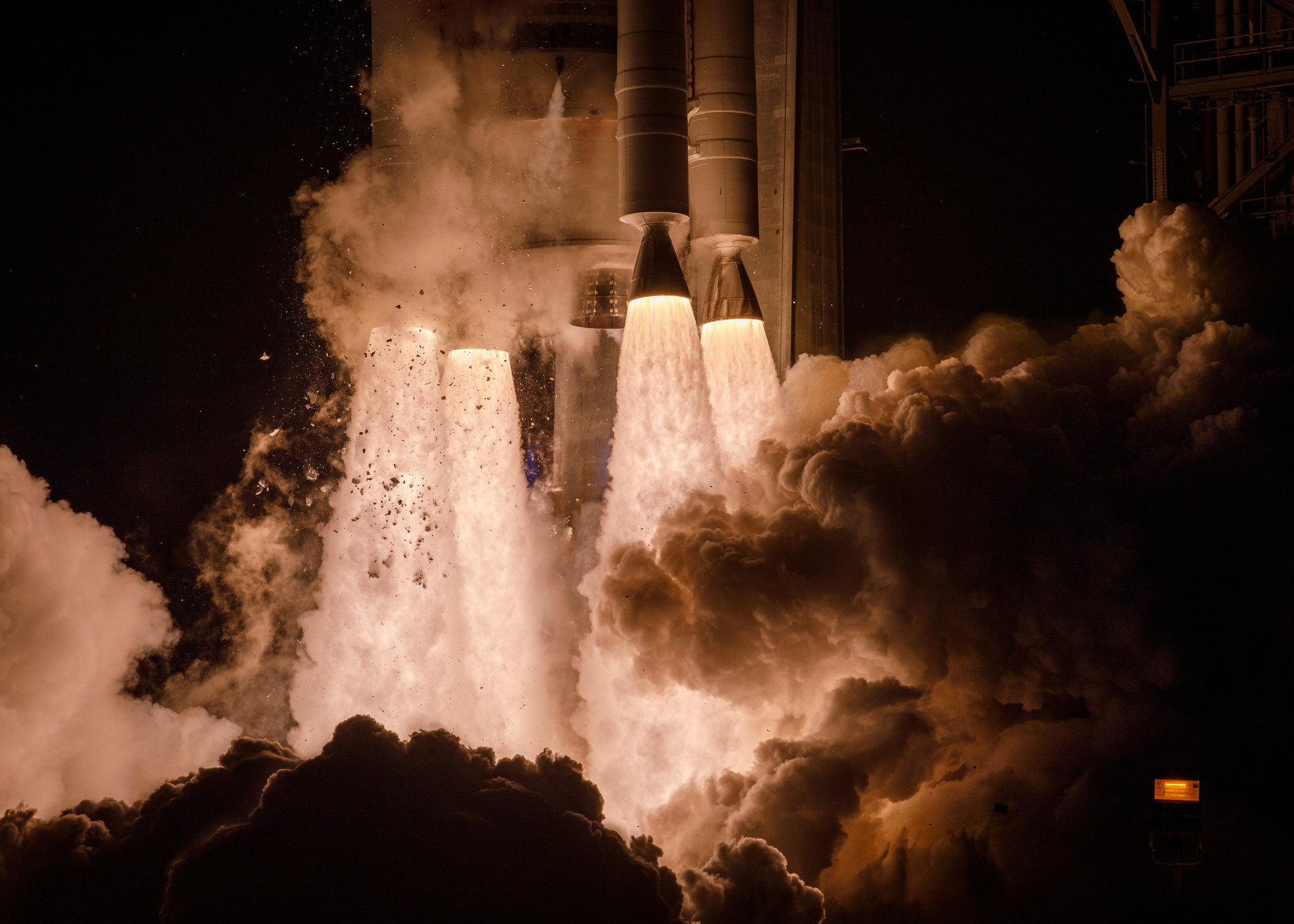

WASHINGTON — The U.S. Space Force said it will not fly additional national security missions on United Launch Alliance’s Vulcan rocket until an investigation is completed into a performance anomaly during a Feb. 12 launch.
The issue emerged shortly after liftoff on the USSF-87 mission, when observers noted what appeared to be an irregular plume or burn pattern from one of the Northrop Grumman-built GEM 63XL solid rocket boosters. The anomaly was reminiscent of Vulcan’s second flight in October 2024, when the nozzle of one of two strap-on boosters separated during ascent. In that case, the rocket compensated for the reduced thrust and completed its mission. A subsequent investigation found a manufacturing defect, which ULA said had been corrected.
On the Feb. 12 flight, Vulcan again delivered its payload directly to geosynchronous orbit. The rocket’s solid boosters ignite at liftoff alongside two BE-4 main engines and burn for roughly 90 seconds before separating. ULA said after the launch that it would work with government partners to determine the root cause of the booster issue.
In a Feb. 25 statement, Col. Eric Zarybnisky, portfolio acquisition executive for space access at Space Systems Command, said further Vulcan national security missions would be paused pending resolution of the anomaly.
“We are going to work through this anomaly until we launch again on Vulcan. Until this anomaly is solved, we will not be launching Vulcan missions,” Zarybnisky said.
The Space Force did not provide an estimate of how long the review could take. The 2024 investigation lasted several months before ULA disclosed its findings in March 2025.
A halt in national security launches is a setback for ULA as it seeks to increase Vulcan’s flight rate and establish a steady operational tempo. The company recently projected 18 to 22 launches this year as it works through a backlog of roughly 80 missions spanning military and commercial customers.
Vulcan is central to ULA’s effort to replace its Atlas 5 rocket and compete more directly for national security launches. With Vulcan missions on hold, the Space Force is now reliant solely on SpaceX to carry out national security space missions until Vulcan returns to flight.










Related Posts

Stay Informed With the Latest & Most Important News
Previous Post
Next Post
Previous Post

Next Post


Advertisement
-
 01Two Black Holes Observed Circling Each Other for the First Time
 -
 02From Polymerization-Enabled Folding and Assembly to Chemical Evolution: Key Processes for Emergence of Functional Polymers in the Origin of Life
 -
 03Astronomy 101: From the Sun and Moon to Wormholes and Warp Drive, Key Theories, Discoveries, and Facts about the Universe (The Adams 101 Series)
 -
 04True Anomaly hires former York Space executive as chief operating officer
 -
 05Φsat-2 begins science phase for AI Earth images
 -
 06Hurricane forecasters are losing 3 key satellites ahead of peak storm season − a meteorologist explains why it matters
 -
 07Binary star systems are complex astronomical objects − a new AI approach could pin down their properties quickly