
Now Reading: Meet Pollux: The brighter twin star of Gemini
-
01
Meet Pollux: The brighter twin star of Gemini


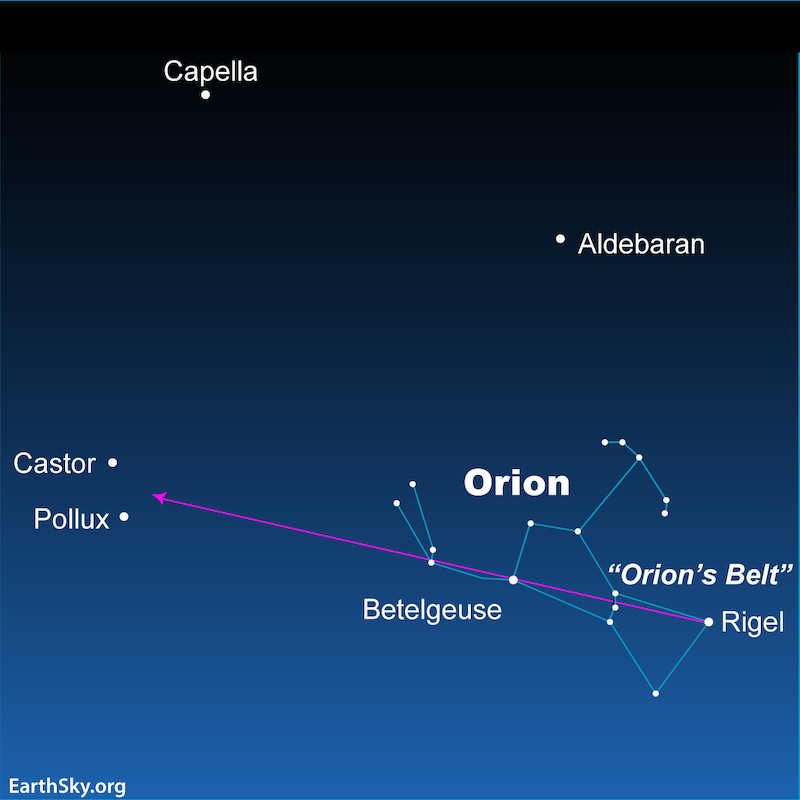
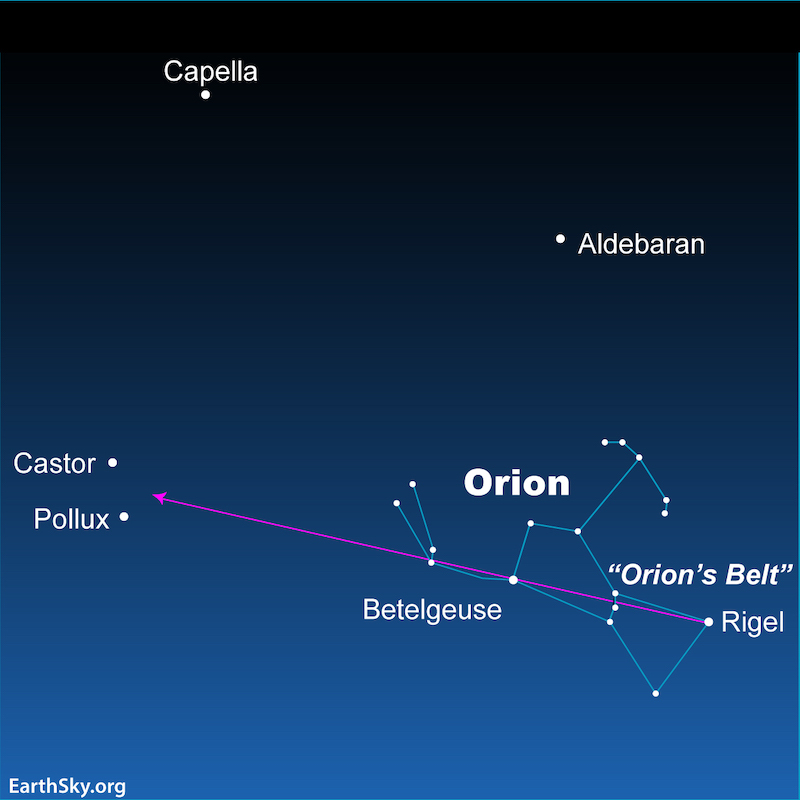
Like a pair of twins, two stars shine prominently in the evening skies in February each year. They are Pollux and Castor in the constellation Gemini the Twins. Pollux, also known as Beta Geminorum, is slightly brighter than Castor. It shines with a golden glow while Castor appears whiter. Pollux is the 17th brightest star in Earth’s night sky.
Pollux and Castor are noticeable for being bright and close together. That’s likely how the early stargazers came to identify them as twins. And it’ll be helpful to you, too, when you’re trying to spot these two stars in our night sky.
Pollux is relatively close to us at 34 light-years away.
You can use the easy-to-see constellation Orion to find Castor and Pollux, as shown on the chart above.
And in 2026, bright Jupiter is nearby

Another way to find them
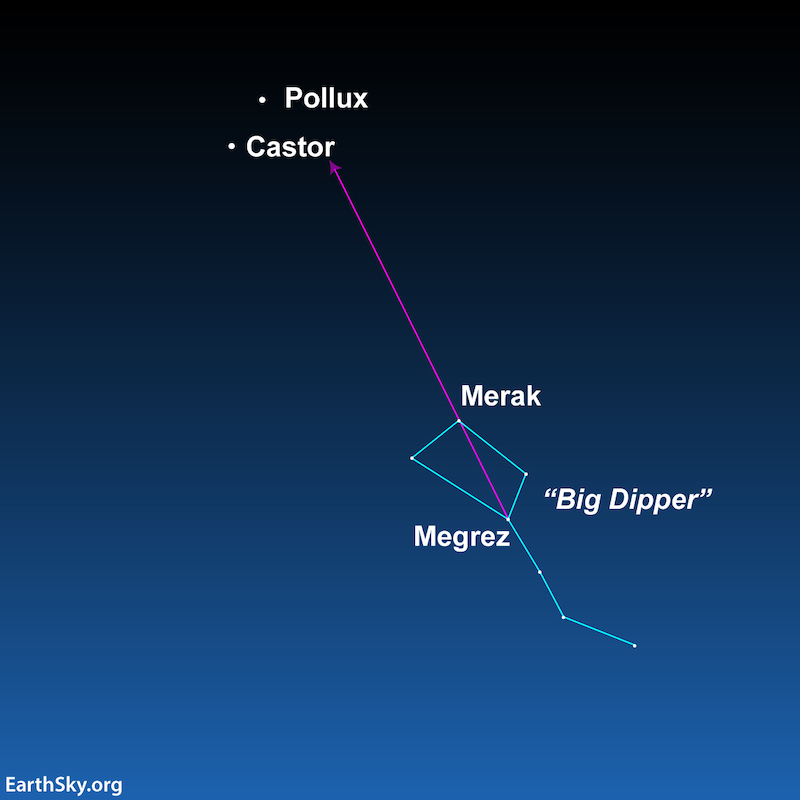
There are two good ways to find Pollux and Castor. From a Northern Hemisphere location face generally northward to find the Big Dipper asterism in the constellation Ursa Major. Draw an imaginary line diagonally through the bowl of the Big Dipper, from the star Megrez through the star Merak. You are going in the direction opposite to the Big Dipper’s handle.
This line will point to Castor and Pollux.
Want the view from your specific location at a specific time of year? Try Stellarium.
Science of Pollux
Pollux is classified as a K0 IIIb star. The K0 means that it is somewhat cooler than the sun, with a surface color that is a light yellowish orange. Keep in mind that when you look at a star, its color depends significantly on the sensitivity of your eyes, and that color is difficult to discern for most point sources.
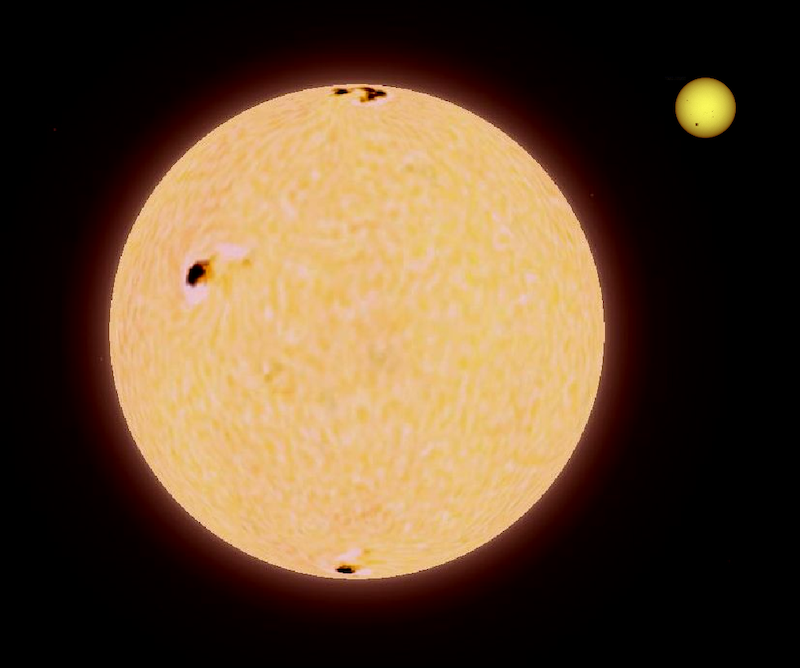
Pollux is just under two times the mass of our sun. It’s almost nine times the diameter of our sun. And it’s about 30 times the sun’s brightness in visible light.
Pollux also pumps out a good bit of energy in non-visible infrared radiation. With all forms of radiation counted, Pollux is about 43 times more energetic than our sun.
A large planet, at least two times the mass of Jupiter, was confirmed for Pollux in 2006. The International Astronomical Union announced a proper name for this planet in 2015: Thestias. At 34 light-years away, Thestias is one of the nearest of the more than 6,000 known exoplanets discovered so far.
Thestias moves around Pollux with a period of about 590 Earth days, which is reminiscent of Mars’ orbital period of 687 days. Thestias moves in a nearly circular orbit around its star.
Why Pollux is Beta
As mentioned above, Pollux is also known as Beta Geminorum. The Greek letter Beta is normally reserved for the 2nd-brightest star in a constellation. But Pollux is brighter than its brother star Castor, which is Gemini’s Alpha star. Being so close together in the sky, Castor and Pollux are easy to compare. If you look, you’ll agree. Pollux is brighter.
It’s possible that one or both stars have altered in brightness since German astronomer Johann Bayer assigned the designation about 300 years ago. Or maybe Bayer sometimes labeled stars in their order of rising times? Castor rises earlier than Pollux as seen from Bayer’s location in Germany. But there’s a geographical dependency here. From some locations south of the equator, Pollux rises first.
Mythology of Pollux and Castor
There is much mythology associated with these two stars, typically only in conjunction with each other. Generally in mythology they are twins. In Greek mythology, Pollux is immortal, the son of Zeus, and Castor is mortal, the son of King Tyndareus of Sparta.
So they were really half-brothers rather than true twins, with a common mother in Queen Leda. Their conception and birth was a complicated and unlikely affair, though, with their mother succumbing to both Zeus (disguised as a swan) and King Tyndareus on the same night. The resulting birth gave us not only Castor and Pollux, but also their sister, Helen of Troy.
Castor and Pollux are later said to have sailed among the Argonauts with Jason in search of the Golden Fleece. By most accounts, Castor was killed in battle and Pollux could not bear to live without him. Pollux begged Zeus to let him die too. Zeus could not grant the gift quite as asked, since Pollux was a god’s son and therefore immortal. But Zeus decreed that Pollux would spend every other day in Olympus with the gods, and the rest of the time in the underworld with his brother.
To honor the brothers’ devotion, Zeus placed their constellation in the sky as a remembrance.
The twin stars in other cultures
While in many cultures they were the Twins, in India they were the Horsemen, and in Phoenicia they were the two gazelles or two kid-goats. Early Christians sometimes called them David and Jonathan, while the early Arabian stargazers knew them as two peacocks.
Perhaps the most unexpected interpretation for the twins (along with the rest of Gemini) was as a “pile of bricks” as reported by Richard Hinckley Allen. Apparently the pile of bricks stood for the foundation of Rome, and in that context Castor and Pollux were associated with Romulus and Remus, the city’s legendary twin founders.
It’s said that in China they were associated with Yin and Yang, the contrasts and complements of life. In all of these cases, they represent two of something.
You’ll see why if you find these two stars in the night sky.
Pollux’s position is RA: 7h 45m 20s, dec: +28° 01′ 35″.
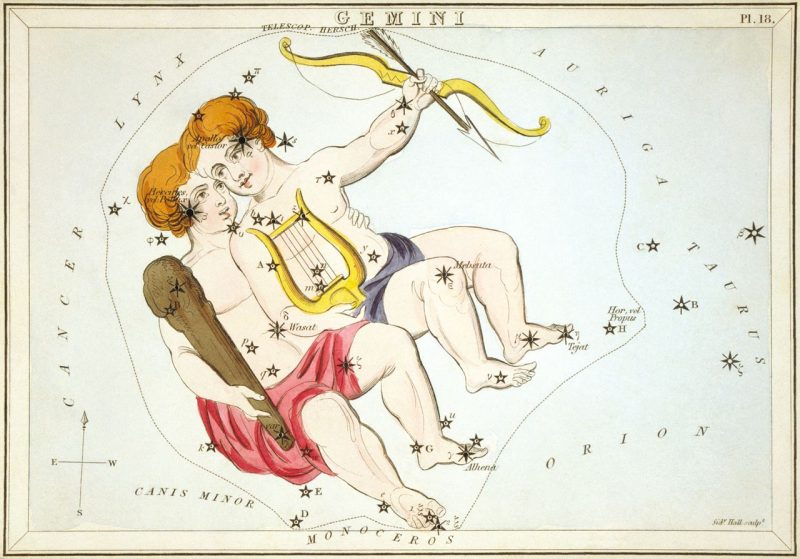
Bottom line: Pollux, aka Beta Geminorum, is the slightly brighter “twin” of Castor in the constellation Gemini the Twins.
The post Meet Pollux: The brighter twin star of Gemini first appeared on EarthSky.










Related Posts


Stay Informed With the Latest & Most Important News
Previous Post
Next Post




Advertisement
-
 01Two Black Holes Observed Circling Each Other for the First Time
 -
 02From Polymerization-Enabled Folding and Assembly to Chemical Evolution: Key Processes for Emergence of Functional Polymers in the Origin of Life
 -
 03Astronomy 101: From the Sun and Moon to Wormholes and Warp Drive, Key Theories, Discoveries, and Facts about the Universe (The Adams 101 Series)
 -
 04True Anomaly hires former York Space executive as chief operating officer
 -
 05Φsat-2 begins science phase for AI Earth images
 -
 06Hurricane forecasters are losing 3 key satellites ahead of peak storm season − a meteorologist explains why it matters
 -
 07Binary star systems are complex astronomical objects − a new AI approach could pin down their properties quickly