
Now Reading: Pentagon details cyber, space ‘first mover’ role in Iran operations
-
01
Pentagon details cyber, space ‘first mover’ role in Iran operations


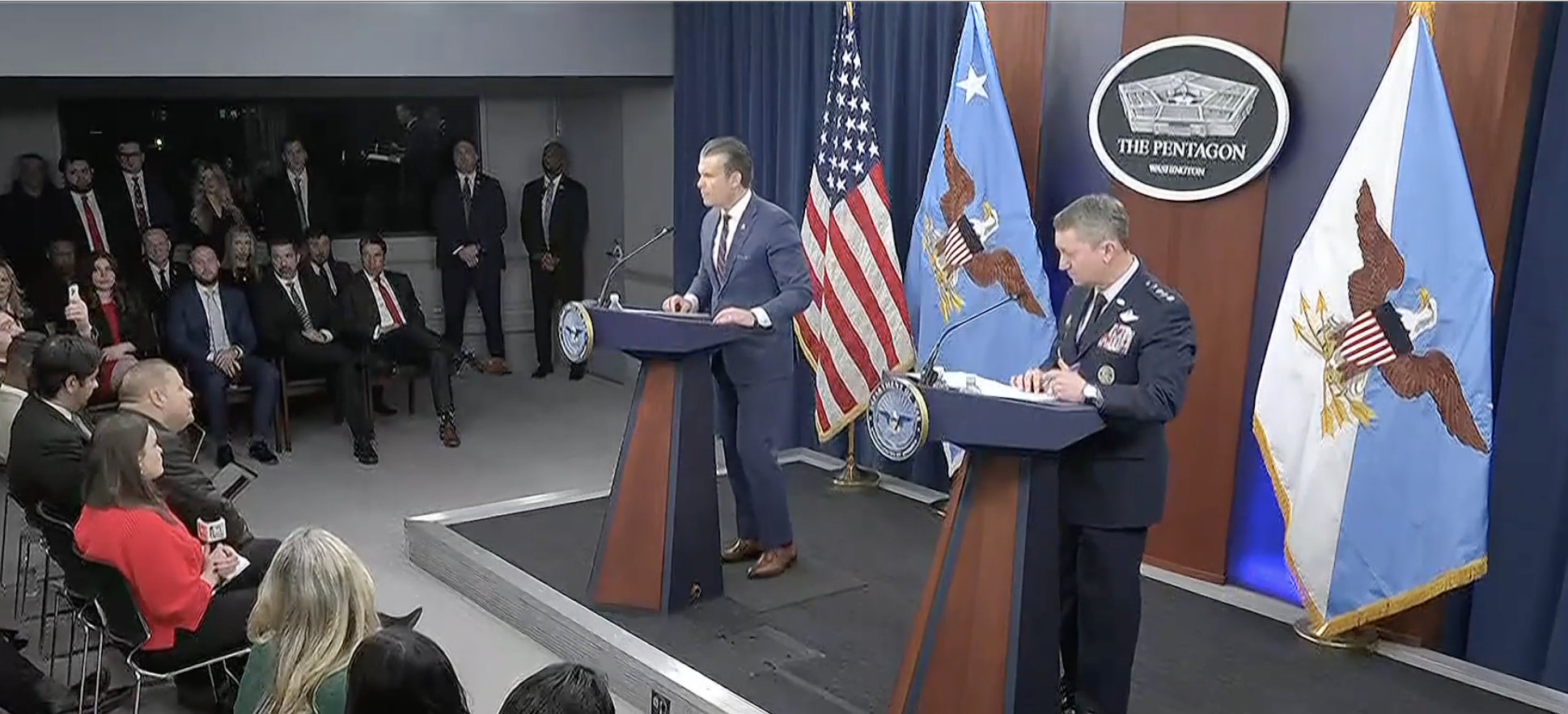

WASHINGTON — Space and cyber forces moved first in preparation for U.S. and Israeli strikes on Iran on Feb. 28, underscoring how military campaigns now begin in orbit and online before aircraft launch or missiles fire.
At a March 2 Pentagon news conference alongside Defense Secretary Pete Hegseth, Gen. Dan Caine, chairman of the Joint Chiefs of Staff, described the coordinated campaign as “major combat operations” that remain ongoing, without offering a timeline. President Trump and senior officials have said the strikes are aimed at halting what they characterize as a growing threat from Iran’s nuclear and missile programs.
Caine said the operation, led by U.S. Central Command, required tight coordination across air, maritime, cyber and space domains. “The United States, Army, Navy, Marine Corps, Air Force, Space Force, Coast Guard and our reserve components integrated across our combat commands and began coordinated operations with the Israeli armed forces of an unprecedented scale,” he said.
Among the combatant commands “directly involved,” Caine highlighted U.S. Space Command and U.S. Cyber Command. Cyber Command conducts offensive and defensive military operations in cyberspace. Space Command oversees military operations in the space domain, including protecting satellites and delivering missile warning and navigation support to joint forces.
In support of the airstrikes, Caine said, “U.S. CYBERCOM and SPACECOM continuously layered effects to disrupt, disorient and confuse the enemy.” He characterized both as “the first movers” that provided “non-kinetic effects disrupting and degrading and blinding Iran’s ability to see, communicate and respond.”
In military planning, first movers are forces that act before visible kinetic operations to shape the battlespace. The preparatory phase is intended to reduce risk to follow-on forces and limit an adversary’s ability to mount a coordinated response.
In practice, Cyber Command’s role would likely involve penetrating and mapping adversary networks, identifying command-and-control nodes and positioning capabilities to degrade communications or air defenses at a chosen moment. The objective is to slow decision-making and fragment information flows before aircraft and missiles arrive.
Space Command’s role includes ensuring resilient U.S. satellite communications and positioning, navigation and timing, while potentially disrupting an adversary’s access to space-enabled capabilities such as satellite communications or reconnaissance. Such actions can include electronic interference with uplinks and downlinks or other reversible measures that impair targeting and coordination.
‘Coordinated cyber, space operations’
The emphasis on cyber and space as opening moves reflects their evolution from supporting functions to operational lead elements. In this campaign, Caine said, more than 100 aircraft launched in a synchronized wave that included fighters, tankers, airborne early warning aircraft, electronic attack platforms and unmanned systems. “This was a massive, overwhelming attack across all domains of warfare, striking more than 1,000 targets in the first 24 hours,” he said.
He reiterated that “coordinated space and cyber operations effectively disrupted communications and sensor networks across the area of responsibility, leaving the adversary without the ability to see, coordinate or respond effectively.”
Space-enabled missile warning is central to countering Iranian retaliation. U.S. and Israeli defenses rely on a layered architecture that detects and tracks ballistic missile launches from space-based infrared satellites within seconds, cueing ground and sea-based radars to calculate trajectories and predicted impact points.
“Our integrated air and missile defense network is performing exactly as it’s intended,” Caine said. “Collectively, these systems have intercepted hundreds of ballistic missiles targeting U.S. forces, our partners and regional stability … The threat from one way attack UAVs has remained persistent.”
Air defense batteries are operating from Qatar, the United Arab Emirates, Kuwait, Jordan and Saudi Arabia, reflecting the regional scope of the conflict and the reliance on distributed sensor and interceptor networks.










Related Posts



Stay Informed With the Latest & Most Important News
Previous Post
Next Post



Advertisement
-
 01Two Black Holes Observed Circling Each Other for the First Time
 -
 02From Polymerization-Enabled Folding and Assembly to Chemical Evolution: Key Processes for Emergence of Functional Polymers in the Origin of Life
 -
 03Astronomy 101: From the Sun and Moon to Wormholes and Warp Drive, Key Theories, Discoveries, and Facts about the Universe (The Adams 101 Series)
 -
 04True Anomaly hires former York Space executive as chief operating officer
 -
 05Φsat-2 begins science phase for AI Earth images
 -
 06Hurricane forecasters are losing 3 key satellites ahead of peak storm season − a meteorologist explains why it matters
 -
 07Binary star systems are complex astronomical objects − a new AI approach could pin down their properties quickly