
Now Reading: Bringing imagery and communications under one roof
-
01
Bringing imagery and communications under one roof


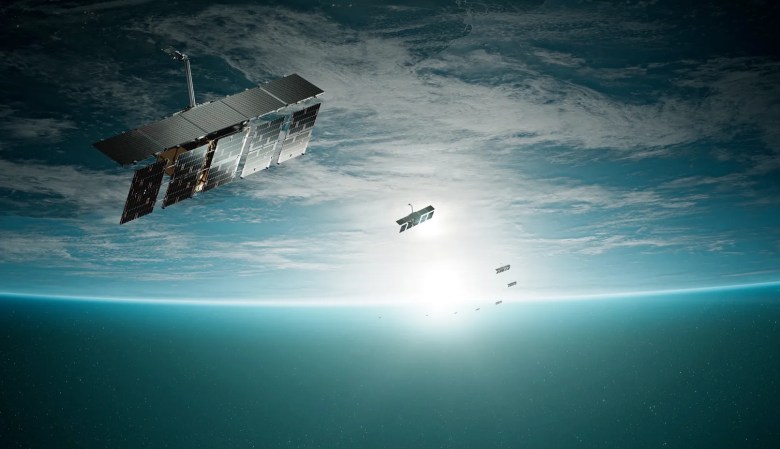
TAMPA, Fla. — As direct-to-smartphone services blur the line between space and terrestrial connectivity, hybrid constellations are bringing communications and imagery closer together in orbit.
One of the clearest examples is Space42 of the United Arab Emirates, formed through the merger of Yahsat’s geostationary communications operations and Bayanat’s geospatial analytics business.
In partnership with Finnish synthetic aperture radar operator Iceye, Space42 deployed its first SAR satellite in 2024 and recently expanded its Foresight low Earth orbit (LEO) imagery constellation to five spacecraft.
Two more SAR satellites from Iceye are slated to join the constellation in 2027, improving Space42’s ability to deliver intelligence services with data unaffected by cloud cover or darkness.
Space42’s broader sensing roadmap also includes high-altitude platform stations (HAPS) and future capabilities that would blend optical and radar sensing, targeting what it says is a growing range of national security and commercial use cases. The goal is to turn satellite data into faster intelligence by reducing the lag between detection and response.
Another emerging opportunity the company is pursuing is support for autonomous vehicles, where Space42 says combining georeferencing with connectivity can help improve safety and efficiency.
However, these efforts remain in the early innings. Space42’s latest financial results showed revenue from Smart Solutions, the business unit focused on turning data from space, air and ground into AI-enabled intelligence, declined 39% to $124 million in 2025.
Looking beyond bandwidth
Japan’s flagship satellite TV and broadband provider Sky Perfect JSAT is on a similar path. The operator inked a $230 million deal last year for 10 Pelican high-resolution optical imagery satellites from San Francisco-based Earth observation operator Planet, slated to launch to LEO in 2027 to grow an intelligence business that currently relies on third-party data.
But owning or procuring imagery satellites is only one part of the convergence.
Sky Perfect JSAT is also part of a wider push to use data relay networks to help get Earth observation data to users on the ground faster. Space Compass, Sky Perfect JSAT’s joint venture with Japanese telecoms giant NTT, signed a contract in March for its first commercial geostationary optical data relay satellite.
Meanwhile, British small satellite manufacturing specialist Open Cosmos is coming from the other direction.
The company recently outlined plans for a sovereign broadband and Internet of Things connectivity constellation, called ConnectedCosmos, that would also link up with Earth observation spacecraft operating under its existing OpenConstellation shared infrastructure initiative.
“Historically, Earth observation satellites have operated in isolation, capturing high-value data but relying on ground station passes to transmit it, which can introduce delays of several hours,” Open Cosmos founder and CEO Rafel Jordà Siquier told SpaceNews in March.

“With our inter-satellite links across the constellation, that bottleneck disappears. Data captured by our cameras and sensors can be transmitted instantly across the network in orbit, enabling near real-time delivery to users on the ground.”
Data transport takes center stage
For Novaspace principal advisor Maxime Puteaux, the market has moved beyond a simple question of whether satcom operators will build or buy their own imagery constellations.
“The most immediate convergence between satcom and Earth observation is happening through data relay and data transport,” Puteaux said.
“Connectivity operators are increasingly positioning themselves as the backbone that enables EO constellations to move data faster, more securely and with lower latency — which is critical for defense and real-time applications.”
He said this is becoming increasingly important as proliferated LEO sensing architectures generate larger volumes of data that need to be downlinked, routed and distributed quickly.
Growing HAPS and mesh-network projects spanning geostationary, LEO and very low Earth orbit also point to a wider shift toward integrated, multi-layer data architectures that combine sensing, connectivity, processing and distribution.
Software-defined networking efforts such as Aalyria’s Spacetime software orchestration platform show where this could lead, Puteaux added. By automating how data moves across fragmented sensors, satellites, relays and ground systems, Spacetime is designed to help fuse information into a more useful picture for decision-makers.
Ground segment-as-a-service models, where companies lease or federate antennas to imagery operators, are another part of the trend.
Eutelsat, for instance, has teamed up with French startup Skynopy to explore using spare capacity from OneWeb ground stations for Earth observation operators.
The multi-orbit operator is also in talks about hosted payload opportunities for the 440 OneWeb satellites it has ordered from Airbus to replenish the LEO broadband network in the coming years.
“Hosted payloads are not new,” Puteaux said, pointing to Iridium’s long-running use of them for aircraft tracking and maritime monitoring services.
“What is changing is the scope. We now see extensions toward space situational awareness, for instance through the EU Space Surveillance and Tracking initiative where [sensor specialist] Sodern, Eutelsat and [Arianespace parent group] ArianeGroup are developing an opportunistic SSA capability leveraging hosted sensors on commercial satellites.”
Rather than marking the start of a wholesale shift by satcom operators into imagery, Puteaux said the real trend is the “emergence of integrated, multi-layer data architectures combining sensing, connectivity, processing and distribution.”
This should also lead to more resilient and secure systems, he said, while closing the gap between data collection and decision-making.










Related Posts



Stay Informed With the Latest & Most Important News
Previous Post
Next Post


Advertisement
-
 01Two Black Holes Observed Circling Each Other for the First Time
 -
 02From Polymerization-Enabled Folding and Assembly to Chemical Evolution: Key Processes for Emergence of Functional Polymers in the Origin of Life
 -
 03Astronomy 101: From the Sun and Moon to Wormholes and Warp Drive, Key Theories, Discoveries, and Facts about the Universe (The Adams 101 Series)
 -
 04True Anomaly hires former York Space executive as chief operating officer
 -
 05Φsat-2 begins science phase for AI Earth images
 -
 06Hurricane forecasters are losing 3 key satellites ahead of peak storm season − a meteorologist explains why it matters
 -
 07Binary star systems are complex astronomical objects − a new AI approach could pin down their properties quickly