
Now Reading: Elevated Eccentricities In The Radius Valley Hint At Water-Rich Mini-Neptunes
-
01
Elevated Eccentricities In The Radius Valley Hint At Water-Rich Mini-Neptunes


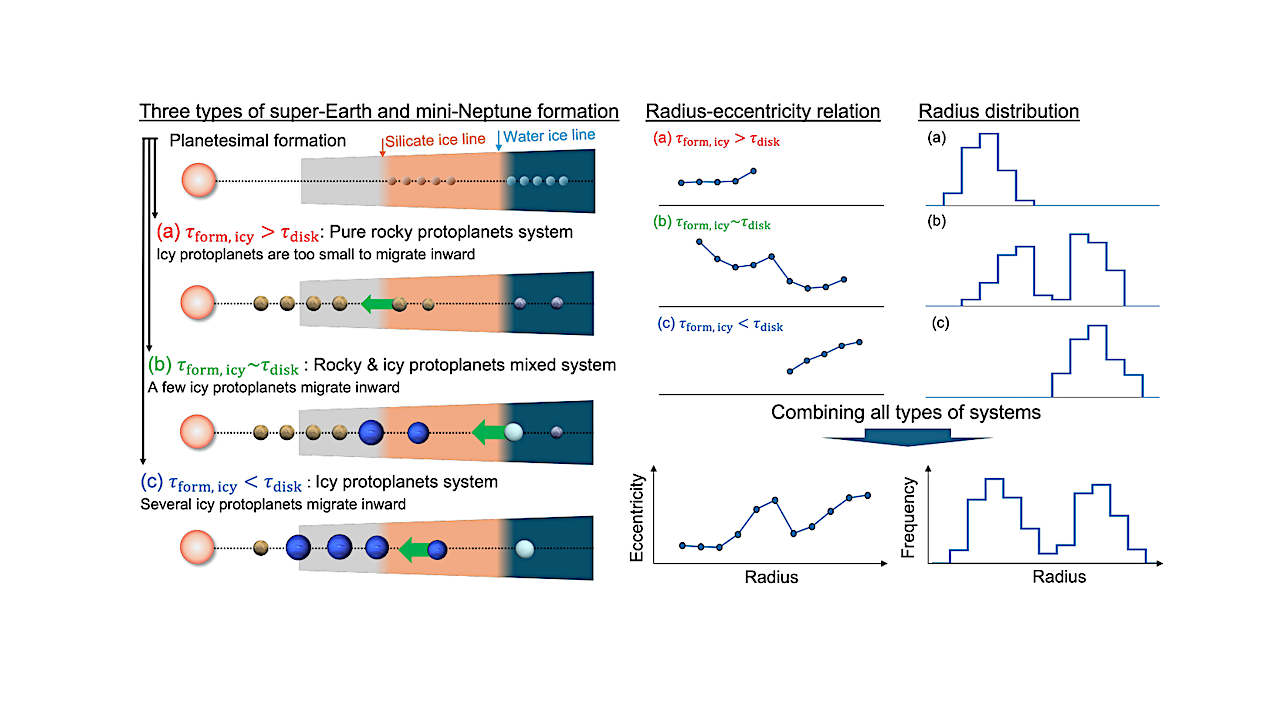
Schematic image of three types of protoplanetary systems and their contribution to the radius-eccentricity profile and radius valley. — astro-ph.EP
While recent planet-formation models broadly reproduce the observed population of super-Earths and mini-Neptunes, as well as the bimodal radius distribution (the “radius valley”), it remains unclear whether all these planets share a common rocky composition (a single popoulation of planets) or instead comprise two distinct populations — rocky planets and icy planets (two populations of planets).
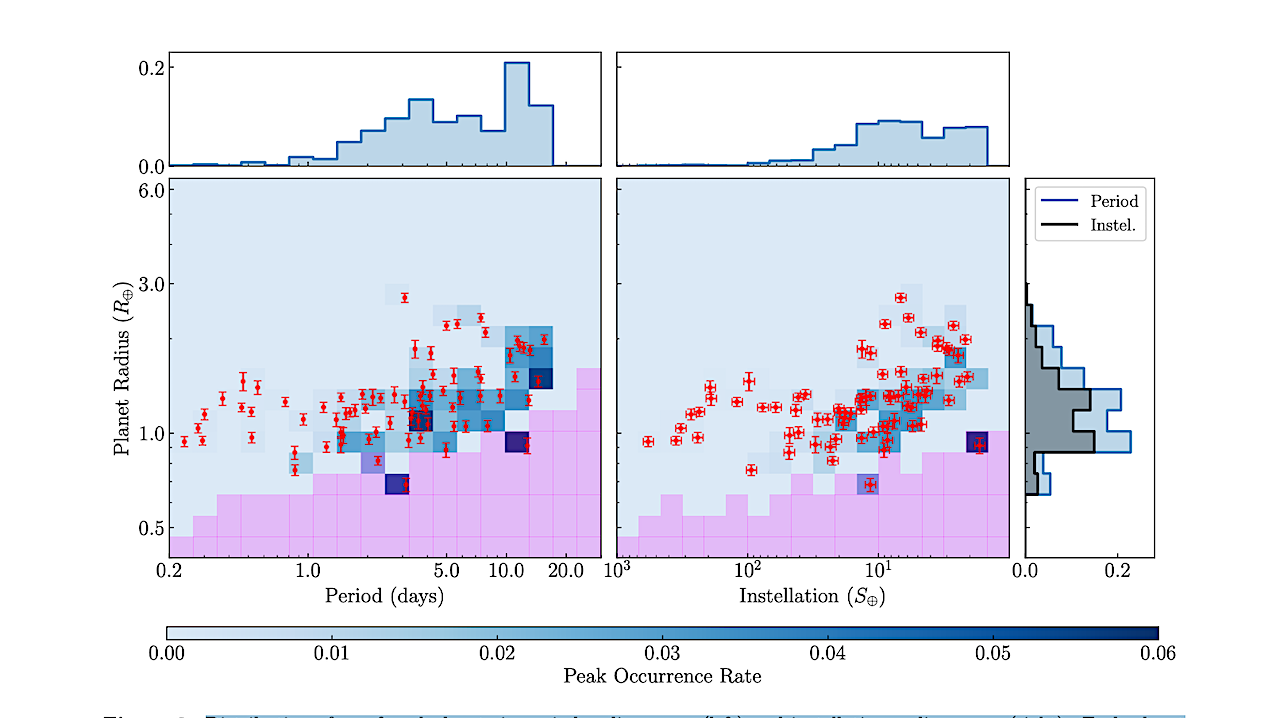
The inferred eccentricity-radius relation, which shows a modest peak near the radius valley, provides a useful diagnostic for distinguishing between these scenarios. Here we use N-body simulations to examine how the radii and eccentricities of close-in planets depend on the masses and orbital configurations of their progenitor protoplanets.
We find that final planetary eccentricities scale with the system initial Safronov number. In two-population systems, energy equipartition between rocky and relatively more massive icy protoplanets creates a strong eccentricity contrast between the two groups, which appears as a peak near the radius valley.
This signature does not appear if planetary systems are composed exclusively of rocky planets (with or without H-rich atmospheres), as assumed in photoevaporation and core-powered mass loss models. Because the eccentricity-radius relation traces a dichotomy in the underlying protoplanet mass distribution — most plausibly arising from formation at different disk locations — our results suggest that a significant fraction of mini-Neptunes are water-worlds.
The observed radius and eccentricity distributions may reflect a mixture of systems that host exclusively rocky planets, systems dominated by icy planets, and systems with both rocky and icy planets.
Sho Shibata, Andre Izidoro
Comments: Accepted for ApJ. 19 pages, 18 figures
Subjects: Earth and Planetary Astrophysics (astro-ph.EP)
Cite as: arXiv:2602.23250 [astro-ph.EP] (or arXiv:2602.23250v1 [astro-ph.EP] for this version)
https://doi.org/10.48550/arXiv.2602.23250
Focus to learn more
Related DOI:
https://doi.org/10.3847/1538-4357/ae4a28
Focus to learn more
Submission history
From: Sho Shibata
[v1] Thu, 26 Feb 2026 17:25:37 UTC (4,714 KB)
https://arxiv.org/abs/2602.23250
Astrobiology,











Related Posts
Stay Informed With the Latest & Most Important News
Previous Post
Next Post



Advertisement
-
 01Two Black Holes Observed Circling Each Other for the First Time
 -
 02From Polymerization-Enabled Folding and Assembly to Chemical Evolution: Key Processes for Emergence of Functional Polymers in the Origin of Life
 -
 03Astronomy 101: From the Sun and Moon to Wormholes and Warp Drive, Key Theories, Discoveries, and Facts about the Universe (The Adams 101 Series)
 -
 04True Anomaly hires former York Space executive as chief operating officer
 -
 05Φsat-2 begins science phase for AI Earth images
 -
 06Hurricane forecasters are losing 3 key satellites ahead of peak storm season − a meteorologist explains why it matters
 -
 07Binary star systems are complex astronomical objects − a new AI approach could pin down their properties quickly