
Now Reading: Chemistry And Isotope Ratios Of Substellar Atmospheres In The β Pictoris Young Moving Group
-
01
Chemistry And Isotope Ratios Of Substellar Atmospheres In The β Pictoris Young Moving Group

Chemistry And Isotope Ratios Of Substellar Atmospheres In The β Pictoris Young Moving Group

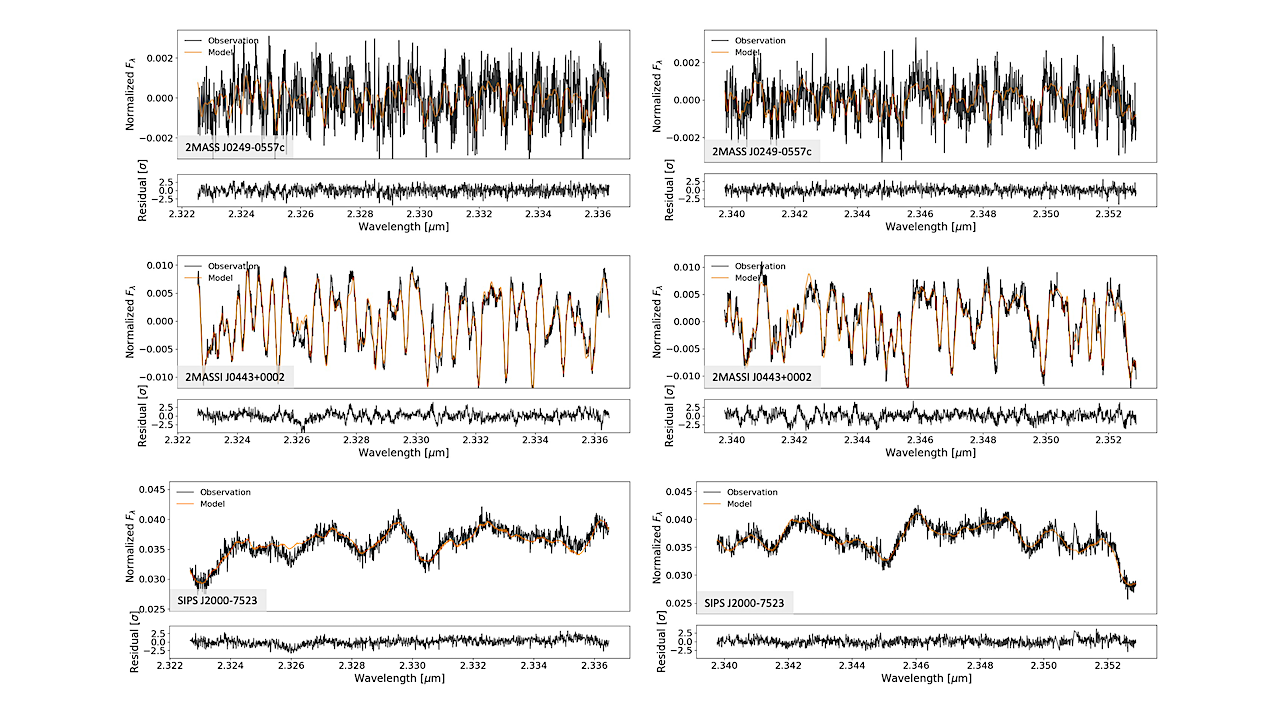

Two orders of high-resolution spectra with the best-fit model overplotted in yellow for each target. The observation on the first day (September 21, 2022) is chosen for 2MASS J0249-0557 c. The wavelength range is selected to include the 12CO and 13CO bandheads. — astro-ph.EP
Measuring the chemical and isotopic compositions of gas giants and brown dwarfs provides insights into their formation pathways and birth environments. 2MASS J0249-0557 c is an L2-type planetary mass companion (∼12MJup) orbiting a pair of brown dwarfs in the β Pictoris young moving group.
Its mass places it at the intersection of planets and brown dwarfs, making it an interesting target for constraining formation pathways at the planet-brown-dwarf boundary. Using high-resolution spectroscopic data of the planet acquired with CRIRES+ mounted on VLT, we conduct atmospheric retrieval with the radiative transfer code RADTRANS and the nested sampling tool PyMultiNest.
We retrieve a C/O ratio of 0.57±0.01, a metallicity of [M/H] = 0.18±0.05, and a 12CO/13CO ratio of 95+23−17. We also retrieve atmospheric compositions for two benchmark brown dwarfs in the β Pic YMG, 2MASSI J0443+0002 and SIPS J2000-7523, using CRIRES+ data and find consistent compositions.
Together with 2MASS J0249-0557 c’s wide separation from its host, its compositional consistency with other members of its group supports gravitational collapse in a star-like manner as its most likely formation mechanism. These results deliver a homogeneous comparison of three substellar members in the β Pic YMG.
Their solar-like abundances provide a baseline for exoplanet members in the same moving group, such as β Pic b, 51 Eri b, and AF Lep b, whose host stellar compositions are difficult to measure. Future comparisons of atmospheric compositions among this moving group offer the potential to distinguish between formation mechanisms for its planetary members.
Yurou Liu, Yapeng Zhang, Jerry W. Xuan, Dimitri Mawet, Ignas Snellen, Rico Landman, Tomas Stolker, Sam de Regt, Aurora Kesseli, Malena Rice
Comments: Accepted by ApJ
Subjects: Earth and Planetary Astrophysics (astro-ph.EP); Solar and Stellar Astrophysics (astro-ph.SR)
Cite as: arXiv:2605.01012 [astro-ph.EP](or arXiv:2605.01012v1 [astro-ph.EP] for this version)
https://doi.org/10.48550/arXiv.2605.01012
Focus to learn more
Submission history
From: Yurou Liu
[v1] Fri, 1 May 2026 18:23:50 UTC (22,578 KB)
https://arxiv.org/abs/2605.01012
Astrobiology,










Related Posts

Stay Informed With the Latest & Most Important News



Advertisement
-
 01Two Black Holes Observed Circling Each Other for the First Time
 -
 02From Polymerization-Enabled Folding and Assembly to Chemical Evolution: Key Processes for Emergence of Functional Polymers in the Origin of Life
 -
 03Astronomy 101: From the Sun and Moon to Wormholes and Warp Drive, Key Theories, Discoveries, and Facts about the Universe (The Adams 101 Series)
 -
 04True Anomaly hires former York Space executive as chief operating officer
 -
 05Φsat-2 begins science phase for AI Earth images
 -
 06Hurricane forecasters are losing 3 key satellites ahead of peak storm season − a meteorologist explains why it matters
 -
 07Binary star systems are complex astronomical objects − a new AI approach could pin down their properties quickly