
Now Reading: TESS Planet Occurrence Rates Reveal the Disappearance of the Radius Valley Around Mid-to-Late M Dwarfs
-
01
TESS Planet Occurrence Rates Reveal the Disappearance of the Radius Valley Around Mid-to-Late M Dwarfs

TESS Planet Occurrence Rates Reveal the Disappearance of the Radius Valley Around Mid-to-Late M Dwarfs

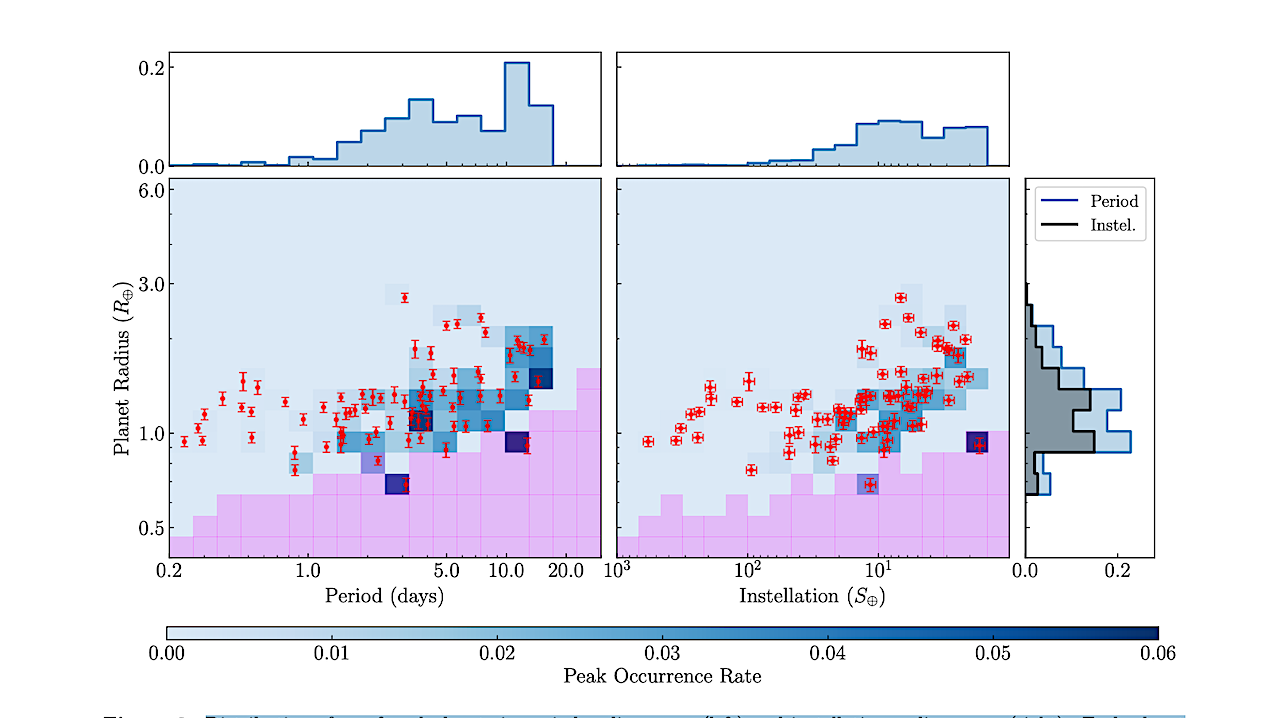
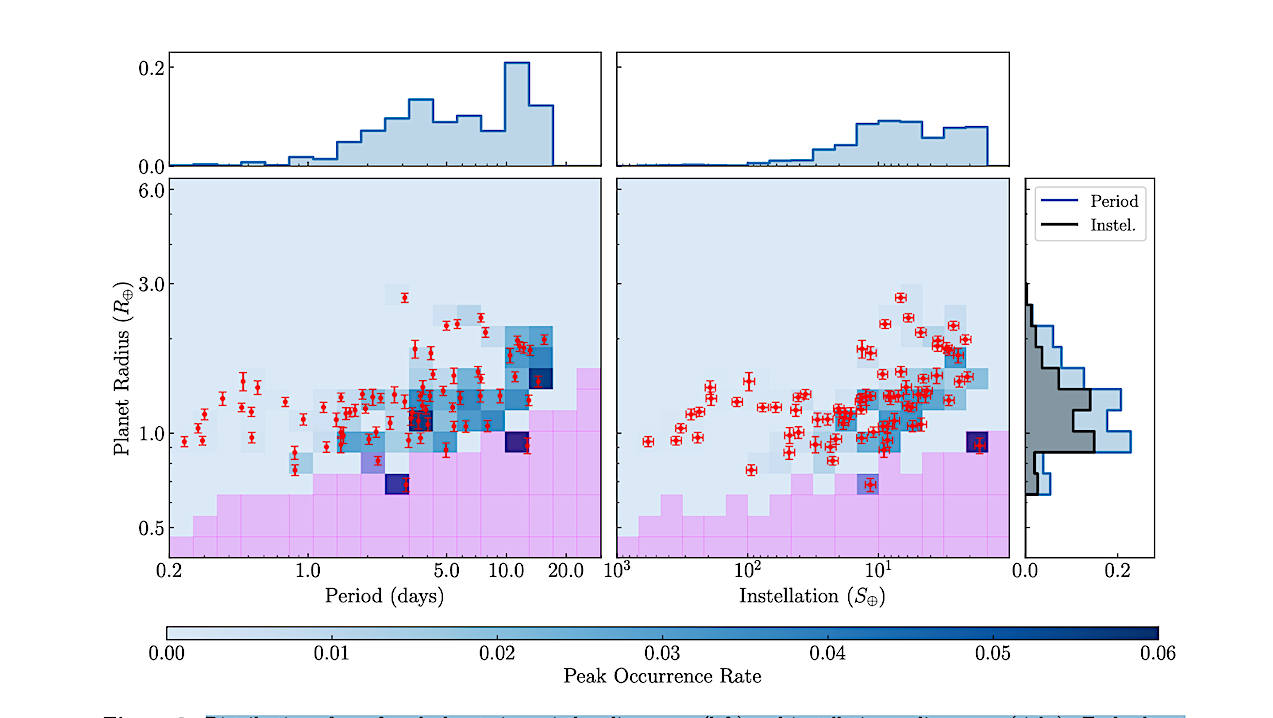
Distribution of our found planets in period–radius space (left) and instellation–radius space (right). Each planet and its associated errors are are marked with the red points, while the background grid shows the peak occurrence rate fpeak in each bin of the grid. Regions where our average sensitivity is 10% are highlighted in pink. The top and leftmost panels show the cumulative fpeak distributions from each map. We note that these distributions are not representative of the full occurrence rates, and differ because planets may find themselves in different regions of sensitivity based on their instellation and period. — astro-ph.EP
We present the deepest systematic search for planets around mid-to-late M dwarfs to date. We have surveyed 8134 mid-to-late M dwarfs observed by TESS with a custom built pipeline and recover 77 vetted transiting planet candidates.
We characterize the sensitivity of our survey via injection-recovery and measure the occurrence rate of planets as a function of orbital period, instellation, and planet radius. We measure a cumulative occurrence rate of 1.10±0.16 planets per star with radii >1R⊕ orbiting within 30 days.
This value is consistent with the cumulative occurrence rate around early M dwarfs, making M dwarfs collectively the most prolific hosts of small close-in planets. Unlike the bimodal Radius Valley exhibited by close-in planet population around FGK and early M dwarfs, we recover a unimodal planet radius distribution peaking at 1.25±0.05R⊕.
We additionally find 0.954±0.147 super-Earths and 0.148±0.045 sub-Neptunes per star, with super-Earths outnumbering sub-Neptunes 5.5:1, firmly demonstrating that the Radius Valley disappears around the lowest mass stars.
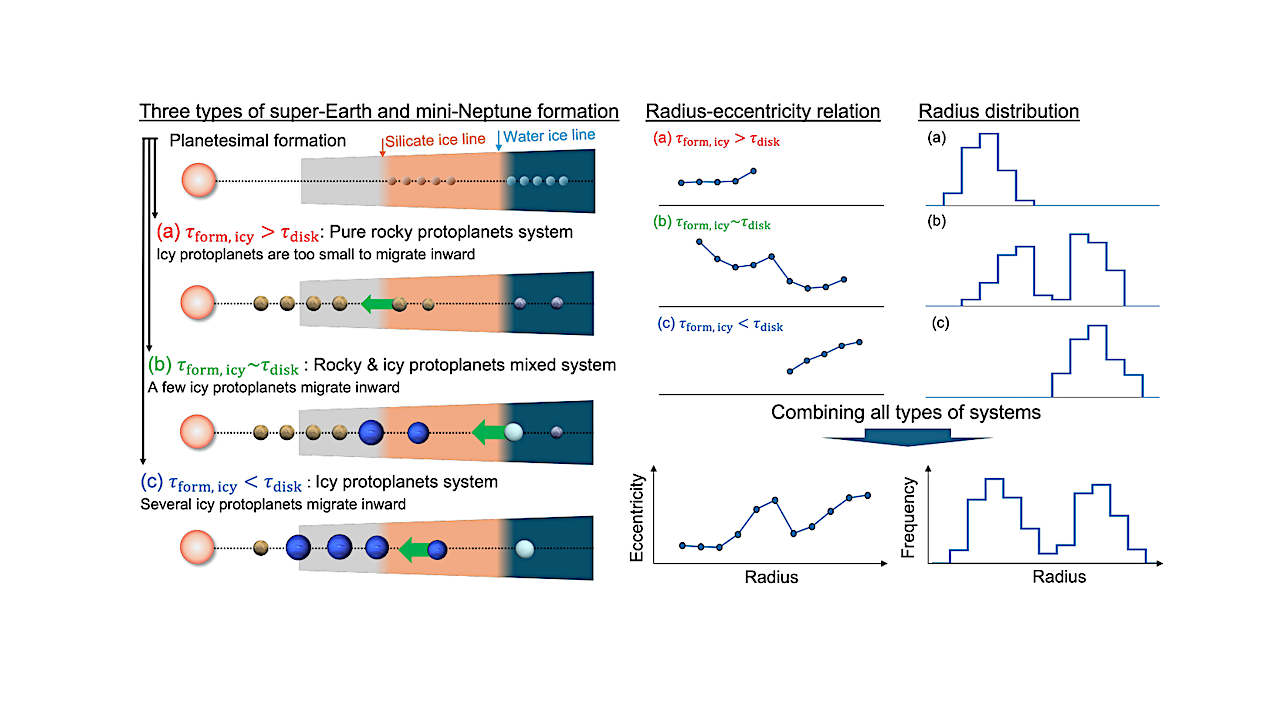
The dearth of sub-Neptunes around mid-to-late M dwarfs is consistent with predictions from water-rich pebble accretion models that predict a fading Radius Valley with decreasing stellar mass.
Our results support the emerging idea that the sub-Neptune population around M dwarfs is composed of water-rich worlds. We find no hot Jupiters in our survey and set an upper limit of 0.012 hot Jupiters per mid-to-late M dwarf within 10 days.
Erik Gillis, Ryan Cloutier, Emily Pass
Comments: Submitted to AAS Journals February 26 2026, 25 pages, 17 Figures, 8 Tables
Subjects: Earth and Planetary Astrophysics (astro-ph.EP)
Cite as: arXiv:2602.23364 [astro-ph.EP] (or arXiv:2602.23364v1 [astro-ph.EP] for this version)
https://doi.org/10.48550/arXiv.2602.23364
Focus to learn more
Submission history
From: Erik Gillis Mr
[v1] Thu, 26 Feb 2026 18:59:48 UTC (20,029 KB)
https://arxiv.org/abs/2602.23364
Astrobiology,











Related Posts

Stay Informed With the Latest & Most Important News





Advertisement
-
 01Two Black Holes Observed Circling Each Other for the First Time
 -
 02From Polymerization-Enabled Folding and Assembly to Chemical Evolution: Key Processes for Emergence of Functional Polymers in the Origin of Life
 -
 03Astronomy 101: From the Sun and Moon to Wormholes and Warp Drive, Key Theories, Discoveries, and Facts about the Universe (The Adams 101 Series)
 -
 04True Anomaly hires former York Space executive as chief operating officer
 -
 05Φsat-2 begins science phase for AI Earth images
 -
 06Hurricane forecasters are losing 3 key satellites ahead of peak storm season − a meteorologist explains why it matters
 -
 07Binary star systems are complex astronomical objects − a new AI approach could pin down their properties quickly