
Now Reading: Space Force modernization push runs into acquisition workforce shortfall
-
01
Space Force modernization push runs into acquisition workforce shortfall


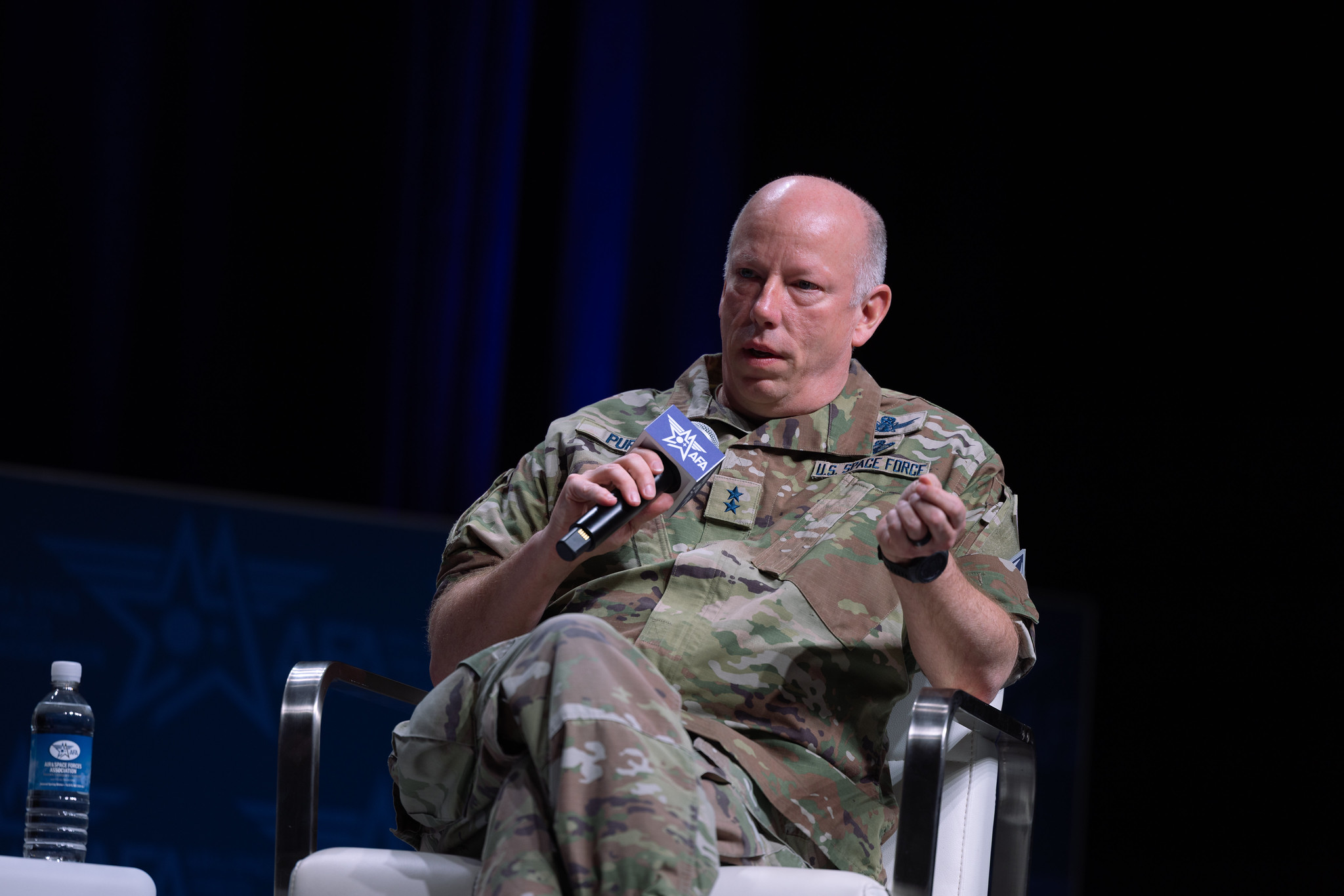

WASHINGTON — The Space Force’s push to accelerate procurement of new systems is running up against a basic constraint: not enough contracting officers and financial managers to execute the work.
Senior leaders and industry executives speaking last week at the Air & Space Forces Association’s Warfare Symposium described a procurement system under strain. The Pentagon has pressed the services to move faster, leaning more heavily on Other Transaction Authorities, commercial-style buying models, iterative contracting and streamlined source selections. Those tools are intended to speed awards and tap nontraditional suppliers. They also add complexity.
Maj. Gen. Stephen Purdy, senior adviser to the secretary of the Air Force for space acquisitions, said the service needs procurement professionals not just to manage its current portfolio but also implement more intricate contracting approaches.
“We have got to deliver integrated warfighting capabilities,” Purdy said.
This means a shift in emphasis from procuring individual hardware platforms to fielding integrated systems designed to transition directly into operations. Rather than awarding contracts for discrete satellites or ground systems, the Space Force is increasingly defining requirements around effects, such as persistent global missile tracking. That approach requires aligning multiple programs, vendors and domains into a coherent capability.
For example, satellites, ground infrastructure, user terminals, data links, software, cyber protection and command-and-control need to function as a unified combat capability.
Purdy said this demands a different skill set from acquisition professionals. “Your job is to deliver integrated war fighting capability. It’s not to deliver a box,” he said, adding that the traditional focus on cost, schedule and contract performance no longer captures the full scope of the mission.
To address that gap, said Purdy, the Space Systems Command has created a new training program tailored to those priorities. Secretary of the Air Force Troy Meink said at the symposium that expanding and properly training the acquisition workforce has become a top priority.
But hiring and training take time, and several career fields are already under acute strain.
Purdy singled out the so-called PK community, responsible for contracting policy, guidance and oversight, including planning solicitations, negotiating terms and managing compliance. He described shortages there as a government-wide issue. Financial management specialists, known as the FM community, are similarly stretched. “We can’t get any of our work done without finance,” he said.
Industry execs: workforce reductions are visible
Kevin Czinger, founder and executive chairman of digital manufacturing firm Divergent, noted that the military has lost hundreds of contracting officers across the services. At a time when the U.S. risks being outpaced by China in technology development, he said, contracting “needs to be enormously sped up.”
Chris Long, deputy general manager for space, cyber and intelligence at General Dynamics Mission Systems, said the loss of contracting officers in the Air Force, Space Force and intelligence community has made dealings with the government “a little bit more complicated” for contractors.
The strain follows workforce reductions tied to Department of Government Efficiency initiatives and voluntary retirement programs rolled out in early 2025. In May, Chief of Space Operations Gen. Chance Saltzman told lawmakers the service had lost nearly 14% of its civilian workforce, a cut he described as having an “outsized impact” because the Space Force relies heavily on civilian expertise in acquisition and contracting. He said the service would end the year with roughly 1,000 fewer civilian personnel than planned and warned he was concerned about replacing that expertise as mission demands grow.
Todd Harrison, a senior fellow at the American Enterprise Institute, said in recent remarks to industry analysts that the Space Force is “flush with funding” for space programs. The constraint, he said, is execution. Contracting officers are the ones who “get the money moving and the programs flowing,” he said. Adding funds or starting new programs without expanding the acquisition workforce could deepen the bottleneck.










Related Posts

Stay Informed With the Latest & Most Important News
Previous Post
Next Post






Advertisement
-
 01Two Black Holes Observed Circling Each Other for the First Time
 -
 02From Polymerization-Enabled Folding and Assembly to Chemical Evolution: Key Processes for Emergence of Functional Polymers in the Origin of Life
 -
 03Astronomy 101: From the Sun and Moon to Wormholes and Warp Drive, Key Theories, Discoveries, and Facts about the Universe (The Adams 101 Series)
 -
 04True Anomaly hires former York Space executive as chief operating officer
 -
 05Φsat-2 begins science phase for AI Earth images
 -
 06Hurricane forecasters are losing 3 key satellites ahead of peak storm season − a meteorologist explains why it matters
 -
 07Binary star systems are complex astronomical objects − a new AI approach could pin down their properties quickly