
Now Reading: General Galactic aims to become “the galaxy’s energy and logistics company”
-
01
General Galactic aims to become “the galaxy’s energy and logistics company”



SAN FRANCISCO – Southern California startup General Galactic plans to launch a 500-kilogram satellite later this year to demonstrate a novel multimode propulsion system.
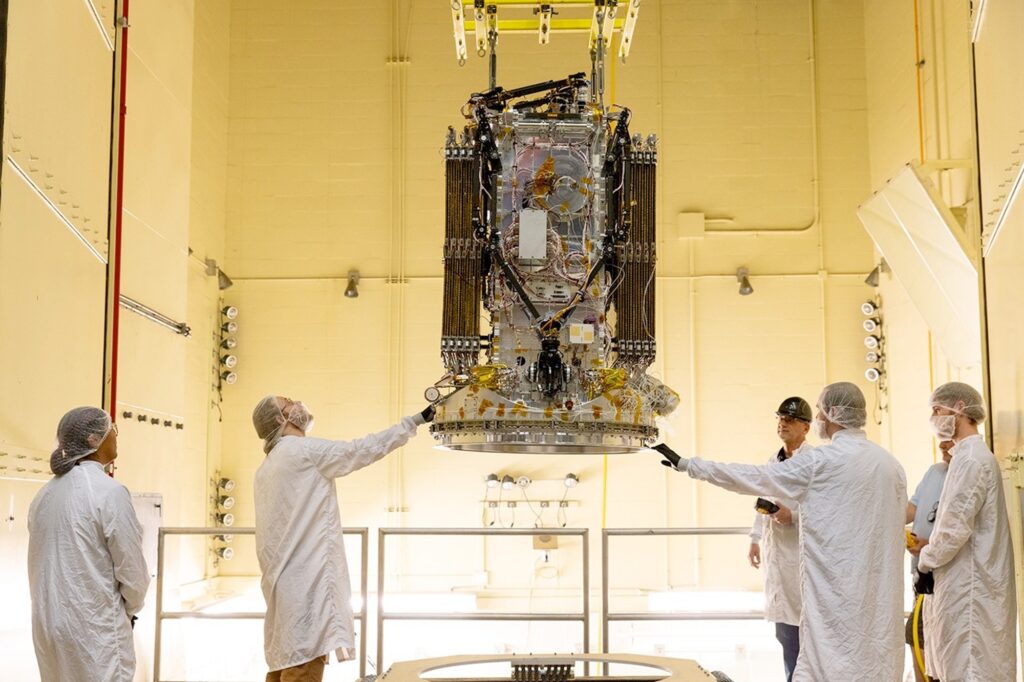
When the Trinity mission travels to low-Earth orbit on the SpaceX Transporter-18 rideshare, no earlier than October, General Galactic will test its Genesis platform, which pairs chemical and electric engines.
“We’re not a propulsion company in the sense of trying to sell propulsion systems, but our propulsion technology is going to be an enabler for a wide range of missions over the next few years,” General Galactic CEO Halen Mattison told SpaceNews. “It’s entirely based around water and water electrolysis and it’s significantly more efficient than a lot of the other options on the market.”
Mattison, a former SpaceX engineer, and Luke Neise, a former Varda Space Industries engineer, founded General Galactic in El Segundo, California, in 2023 with a grand vision.
“We want to be a large operator in the space domain that also effectively acts like the galaxy’s energy and logistics company,” Mattison said. “The same electrolyzer technology that we’re proving out for the first time with Trinity will form the building blocks of a propellant factory that we want to deploy on the moon and eventually on Mars to enable refueling operations, not just for us but for launch companies and others that want to operate in that domain.”

Rapid Maneuverability
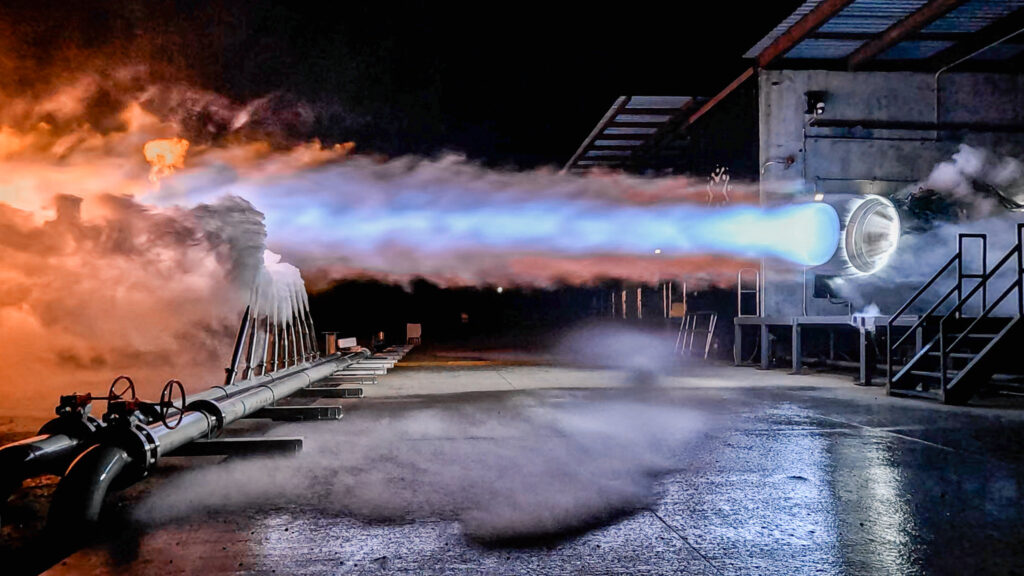
To date, General Galactic has raised about $10 million dollars to develop the water-based propulsion system that is scheduled to launch in October on a satellite provided by an unnamed partner. The Genesis platform is designed to improve satellite maneuverability with a chemical engine for quick maneuvers and a Hall thruster for longer-duration burns.
“It will be the most agile and most capable spacecraft architecture that has been fielded,” Mattison said. “That means that we can support what Space Force calls sustained maneuver and rapid maneuverability.”
Through Trinity and follow-on missions, General Galactic intends to demonstrate maneuverability in ways that will attract the attention of professional and amateur satellite trackers.
“We will perform maneuvers and do operations in a way that makes a difference from a business-development standpoint but also is something that observers and adversaries could take notice of,” Mattison said. “Virtually every space object and launch is tracked. There’s a huge race going on to make more maneuverable and more capable spacecraft.”
Cis-Lunar Space and Beyond
General Galactic is meeting with commercial, civil and military customers ahead of the Trinity launch. Beyond Trinity, General Galactic plans to send satellites to medium-Earth and geosynchronous orbit, “cis-lunar space and ideally beyond,” Mattison said. “We want to make sure that we’re building a platform that can support all of it.”
Water electrolysis propulsion systems have been spaceflight tested. NASA’s four satellite Polarimeter to Unify the Corona and Heliosphere (PUNCH) mission, launched in 2025, is equipped with thrusters that split water into hydrogen and oxygen through electrolysis. And Tethers Unlimited demonstrated a water electrolysis thruster called Hydros-C on a NASA Pathfinder Technology Demonstrator cubesat in 2021.
Genesis will provide “higher specific impulse” than its predecessors, Mattison said, and it’s designed for ease of manufacturing.
“We’re designing our electrolyzer entirely in-house to be able to support a higher production capacity,” Mattison said. “We are doing things that are necessary to scale this to something that’s a lot more enabling for the huge demand in missions that we’re seeing.”
Long-Term Potential
General Galactic engineers opted for water-fueled thrusters because of their current and long-term potential.
“In the near term, we’re offering a game-changing ability to move things in space,” Mattison said. “As soon as you have some ability to procure that water outside of Earth’s gravity, you have a new baseline for how human activities take place off the Earth.
Eventually, the water for Genesis engines could come from in situ resources like lunar ice.










Related Posts
Stay Informed With the Latest & Most Important News
Previous Post
Next Post



Advertisement
-
 01Two Black Holes Observed Circling Each Other for the First Time
 -
 02From Polymerization-Enabled Folding and Assembly to Chemical Evolution: Key Processes for Emergence of Functional Polymers in the Origin of Life
 -
 03Astronomy 101: From the Sun and Moon to Wormholes and Warp Drive, Key Theories, Discoveries, and Facts about the Universe (The Adams 101 Series)
 -
 04True Anomaly hires former York Space executive as chief operating officer
 -
 05Φsat-2 begins science phase for AI Earth images
 -
 06Hurricane forecasters are losing 3 key satellites ahead of peak storm season − a meteorologist explains why it matters
 -
 07Binary star systems are complex astronomical objects − a new AI approach could pin down their properties quickly