
Now Reading: Rocket Lab announces large launch contract and plans to acquire space robotics company
-
01
Rocket Lab announces large launch contract and plans to acquire space robotics company

Rocket Lab announces large launch contract and plans to acquire space robotics company

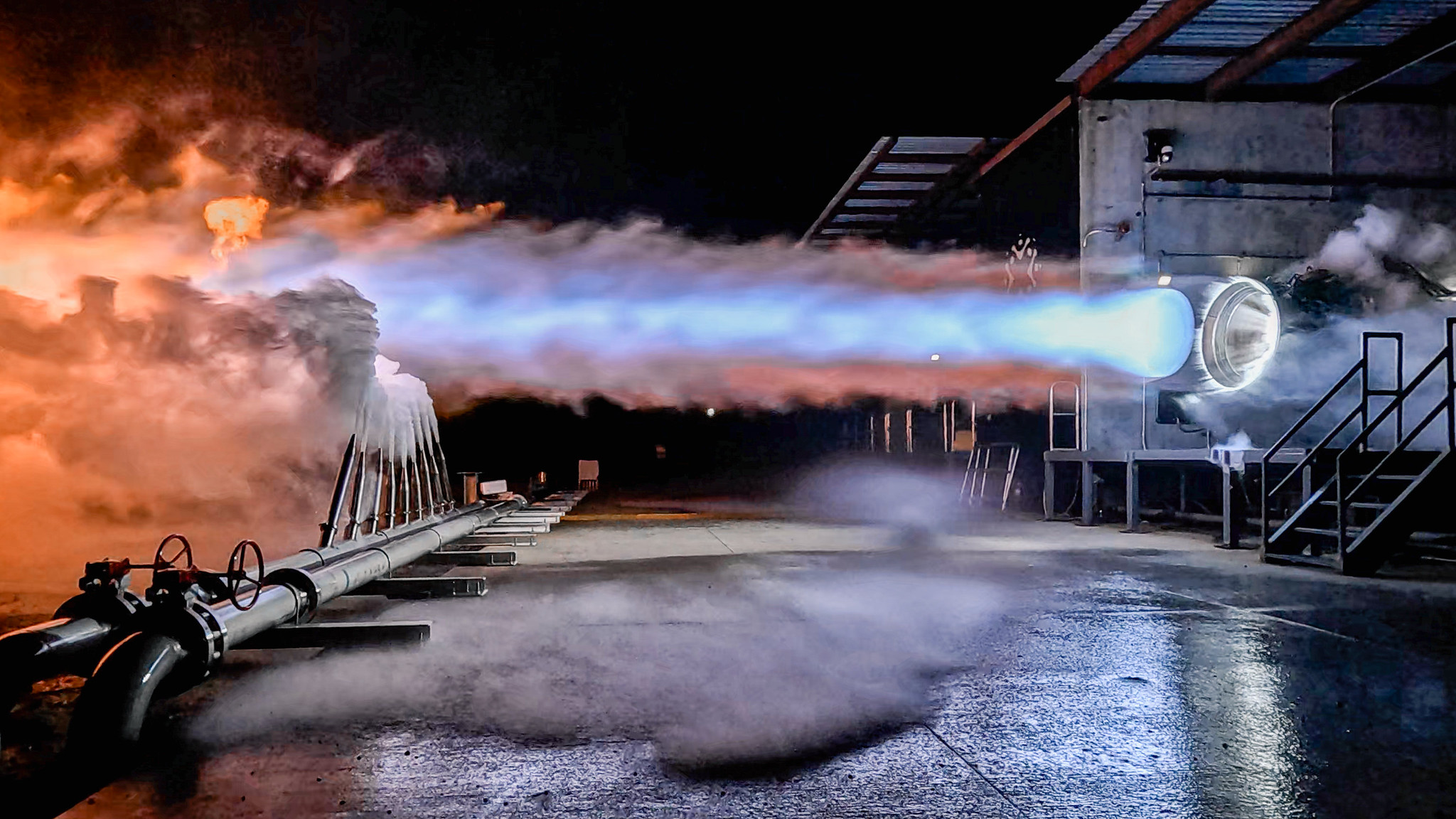

WASHINGTON — Rocket Lab announced May 7 the largest launch contract in the company’s history as it also moves to acquire a space robotics company.
As part of its first-quarter earnings announcement, Rocket Lab said it signed a contract with a confidential customer for five launches of its Neutron medium-lift rocket and Electron launches. Those launches are scheduled for 2026 to 2029.
The company did not disclose terms of the contract other than to say that the pricing of the launches “aligns with Rocket Lab’s average selling price” for the vehicles.
In an earnings call, Peter Beck, Rocket Lab’s chief executive, said the contract value exceeds the company’s previous record, a $190 million contract for 20 launches of Electron’s suborbital variant, HASTE, announced in March.
“It speaks volumes to the strong and growing demand for all of our launch capabilities, and this booking means Neutron’s manifest is filling up fast right through the end of the decade,” he said.
Rocket Lab was originally reticent to sell Neutron launches before the rocket’s first flight, arguing that such contracts usually involved heavily discounted pricing until a vehicle was proven. However, by late 2024 the company had started selling Neutron launches, citing strong demand that allowed it to make deals without cutting prices.
That is true with this latest contract. “I hope that by now you know that my stance is not discounting flights just to fill up a manifest, so I can confirm that pricing for these Neutron and Electron launches is very much in family with their commercial rates,” Beck said.
Beck said in the call that Rocket Lab is holding to a schedule for the first launch of the rocket in the fourth quarter of this year. The company pushed back the launch from early this year after a tank for the rocket’s first stage ruptured during testing in January, prompting design changes.
“The team has made tremendous strides on the stage one tank design refinements and have improved both the tank strength margins and manufacturability, and give us confidence in the structural performance,” he said.
While the company is maintaining a planned fourth-quarter launch of Neutron, he acknowledged that is an “aggressive schedule” and, when asked, declined to say whether the company was looking to launch early or late that quarter.
“I don’t think we have enough visibility to nail it down to a couple of weeks in a quarter at this point in time,” he said. He added the company still plans a gradual expansion of Neutron’s launch rate, with three launches in 2027 and five in 2028.
Motiv Space Systems acquisition
Rocket Lab also announced May 7 that it signed an agreement to acquire Motiv Space Systems, a California company that specializes in space robotics and mechanisms, for an undisclosed sum. Motiv will be rebranded as Rocket Lab Robotics once the deal closes, which is expected to occur this quarter.
Beck noted that while Motiv is known for developing systems like the robotic arm for the Perseverance Mars rover, it also gives Rocket Lab the ability to produce components like solar array drive assemblies and antenna gimbals in-house, part of the company’s efforts to vertically integrate the production of satellites.
He added that the Motiv deal “closes one of the few subsystems we currently buy externally” in the form of solar array drives. “It does a number of things for us.”
Another example of that effort was the company’s announcement of its first electric propulsion system, Gauss, in April. The company developed Gauss to meet the needs for satellites it is producing but is seeing demand from other customers as well.
“We’ve been inundated with inquiries from programs in need of hundreds of units each, and we’re ready to break the bottleneck on electric propulsion,” Beck said. “Rocket Lab is recognized as a world leader in propulsion, so an organic electric propulsion solution is a natural progression for us.”
He noted that the capabilities of the Motiv acquisition could also aid some of Rocket Lab’s proposals for Mars missions. The company has been actively lobbying for a Mars communications orbiter mission NASA plans to soon request proposals for and has advocated for a commercial approach for returning samples from Mars.
“This acquisition positions us to play a critical role in future lunar and planetary exploration missions, such as future commercial Mars sample return missions,” he said.
However, he played down potential roles in NASA’s revised Artemis lunar exploration efforts, with the agency focusing on a lunar base and a much higher cadence of lander missions.
“For the lunar stuff, I think we prefer to be the picks and shovels behind those missions, rather than headline those missions,” he said. He said past lunar programs have been “wobbly” with changes in direction, citing the planned cancellation of the lunar Gateway as part of those revised plans.
“I just don’t want to get whipsawed and have those big contracts in the mix getting whipsawed backwards and forwards,” he said. “We much prefer to play a quieter role.”










Related Posts


Stay Informed With the Latest & Most Important News
Previous Post
Next Post





Advertisement
-
 01Two Black Holes Observed Circling Each Other for the First Time
 -
 02From Polymerization-Enabled Folding and Assembly to Chemical Evolution: Key Processes for Emergence of Functional Polymers in the Origin of Life
 -
 03Astronomy 101: From the Sun and Moon to Wormholes and Warp Drive, Key Theories, Discoveries, and Facts about the Universe (The Adams 101 Series)
 -
 04True Anomaly hires former York Space executive as chief operating officer
 -
 05Φsat-2 begins science phase for AI Earth images
 -
 06Hurricane forecasters are losing 3 key satellites ahead of peak storm season − a meteorologist explains why it matters
 -
 07Binary star systems are complex astronomical objects − a new AI approach could pin down their properties quickly