
Now Reading: Predicting Gaia Astrometry’s Ability To Constrain The Populations Of Circumbinary Planets
-
01
Predicting Gaia Astrometry’s Ability To Constrain The Populations Of Circumbinary Planets

Predicting Gaia Astrometry’s Ability To Constrain The Populations Of Circumbinary Planets

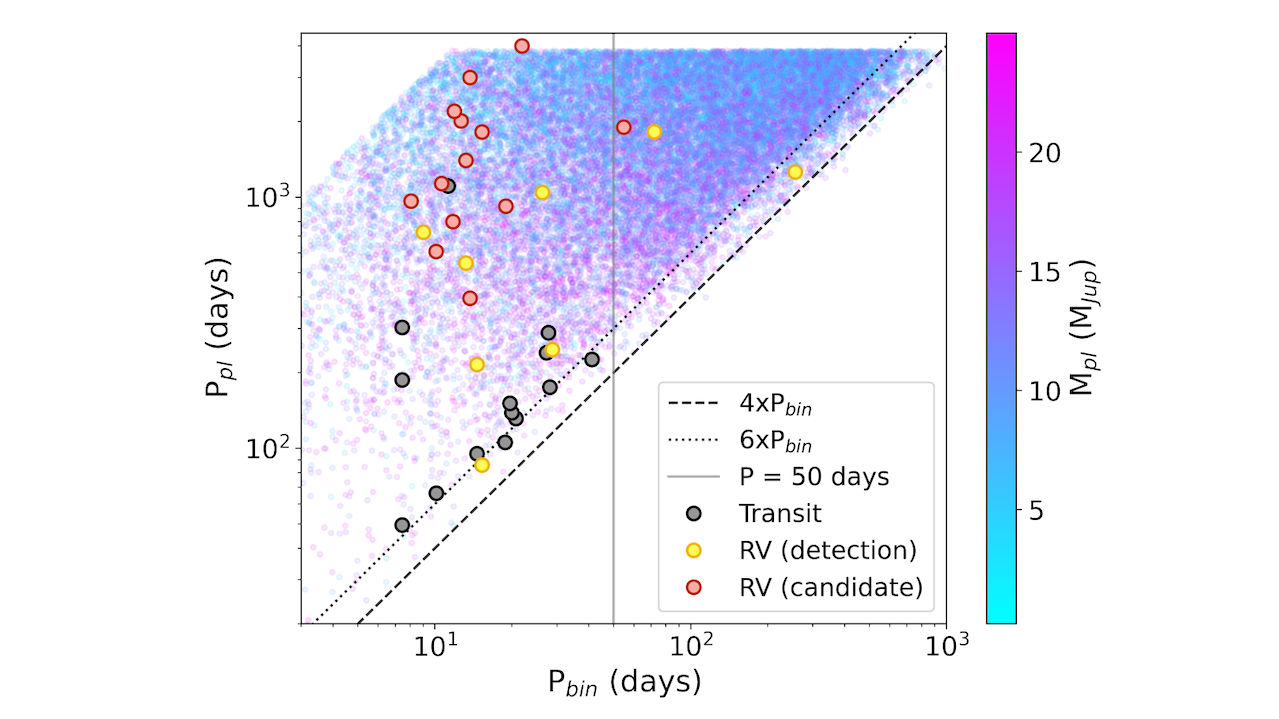
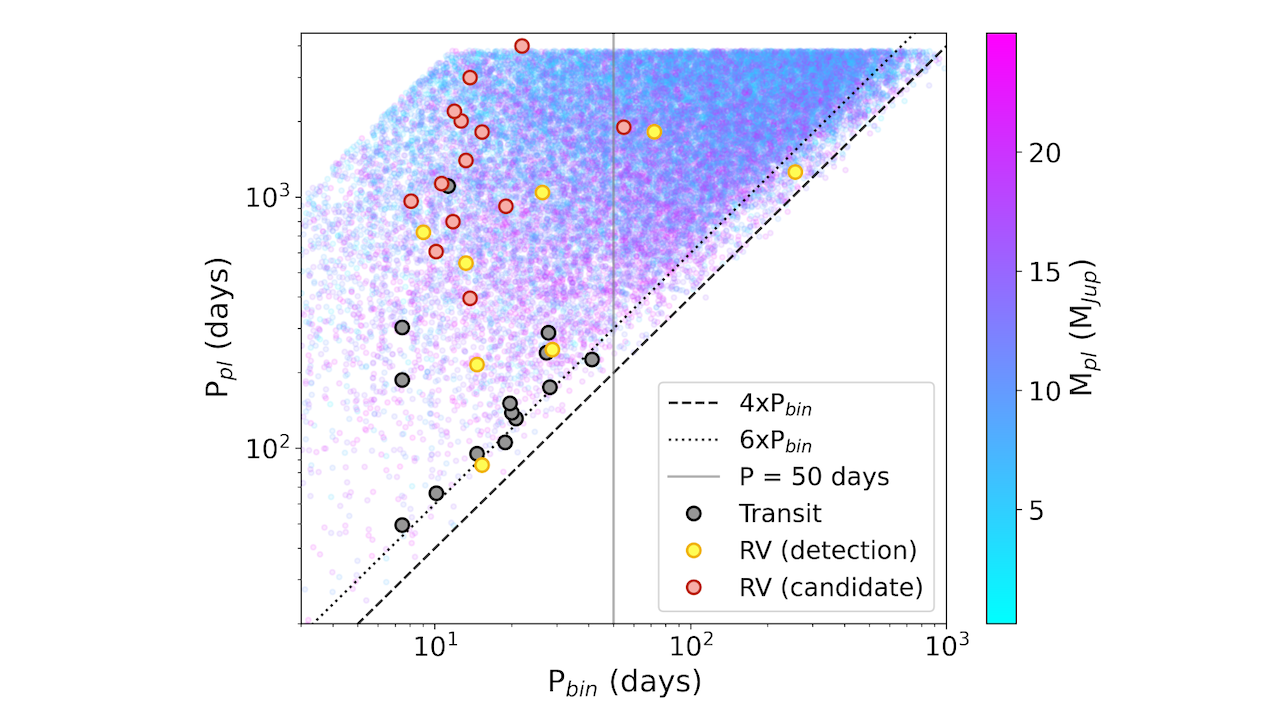
Binary and Planet periods for the detected planets in the synthetic yield of Setup 1 (coloured by planet mass) alongside known circumbinary planets detected by transit or radial velocities. Dashed and dotted lines show the approximate stability threshold at 4 × 𝑃bin and approximate location of the “pile-up” from the transiting systems at 6 × 𝑃bin. The vertical lines shows the 50 day marker that we use to distinguish the type of binaries most studied by the transit and radial velocity samples.– astro-ph.EP
The coming data releases of Gaia are expected to result in an upheaval of exoplanet science, in particular for long period giant planets (0.2MJ≤M≤25MJ). One class of exoplanets which Gaia will help investigate is circumbinary planets.
tions for the Gaia sensitivity, we investigate the impact Gaia will have on our understanding of circumbinary planets. We compare our results to a pre-launch estimate, the main differences arising from a better understanding of the circumbinary planet population, which result in a lower expected yield than previously predicted, though still significant compared to the known population.
We make a rough yield estimate, with conservative detection criteria and parameter-space cuts, predicting in the 10s – 100s of detections in Gaia DR4. More importantly, we show how the yield estimate varies strongly with different assumptions on the injected circumbinary population, showing Gaia’s sensitivity to the mass and orbital period distribution of circumbinary planets.
We find that Gaia circumbinary exoplanet detections will be biased towards planets closer to the instability zone surrounding the binary, due to the larger number of binaries on wider orbits and the limited timespan of Gaia.
We also assess the impact Gaia will have on known circumbinary systems, one being that it may resolve the question of reliability of the claimed planets orbiting post-common-envelope binaries, with Gaia DR5 being sensitive to between 3 and 11 out of 32 such planet candidates.
Thomas A. Baycroft, Amaury H.M.J Triaud, Johannes Sahlmann
Comments: 17 pages, 14 figures, 5 tables, accepted for publication in MNRAS
Subjects: Earth and Planetary Astrophysics (astro-ph.EP); Instrumentation and Methods for Astrophysics (astro-ph.IM); Solar and Stellar Astrophysics (astro-ph.SR)
Cite as: arXiv:2603.02198 [astro-ph.EP] (or arXiv:2603.02198v1 [astro-ph.EP] for this version)
https://doi.org/10.48550/arXiv.2603.02198
Focus to learn more
Submission history
From: Thomas Baycroft
[v1] Mon, 2 Mar 2026 18:55:32 UTC (9,516 KB)
https://arxiv.org/abs/2603.02198
Astrobiology,










Related Posts

Stay Informed With the Latest & Most Important News
Previous Post
Next Post




Advertisement
-
 01Two Black Holes Observed Circling Each Other for the First Time
 -
 02From Polymerization-Enabled Folding and Assembly to Chemical Evolution: Key Processes for Emergence of Functional Polymers in the Origin of Life
 -
 03Astronomy 101: From the Sun and Moon to Wormholes and Warp Drive, Key Theories, Discoveries, and Facts about the Universe (The Adams 101 Series)
 -
 04True Anomaly hires former York Space executive as chief operating officer
 -
 05Φsat-2 begins science phase for AI Earth images
 -
 06Hurricane forecasters are losing 3 key satellites ahead of peak storm season − a meteorologist explains why it matters
 -
 07Binary star systems are complex astronomical objects − a new AI approach could pin down their properties quickly