
Now Reading: The Observation Of Earth-like Exoplanets With Ground-based Telescopes And A Shared Orbiting Starshade
-
01
The Observation Of Earth-like Exoplanets With Ground-based Telescopes And A Shared Orbiting Starshade

The Observation Of Earth-like Exoplanets With Ground-based Telescopes And A Shared Orbiting Starshade

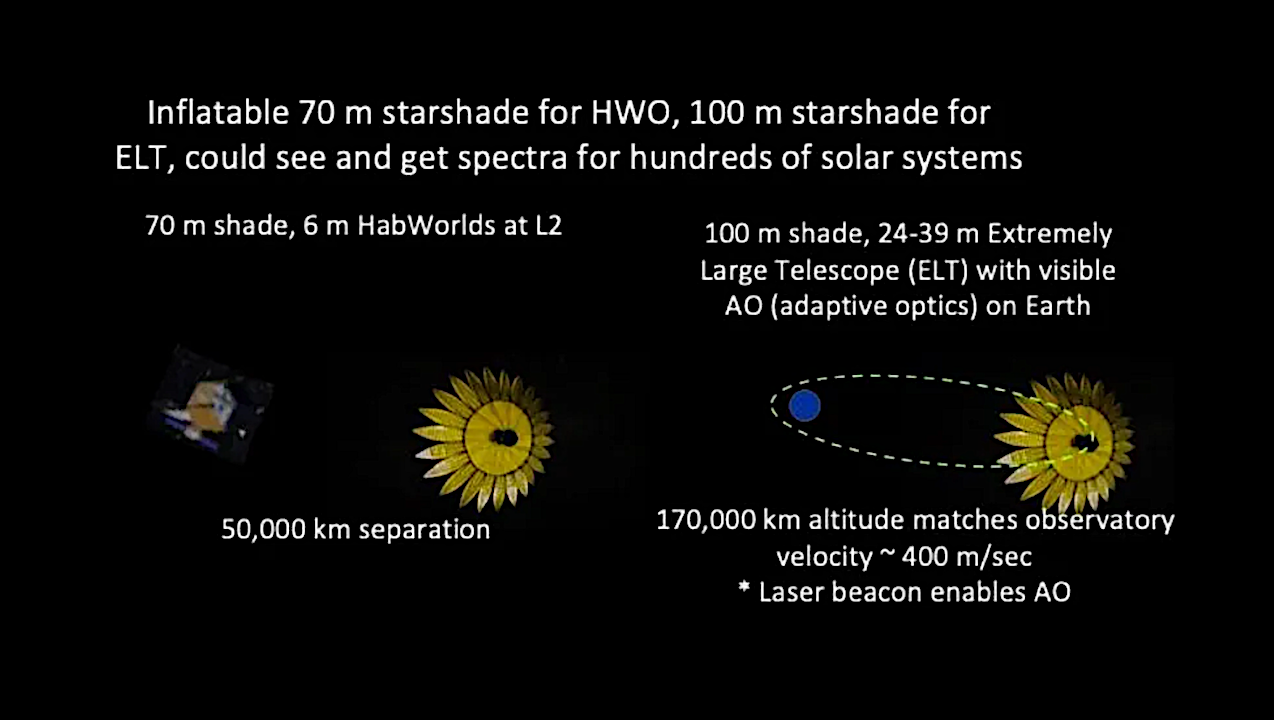

Imaging Earth-like exoplanets around Sun-like stars from the ground is challenging and requires substantial advances in techniques. This Perspective presents and provides the predicted performance of a hybrid space–ground approach that combines a large ground-based telescope, such as the Extremely Large Telescope (ELT), the Thirty Meter Telescope (TMT) or the Giant Magellan Telescope (GMT), with a shared orbiting starshade in space.
This integration aims to image Earth-like exoplanets around Sun-like stars with deep-contrast imaging and an unmatched angular resolution. The starshade forms a deep shadow above Earth’s atmosphere.
However, the presence of atmospheric turbulence requires compensation with adaptive optics to sharpen the images to the diffraction limit. In this Perspective, we present the expected image plane contrast of the three large telescopes operating with a shared orbiting 99-m-diameter starshade, with a detailed analysis focusing on the ELT to measure the reflected light spectra of a Solar System analogue, from Venus to Saturn, orbiting a Sun-like star.
Our analysis utilizes a comprehensive and realistic model of the entire system, incorporating the latest ELT adaptive optics models to mitigate the effects of Earth’s atmospheric turbulence under moderate weather conditions. Our studies show that the ELT adaptive optics effectively corrects for these effects, demonstrating minimal impact on sensitivity with different Strehl ratios and throughout the full 300–1,000-nm bandpass. This includes a comparison with current and future ground- and space-based observatories.
We simulate the reflected light images and spectra through Earth’s atmosphere. We show observation of the major molecular signatures for life, such as oxygen and water on an exo-Earth, leading to a promising avenue for future hybrid space–ground observatories to revolutionize the search for Earth-like planets. Near-term advancements for the implementation of this concept towards deployment are also discussed.
Astrobiology, Astronomy,











Related Posts
Stay Informed With the Latest & Most Important News
Advertisement
-
 01Two Black Holes Observed Circling Each Other for the First Time
 -
 02From Polymerization-Enabled Folding and Assembly to Chemical Evolution: Key Processes for Emergence of Functional Polymers in the Origin of Life
 -
 03Astronomy 101: From the Sun and Moon to Wormholes and Warp Drive, Key Theories, Discoveries, and Facts about the Universe (The Adams 101 Series)
 -
 04True Anomaly hires former York Space executive as chief operating officer
 -
 05Φsat-2 begins science phase for AI Earth images
 -
 06Hurricane forecasters are losing 3 key satellites ahead of peak storm season − a meteorologist explains why it matters
 -
 07Binary star systems are complex astronomical objects − a new AI approach could pin down their properties quickly