
Now Reading: Voyager Technologies invests in Max Space
-
01
Voyager Technologies invests in Max Space


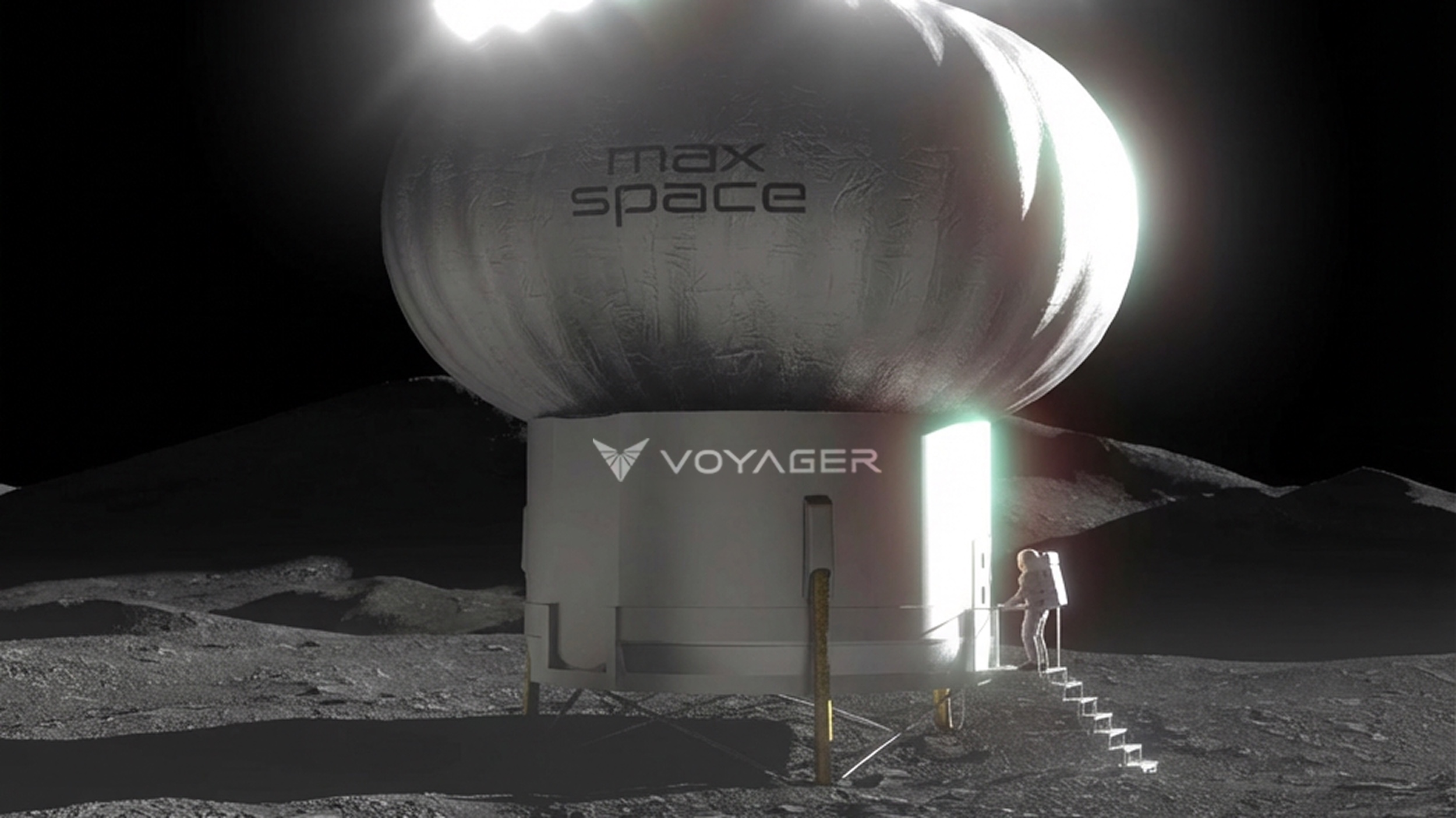

WASHINGTON — Voyager Technologies is investing in Max Space to help accelerate a partnership between the two companies on developing lunar habitats.
Voyager announced March 9 it was making a strategic investment into Max Space, a startup developing expandable modules, to support the work the companies are doing to develop habitats for a future lunar base.
The companies did not disclose the exact size of the investment but Dylan Taylor, chairman and chief executive of Voyager Technologies, said in an interview that it is in the “low eight figures.” He said more details would come in filings the company makes this week as it releases its 2025 financial results.
The investment comes a little more than a month after the companies said they would work together to design lunar habitats using Max Space’s expandable module technology. The companies said then they hoped to support plans for a lunar base included in a White House executive order on space policy in December.
“Max Space’s technologies we think are incredibly relevant to the moon, especially when you combine it with other technologies that we have at Voyager,” Taylor said. “Think of it as an integrated package.”
“The more we’ve been working with Max Space, the more opportunities we see for collaboration,” he said. “It just really gave us the conviction to put capital into Max Space, strengthen our partnership and really accelerate the development that we’re contemplating working on together.”
Saleem Miyan, chief executive of Max Space, said his company was not looking for investment at the time, having recently completed a pre-seed round that brought in more than $10 million. However, he said the discussions with Voyager showed what could be done if they could move faster.
“It was very clear that accelerating our energies and our efforts towards building these types of habitats was, without a doubt, the right way to go,” he said in an interview. “It became evidently clear that we could really step our pace up quite a lot in terms of that energy and that focus.”
Miyan said the funding will allow Max Space to complete a new manufacturing facility in Florida for its modules and begin developing a series of demonstrations of them. “We’re very focused on the priorities of NASA and the administration,” he said, offering inflatable modules for lunar habitats and potentially other infrastructure on or around the moon.
The goal, Taylor said, is “hardware in space as quickly as possible to demonstrate further capability.” He noted the Voyager would combine Max Space’s modules with its own technologies in areas like power and propulsion to develop lunar and other capabilities.
“We’re really focused on these three L’s, as I call them: LEO, lunar and Lagrange,” he said, or low Earth orbit, the moon and deep space. “The Max Space inflatable technology is instrumental in this and can play a role in all three of those domains.”
In LEO, the companies are potentially competitors. Voyager is the lead company on the Starlab Space joint venture developing the Starlab commercial space station, while Max Space announced in December plans to develop Thunderbird, a commercial space station using its expandable module technology.
Taylor said the two companies could work together on commercial stations. “We’re exploring areas of collaboration on that,” he said. “I definitely wouldn’t take that off the table, but it hasn’t been the primary focus as of yet.”
“Neither one of us was blind to the fact that we had a Thunderbird announcement along with Starlab,” Miyan said, noting that his company has talked with Starlab about incorporating expandable modules for habitation or storage.
Taylor said Voyager may make additional strategic investments in companies to support its plans.
“I would anticipate a couple of additional strategic investments over the next 12 to 24 months that would further enhance capability in particular areas,” he said, although that will be secondary to both internal research and development efforts and acquisitions of companies.










Related Posts
Stay Informed With the Latest & Most Important News
Previous Post
Next Post

Advertisement
-
 01Two Black Holes Observed Circling Each Other for the First Time
 -
 02From Polymerization-Enabled Folding and Assembly to Chemical Evolution: Key Processes for Emergence of Functional Polymers in the Origin of Life
 -
 03Astronomy 101: From the Sun and Moon to Wormholes and Warp Drive, Key Theories, Discoveries, and Facts about the Universe (The Adams 101 Series)
 -
 04True Anomaly hires former York Space executive as chief operating officer
 -
 05Φsat-2 begins science phase for AI Earth images
 -
 06Hurricane forecasters are losing 3 key satellites ahead of peak storm season − a meteorologist explains why it matters
 -
 07Binary star systems are complex astronomical objects − a new AI approach could pin down their properties quickly