
Now Reading: Motional Induction in Ganymede’s Ocean
-
01
Motional Induction in Ganymede’s Ocean


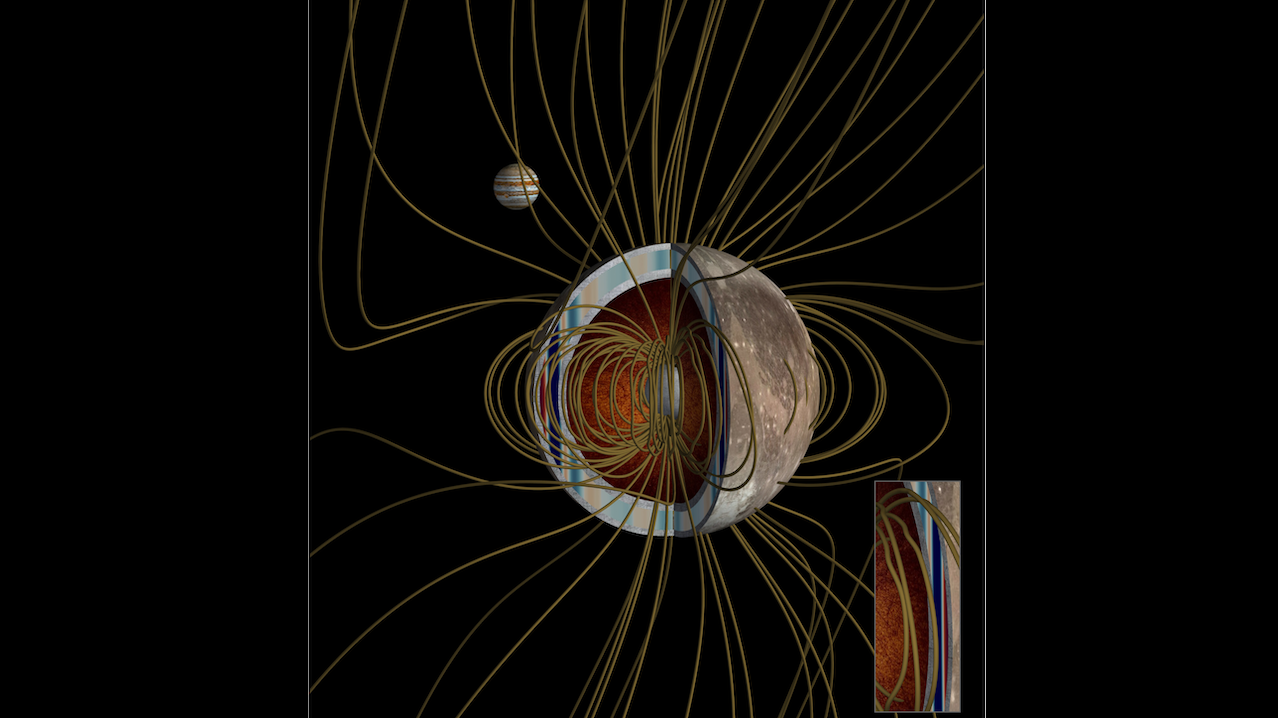
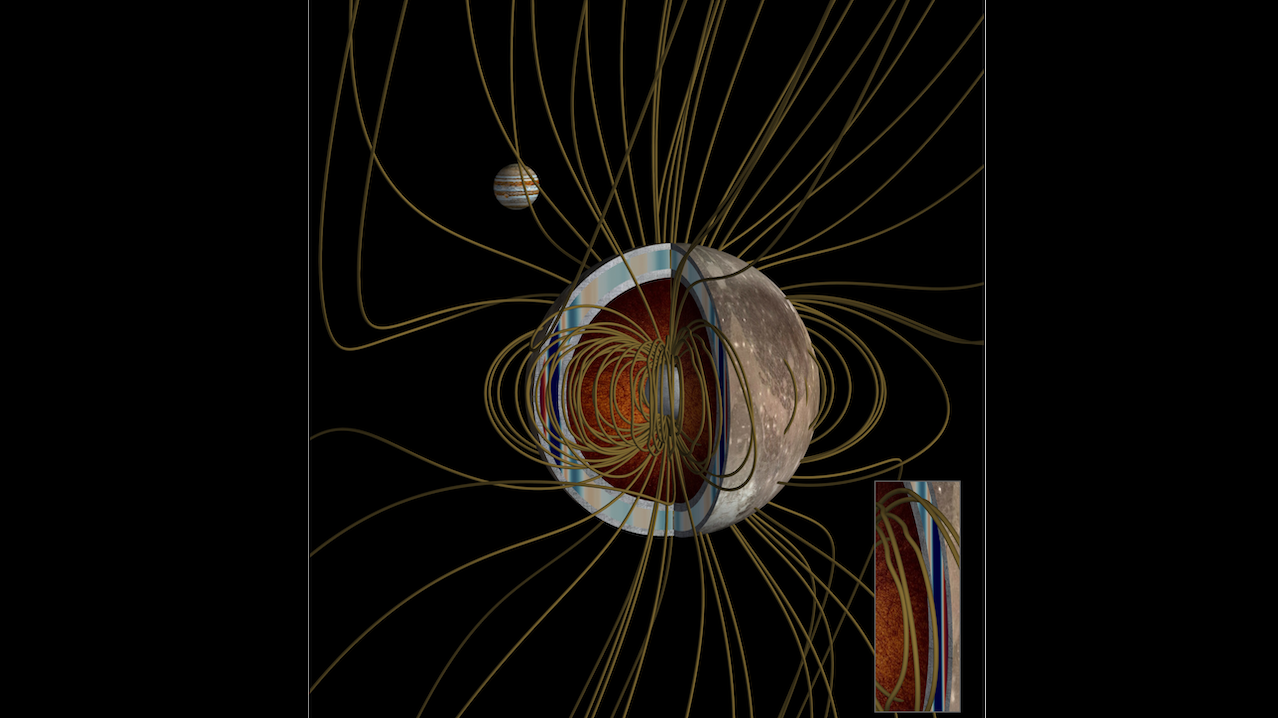
Numerical ocean-induction setup for Ganymede in a deep-ocean scenario with REM = 1.77 . Ganymede’s internal structure is depicted, featuring the ice crust, the deep ocean with its simulated zonal flow, the internal ice layer, the silicate mantle, and the metallic core. Yellow tubes visualize the magnetic field lines. The bottom-right panel shows how magnetic field lines are sheared by the zonal (east–west) jet flow in the ocean (blue/red denote westward/eastward jets, respectively), thereby reflecting the secondary magnetic field induced by such dynamics. — Geophysical Research Letters
We investigate the magnetic signature of oceanic circulation in Ganymede’s subsurface ocean using kinematic induction modeling. Our approach couples zonal jet flows from rotating thermal convection simulations with magnetic field models incorporating Ganymede’s internal dynamo and external contributions from Jupiter.
We solve the induction equation in spherical geometry for deep-ocean (493 km) and shallow-ocean (287 km) scenarios with varying magnetic Reynolds numbers. Ocean flows generate a predominantly toroidal magnetic field through the omega-effect, with a weaker poloidal component pervading beyond the conductive ocean layer.
For some, but not all, induction configurations, analysis of the time-averaged Lowes-Mauersberger spectra reveals that ocean-induced signals dominate at spherical harmonic degrees. Deep ocean scenarios with magnetic Reynolds numbers above unity produce surface magnetic signals up to 9 nT. Our results demonstrate that Ganymede’s intrinsic magnetic field creates favorable conditions for detecting subsurface ocean dynamics, thus emphasizing the need for low-altitude orbits for the Juice probe.
Plain Language Summary
Jupiter’s moon Ganymede harbors a vast subsurface ocean. Understanding its dynamics is key to assessing how its circulation may facilitate the exchange of heat and materials essential for life between the moon’s interior and the overlying ice shell. However, since this ocean is buried under kilometers of ice, direct observation of this circulation appears to be impossible.
Our study shows that Ganymede’s ocean currents might actually reveal themselves through magnetic signals. Ganymede is unique among icy moons because it has its own magnetic field, generated deep in its metallic core. When electrically conducting ocean water flows through this magnetic field, it creates additional magnetic signatures that could be detected by spacecraft magnetometers.
Using computer simulations, we find that strong east-west ocean currents may generate magnetic signals up to 9 nT at Ganymede’s surface. The European Space Agency’s Juice mission, en route to study Jupiter’s moons, should be capable of detecting these signals when it orbits Ganymede, with enhanced sensitivity if low-altitude orbits are performed.
This research suggests that magnetic measurements could provide a welcome glimpse into the hidden dynamics of an extraterrestrial ocean, opening a new window into worlds that might support life.
Motional Induction in Ganymede’s Ocean, Geophysical Research Letters (open access)
Astrobiology,










Related Posts


Stay Informed With the Latest & Most Important News
Previous Post
Next Post



Advertisement
-
 01Two Black Holes Observed Circling Each Other for the First Time
 -
 02From Polymerization-Enabled Folding and Assembly to Chemical Evolution: Key Processes for Emergence of Functional Polymers in the Origin of Life
 -
 03Astronomy 101: From the Sun and Moon to Wormholes and Warp Drive, Key Theories, Discoveries, and Facts about the Universe (The Adams 101 Series)
 -
 04True Anomaly hires former York Space executive as chief operating officer
 -
 05Φsat-2 begins science phase for AI Earth images
 -
 06Hurricane forecasters are losing 3 key satellites ahead of peak storm season − a meteorologist explains why it matters
 -
 07Binary star systems are complex astronomical objects − a new AI approach could pin down their properties quickly