
Now Reading: Researchers Uncover Hidden Genetic World in Antarctic Waters
-
01
Researchers Uncover Hidden Genetic World in Antarctic Waters


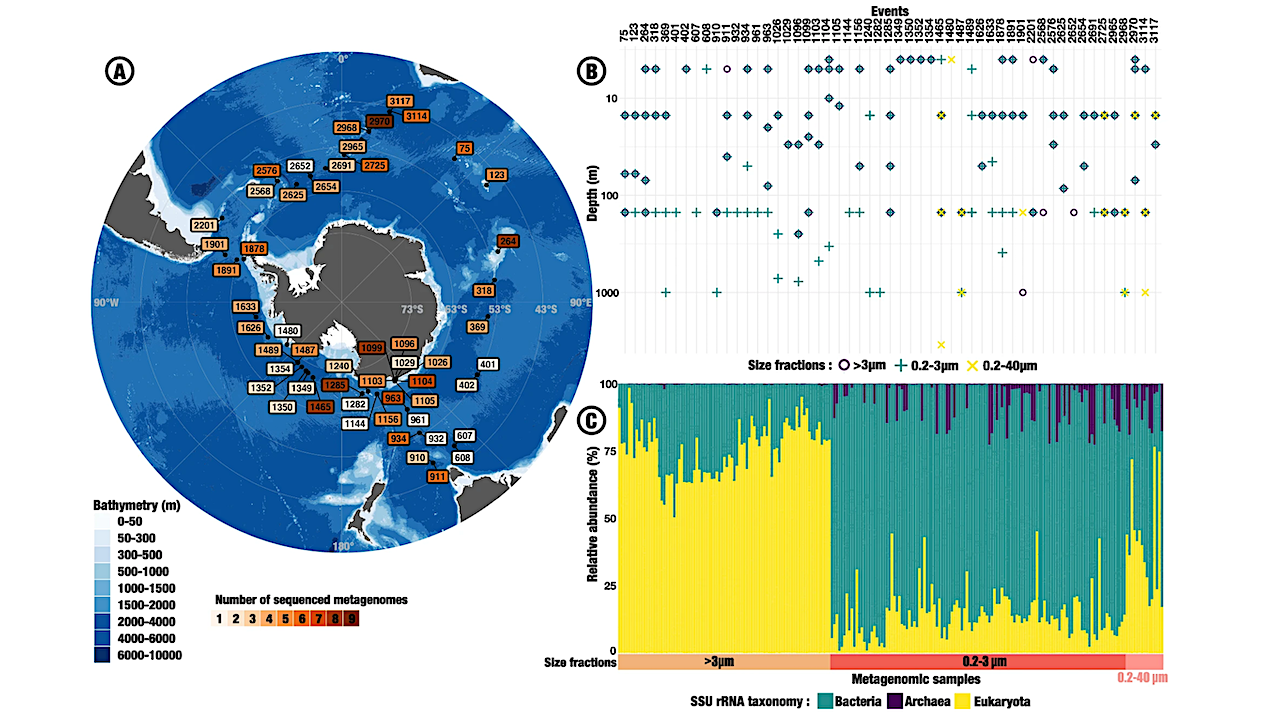
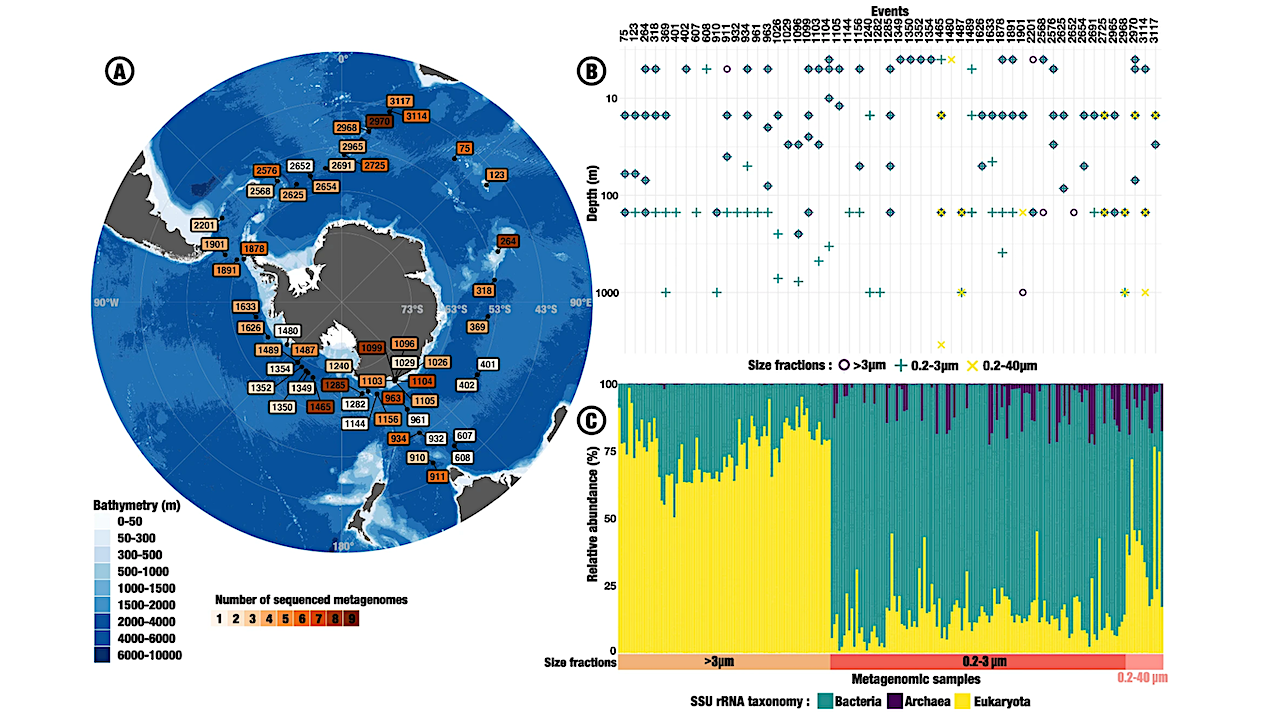
A Map of CTD downcast events on which metagenomics samples were taken, colored according to the number of samples taken on the cast. — Nature Communications
The researchers analyzed DNA from water samples collected throughout the Southern Ocean during a three-month expedition in late 2016 and early 2017. After sequencing the DNA, they cross-referenced their results with data on known genes, called gene catalogs. Next, they divided their samples into groups based on genetic similarities, such as adaptation to cold temperatures.
Remarkably, at least a third of the genes identified are missing from existing marine gene catalogs, underscoring how little we know about microbial life on our planet, according to Cassar.
“When we looked at the databases, a huge portion of these genes just wasn’t there. That’s a sign we’re charting largely uncharacterized genetic territory,” he said.
The analysis also indicated that microbial communities are not evenly distributed in the Southern Ocean. Rather, they exist in distinct microbial ecosystems shaped by ocean circulation. Some live in cold surface water and others in deep waters, for instance.
The next step is to dig deeper into this newfound genetic diversity to ultimately understand how it affects, and is affected by, climate change, according to Cassar.
“Microbes regulate much of the ocean’s chemistry,” he said. “To understand how the Southern Ocean will influence future climate, we need to understand the genes that control those microbial processes.”
Funding: The Antarctic Circumnavigation Expedition was funded by the Swiss Polar Institute and Ferring Pharmaceuticals.
Citation: Faure E, Pommellec,J, Noel C, et al. Water Mass Specific Genes Dominate the Southern Ocean Microbiome. Nature Communications. Published online March 9, 2026. (open access)
Astrobiology,










Related Posts
Stay Informed With the Latest & Most Important News
Previous Post
Next Post

Advertisement
-
 01Two Black Holes Observed Circling Each Other for the First Time
 -
 02From Polymerization-Enabled Folding and Assembly to Chemical Evolution: Key Processes for Emergence of Functional Polymers in the Origin of Life
 -
 03Astronomy 101: From the Sun and Moon to Wormholes and Warp Drive, Key Theories, Discoveries, and Facts about the Universe (The Adams 101 Series)
 -
 04True Anomaly hires former York Space executive as chief operating officer
 -
 05Φsat-2 begins science phase for AI Earth images
 -
 06Hurricane forecasters are losing 3 key satellites ahead of peak storm season − a meteorologist explains why it matters
 -
 07Binary star systems are complex astronomical objects − a new AI approach could pin down their properties quickly