
Now Reading: Mineral False Positives in the Search for Exoplanet Surface Biosignatures
-
01
Mineral False Positives in the Search for Exoplanet Surface Biosignatures


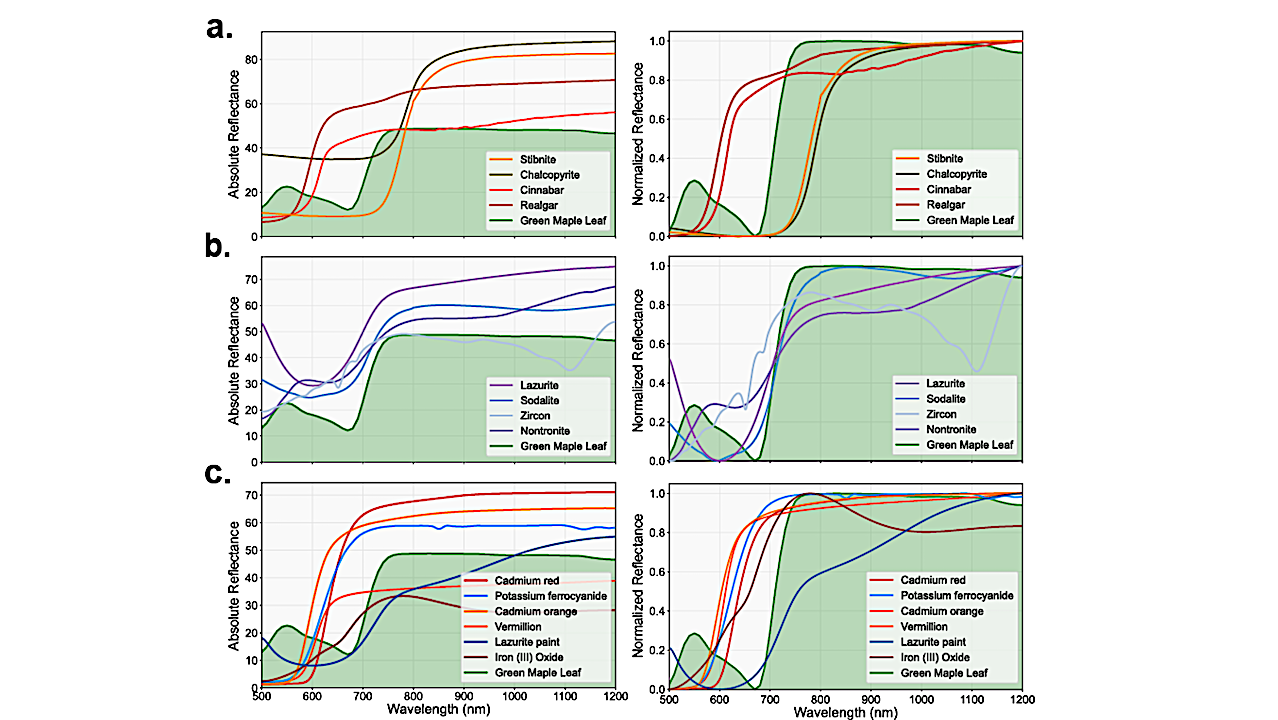

Comparison of (left) absolute and (right) normalized mineral and artificial reflectance spectra with the photosynthetic red edge. Spectra on the right were vectornormalized here to facilitate visualization of spectral features rather than overall reflectance. All spectra were also subjected to Gaussian smoothing with standard deviation 3. (a) sulfide mineral spectra from Table 1 (database source: stibnite, ECOSTRESS | chalcopyrite, ECOSTRESS | cinnabar, USGS | realgar, ECOSTRESS) alongside the green leaf spectrum used to model the VRE/PRE; (b) silicate mineral spectra from Table 1 (database source: lazurite, USGS | sodalite, ECOSTRESS | zircon, ECOSTRESS | nontronite, ECOSTRESS) — astro-ph.EP
In the search for life in the cosmos, biopigments on exoplanet surfaces are a critical target.
Such pigments have been detected in Earth’s spectrum (by the Galileo spacecraft and in Earthshine) via the “vegetation” or “photosynthesis red edge” (VRE or PRE), a sharp, step-like increase in reflectance with increasing wavelength at ~700 nm. Future space telescopes like the Habitable Worlds Observatory (HWO) are designed to obtain disk-integrated spectra of Earth-like exoplanets in the visible-to-near-infrared to identify such features.
However, there has been no systematic analysis of the occurrence of similar reflectance edges among minerals of non-biological origin. Here, we use existing databases of mineral reflectance spectra to explore the risk that minerals may present false positives in the search for biopigments on exoplanets. We find that several sulfide and tectosilicate minerals, as well as the prebiotically important cyanide salt, potassium ferrocyanide, have PRE-like features.
We characterize these features in order to assess how they may be distinguished from biopigments. We conclude that the future evaluation of the biogenicity of PRE-like features in exoplanet reflectance spectra can be informed by the atmospheric context, but may require an assessment of the prior probability of non-biological and biological hypotheses about the surface materials of exoplanets.
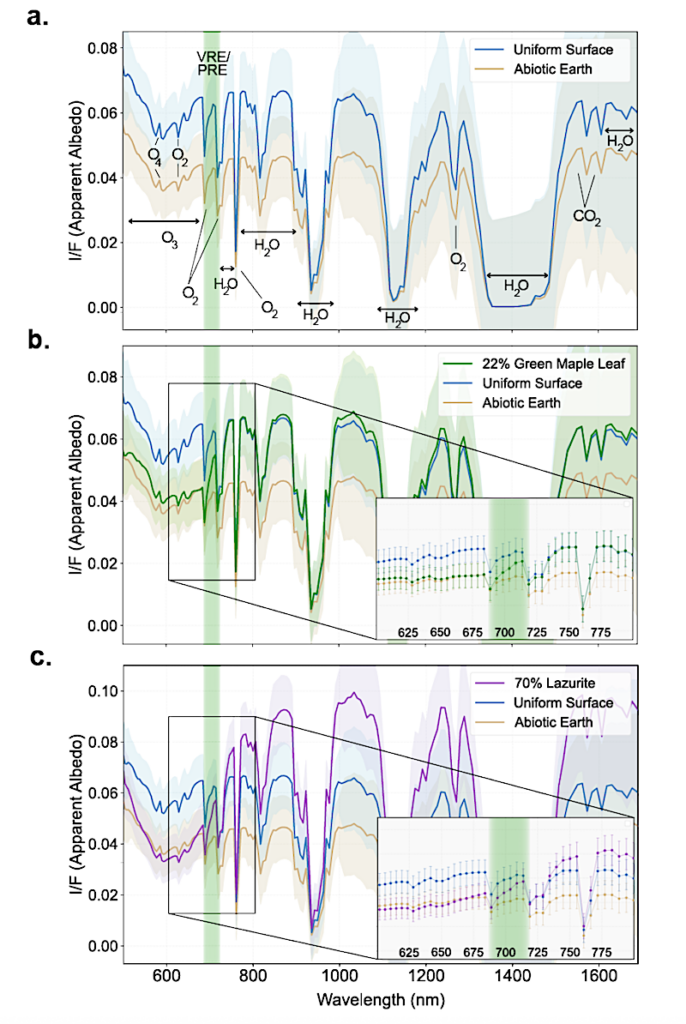
Simulated reflectance spectra (I/F) of alternative Earths. The shaded errors represent telescope noise in an observation simulated with PSG with 8 hours of exposure time (LUVOIR B-VIS instrument). All simulations use modern Earth’s atmosphere with 21% oxygen. (a) Earth with neither vegetation nor VRE/PRE-like mineral edges. The “uniform surface” spectrum was generated using a featureless surface (uniform albedo 0.308), to highlight the atmospheric features. The “Abiotic Earth” spectrum includes oceans, ice, deserts and granitic rock in Earth-like proportions. (b) Earth with a surface comprising 22% green maple leaf, with the remainder being “Abiotic Earth”. (c) Earth with a surface comprising 70% lazurite, with the remainder being “Abiotic Earth”. Atmospheric components responsible for key spectral features are labeled in each panel, sourced from Claudi and Alei (2019). Note the O2 absorption features at ~690 and ~720 nm, bracketing the VRE/PRE. These surfaces are modeled without atmospheres in Supplementary Figure 2. — astro-ph.EP
Mia Belle Parkinson, Lisa Kaltenegger, Beth Biller, Grant Lach, Sean McMahon
Comments: Submitted to Astrobiology, manuscript ID is AST-2025-0217
Subjects: Earth and Planetary Astrophysics (astro-ph.EP)
Cite as: arXiv:2605.10646 [astro-ph.EP] (or arXiv:2605.10646v1 [astro-ph.EP] for this version)
https://doi.org/10.48550/arXiv.2605.10646
Focus to learn more
Submission history
From: Mia Belle Parkinson
[v1] Mon, 11 May 2026 14:33:28 UTC (967 KB)
https://arxiv.org/abs/2605.10646
Astrobiology, exoplanet,










Related Posts
Stay Informed With the Latest & Most Important News
Previous Post
Next Post

Advertisement
-
 01Two Black Holes Observed Circling Each Other for the First Time
 -
 02From Polymerization-Enabled Folding and Assembly to Chemical Evolution: Key Processes for Emergence of Functional Polymers in the Origin of Life
 -
 03Astronomy 101: From the Sun and Moon to Wormholes and Warp Drive, Key Theories, Discoveries, and Facts about the Universe (The Adams 101 Series)
 -
 04True Anomaly hires former York Space executive as chief operating officer
 -
 05Φsat-2 begins science phase for AI Earth images
 -
 06Hurricane forecasters are losing 3 key satellites ahead of peak storm season − a meteorologist explains why it matters
 -
 07Binary star systems are complex astronomical objects − a new AI approach could pin down their properties quickly