
Now Reading: The Key To Unlocking Exoplanet Biosignatures: A UK-led IR Spectrograph for the Habitable Worlds Observatory Coronagraph
-
01
The Key To Unlocking Exoplanet Biosignatures: A UK-led IR Spectrograph for the Habitable Worlds Observatory Coronagraph

The Key To Unlocking Exoplanet Biosignatures: A UK-led IR Spectrograph for the Habitable Worlds Observatory Coronagraph

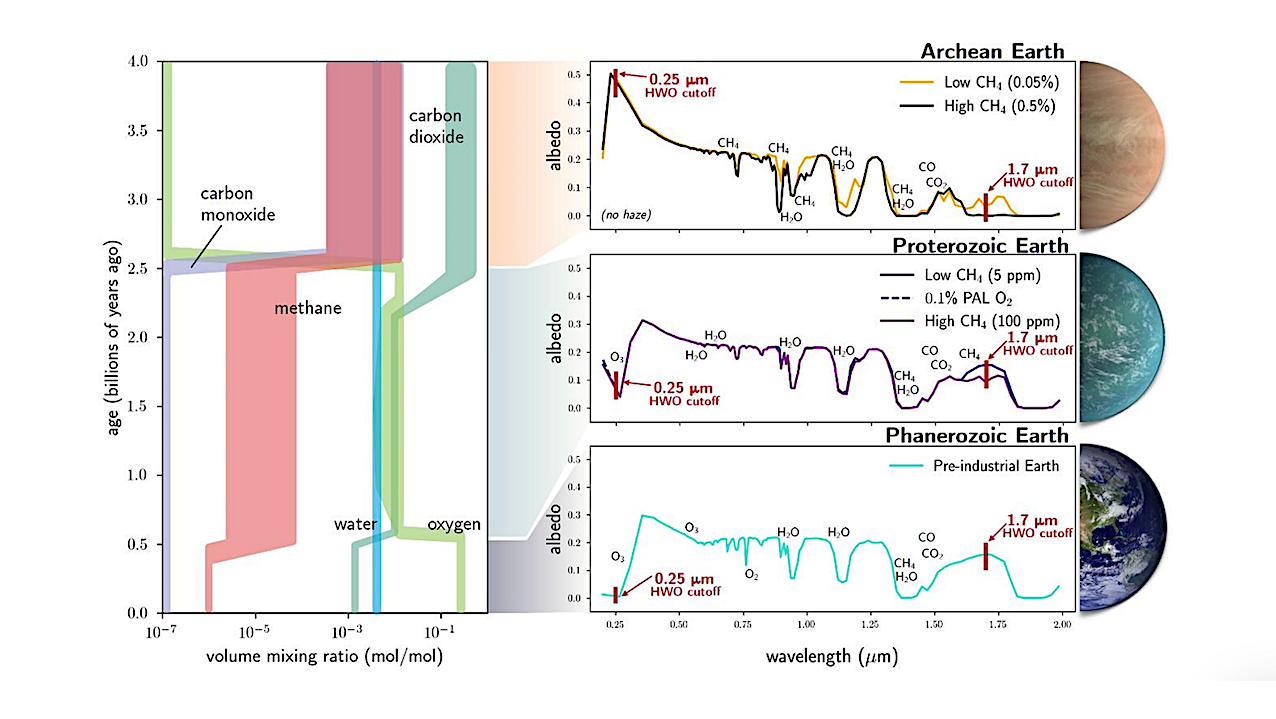
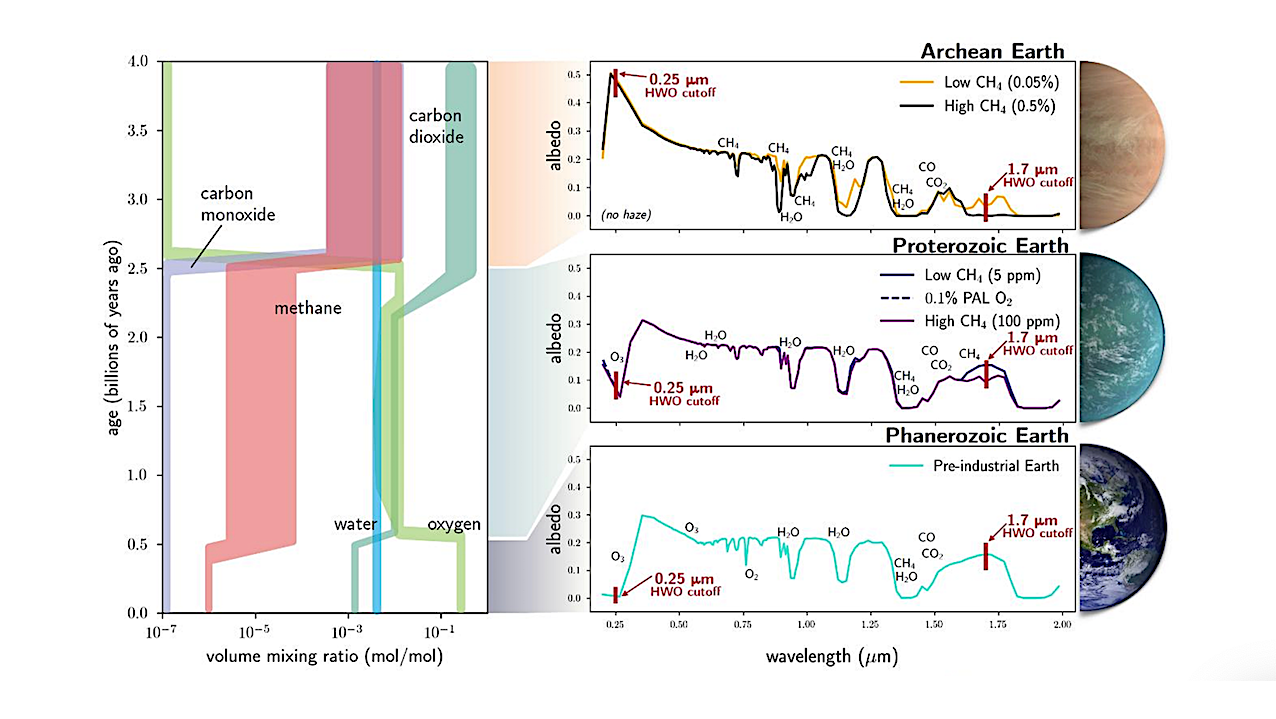
Earth’s spectrum over time (right panel), reproduced from [11]. The biosignature gases present change dramatically from epoch to epoch (left panel), producing significantly different spectra. The simultaneous detection of O2 at 0.8 µm with H2O, CH4, and CO2 at >0.8 µm demonstrates the presence of life in the modern Earth spectrum shown in the bottom right panel, but for habitable planets without much evidence of oxygenic biosignatures (e.g. Proterozoic and Archean Earth), coverage beyond 0.8 µm will be key to capture H2O, and CH4 features. — astro-ph.IM
The detection of life on rocky exoplanets in the habitable zones of nearby stars would be a paradigm-shifting advance, and it is one of the greatest scientific challenges of our time. There is no single spectral feature that is an unambiguous sign of life on a given exoplanet.
Instead, the current state-of-the-art approach involves detecting multiple molecular atmospheric features that should not exist together in equilibrium, e.g. simultaneous detection of O2 and CH4. Spectra across a wide wavelength (0.3-1.7 μm) range are necessary to cover multiple spectral features per molecule of interest and to contextualise the suite of molecular features detected.
While the US will lead the optical arm of the Habitable Worlds Observatory (HWO) coronagraph, a UK-led contribution of a near-infrared Integral Field Spectrograph (IFS) for the infrared arm will ensure UK leadership in the flagship scientific goal of HWO – to search for signatures of life on potentially habitable exoplanets.
Beth Biller, Dan Dicken, Olivier Absil, Raziye Artan, Jo Barstow, Jayne Birkby, Christophe Dumas, Sasha Hinkley, Tad Komacek, Katherine Morris, Lorenzo Pino, Sarah Rugheimer, Colin Snodgrass, Stephen Todd, Vinooja Thurairethinam, Amaury Triaud
Comments: White paper submitted to the UK Space Agency’s initiative “UK Space Frontiers 2035” this https URL
Subjects: Instrumentation and Methods for Astrophysics (astro-ph.IM); Earth and Planetary Astrophysics (astro-ph.EP)
Cite as: arXiv:2603.09321 [astro-ph.IM] (or arXiv:2603.09321v1 [astro-ph.IM] for this version)
https://doi.org/10.48550/arXiv.2603.09321
Focus to learn more
Submission history
From: Beth Biller
[v1] Tue, 10 Mar 2026 07:54:31 UTC (1,344 KB)
https://arxiv.org/abs/2603.09321
Astrobiology, Exoplanet, Astronomy,










Related Posts
Stay Informed With the Latest & Most Important News
Previous Post
Next Post
Advertisement
-
 01Two Black Holes Observed Circling Each Other for the First Time
 -
 02From Polymerization-Enabled Folding and Assembly to Chemical Evolution: Key Processes for Emergence of Functional Polymers in the Origin of Life
 -
 03Astronomy 101: From the Sun and Moon to Wormholes and Warp Drive, Key Theories, Discoveries, and Facts about the Universe (The Adams 101 Series)
 -
 04True Anomaly hires former York Space executive as chief operating officer
 -
 05Φsat-2 begins science phase for AI Earth images
 -
 06Hurricane forecasters are losing 3 key satellites ahead of peak storm season − a meteorologist explains why it matters
 -
 07Binary star systems are complex astronomical objects − a new AI approach could pin down their properties quickly