
Now Reading: A Hydrogen Atmosphere Could Keep Exomoons Habitable For Billions Of Years
-
01
A Hydrogen Atmosphere Could Keep Exomoons Habitable For Billions Of Years


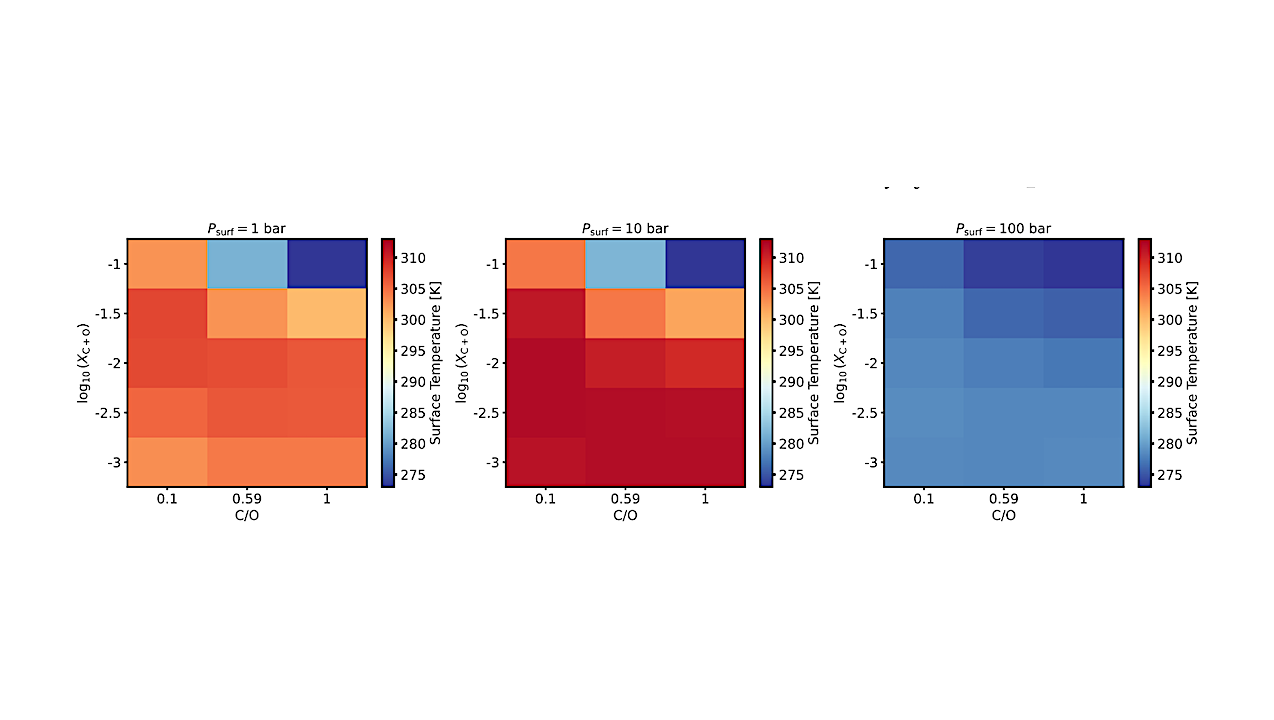

Surface temperatures Tsurf (𝑋C+O, C/O) for varying Psurf (from left to right: 1, 10, and 100 bar). For comparability, the internal temperatures Tint
(185, 104, and 56 K, respectively) were chosen such that the minimum Tsurf for each pressure is at the freezing point of water, 273 K. For this, Tsurf(Tint) was
linearly interpolated. — MNRAS
Liquid water is considered essential for life. Surprisingly, however, stable conditions that are conducive to life could exist far from any sun.
A research team from the Excellence Cluster ORIGINS at LMU and the Max Planck Institute for Extraterrestrial Physics (MPE) has shown that moons around free-floating planets can keep their water oceans liquid for up to 4.3 billion years by virtue of dense hydrogen atmospheres and tidal heating – that is to say, for almost as long as the Earth has existed and sufficient time for complex life to develop.
Planetary systems often form under unstable conditions. If young planets come too close, they can fling each other out of their orbits. This creates free-floating planets (FFPs), which wander through the galaxy without a parent star. An earlier study by LMU physicist Dr. Giulia Roccetti had shown that gas giants ejected in this way do not necessarily lose all of their moons in the process.
Tidal heating keeps oceans liquid
The ejection does, however, alter the orbits of the moons. They become highly elliptical, such that their distance from the planet constantly changes. The resulting tidal forces rhythmically deform the lunar body, compress its interior, and generate heat through friction. This tidal heating can be sufficient to maintain oceans of liquid water on the surface – even without the energy of a star, and in the cold of interstellar space.
Hydrogen as stable heat trap
The atmosphere determines whether this heat is retained at the surface. On Earth, carbon dioxide functions as an effective greenhouse gas. Earlier studies had demonstrated that carbon dioxide could stabilize life-friendly conditions on exomoons for periods of up to 1.6 billion years. Under the extremely low temperatures of free-floating systems, however, carbon dioxide would condense, causing the atmosphere to lose its protective effect and allowing heat to escape.
And so the research team from the fields of astrophysics, biophysics, and astrochemistry investigated hydrogen-rich atmospheres as alternative heat traps. Although molecular hydrogen is largely transparent to infrared radiation, a crucial physical effect arises under high pressures: collision-induced absorption. In this process, colliding hydrogen molecules form transient complexes that can absorb thermal radiation and retain it in the atmosphere. At the same time, hydrogen remains stable even at very low temperatures.
Parallels to early Earth
The findings also furnish new clues to the origin of life. “Our collaboration with the team of Professor Dieter Braun helped us recognize that the cradle of life does not necessarily require a sun,” says David Dahlbüdding, doctoral researcher at LMU and lead author of the study. “We discovered a clear connection between these distant moons and the early Earth, where high concentrations of hydrogen through asteroid impacts could have created the conditions for life.”
Tidal forces could not only supply heat, but also drive processes of chemical development. Periodic deformation gives rise to local wet-dry cycles, in which water evaporates and then condenses again. Such cycles are considered an important mechanism for the formation of complex molecules and could facilitate crucial steps on the path to the emergence of life.
Moons hospitable to life in interstellar space
Free-floating planets are thought to be common. According to estimates, there could be as many of these ‘nomadic’ planets in the Milky Way as there are stars. Their moons could provide stable habitats for long periods of time. The new findings could thus significantly broaden the spectrum of possible environments that could harbor life – and show that life could arise and endure even in the darkest regions of the galaxy.
David Dahlbüdding, Tommaso Grassi, Karan Molaverdikhani, Giulia Roccetti, Barbara Ercolano, Dieter Braun, Paola Caselli. Habitability of Tidally Heated H2-Dominated Exomoons around Free-Floating Planets. In: MNRAS 2026 (open access)
Astrobiology, exoplanet,










Related Posts
Stay Informed With the Latest & Most Important News

Advertisement
-
 01Two Black Holes Observed Circling Each Other for the First Time
 -
 02From Polymerization-Enabled Folding and Assembly to Chemical Evolution: Key Processes for Emergence of Functional Polymers in the Origin of Life
 -
 03Astronomy 101: From the Sun and Moon to Wormholes and Warp Drive, Key Theories, Discoveries, and Facts about the Universe (The Adams 101 Series)
 -
 04True Anomaly hires former York Space executive as chief operating officer
 -
 05Φsat-2 begins science phase for AI Earth images
 -
 06Hurricane forecasters are losing 3 key satellites ahead of peak storm season − a meteorologist explains why it matters
 -
 07Binary star systems are complex astronomical objects − a new AI approach could pin down their properties quickly