
Now Reading: Hunting For Methanol In The Water Rich, Planet Forming Disk Aaround HL Tau
-
01
Hunting For Methanol In The Water Rich, Planet Forming Disk Aaround HL Tau


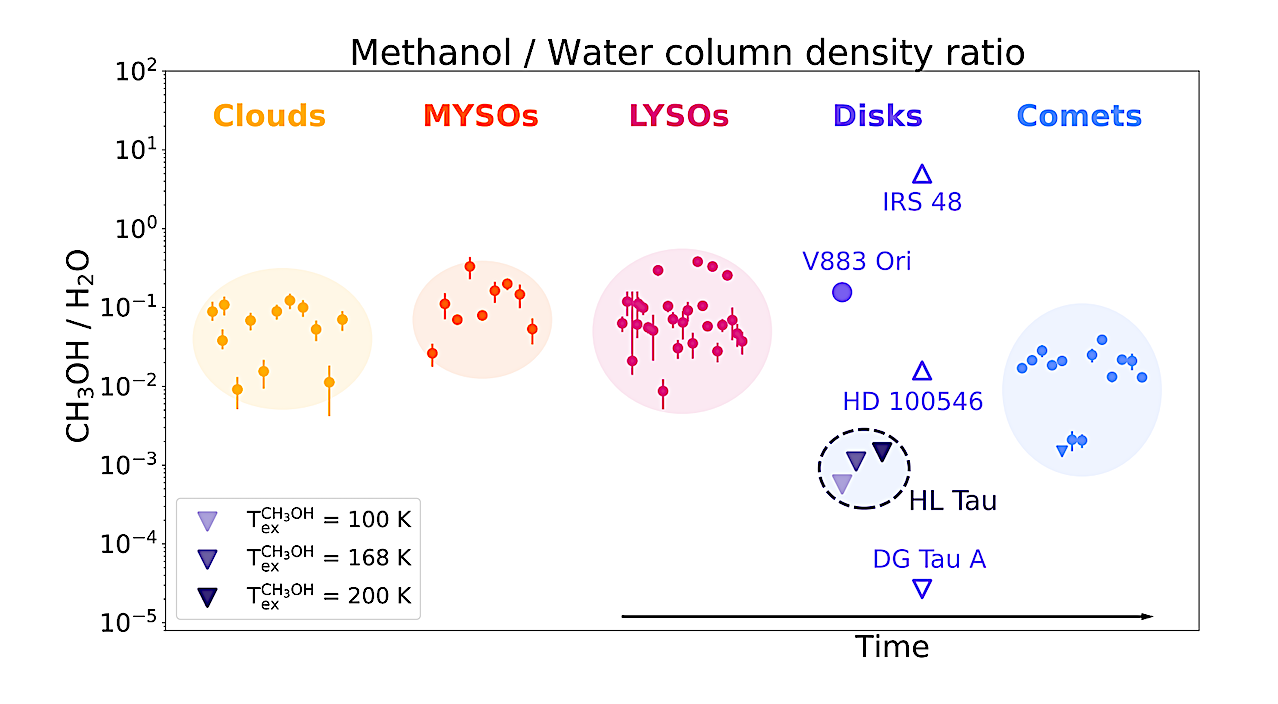

CH3OH/H2O column density ratio found in the literature for a wide range of clouds, YSOs and Solar System comets (see Sect 4.1 for the references). The values for molecular clouds, LYSOs and MYSOs reflect the ice composition, while the ratio was measured in the gas-phase for protoplanetary disks and comets. We used open symbols for the protoplanetary disks in which the upper/lower limit on the methanol-to-water column density ratio was estimated combining measurements taken at different wavelength ranges. The upward triangles for the HD 100546 and the IRS 48 disks indicate a lower limit, whereas the downward triangles for DG Tau A and HL Tau indicate a upper limit. The values for HL Tau are taken dividing the 3σ upper limit on the NCH3OH for the three different assumed excitation temperature in Table 2 for the water column density measured by Facchini et al. (2024). — astro-ph.SR
Methanol, the simplest complex organic molecule found in space, is considered a key compound necessary for the formation of chemical species of prebiotic interest. Methanol detections in protoplanetary disks remain scarce, even though it is frequently detected in the material surrounding other Young Stellar Objects.
We investigate the presence of methanol in the protoplanetary disk around the HL Tau protostar, motivated by the detection of spatially resolved warm water emission. Given the similar volatility of methanol and water, thermally desorbed gas-phase methanol is expected to emit from the same region of the HL Tau disk where water vapour has been observed.
Accordingly, we selected and imaged the most promising ALMA archival observations to search for rotational methanol lines. We found no methanol emission in the analysed archival datasets. Assuming optically thin emission and LTE, we derive stringent upper limits on the methanol column density for different excitation temperatures: < 7.2 x 10^(14) cm^(-2) at 100 K and < 1.8 x 10^(15) cm^(-2) at 200 K, assuming a circular emitting region with a radius of 17 au (~ 0.12”).
Furthermore, we obtain a stringent upper limit on the methanol-to-water column density ratio (< 0.55 x 10^(-3) at 100 K and < 1.4x 10^(-3) at 200 K), which is, on average, an order of magnitude lower than the values measured for other Young Stellar Objects and Solar System comets.
We argue that the most likely explanation for the methanol non-detection in HL Tau is the presence of optically thick dust in the central region of the disk, which obscures part of the methanol emission.
The upper limit on the methanol-to-water ratio in the HL Tau disk is at least an order of magnitude smaller than most clouds, YSOs and comets, possibly due to radiative transfer and/or excitation effects, or due to a different chemical evolution compared to the other sources.
Alessandro Soave, Margot Leemker, Stefano Facchini, Luke Maud, Kazi Lucie Jessica Rygl, Leonardo Testi
Subjects: Solar and Stellar Astrophysics (astro-ph.SR); Earth and Planetary Astrophysics (astro-ph.EP)
Cite as: arXiv:2603.04322 [astro-ph.SR] (or arXiv:2603.04322v2 [astro-ph.SR] for this version)
https://doi.org/10.48550/arXiv.2603.04322
Focus to learn more
Submission history
From: Alessandro Soave
[v1] Wed, 4 Mar 2026 17:42:58 UTC (247 KB)
[v2] Tue, 10 Mar 2026 16:59:14 UTC (237 KB)
https://arxiv.org/abs/2603.04322
Astrobiology, Astrochemistry,










Related Posts

Stay Informed With the Latest & Most Important News
Previous Post
Next Post


Advertisement
-
 01Two Black Holes Observed Circling Each Other for the First Time
 -
 02From Polymerization-Enabled Folding and Assembly to Chemical Evolution: Key Processes for Emergence of Functional Polymers in the Origin of Life
 -
 03Astronomy 101: From the Sun and Moon to Wormholes and Warp Drive, Key Theories, Discoveries, and Facts about the Universe (The Adams 101 Series)
 -
 04True Anomaly hires former York Space executive as chief operating officer
 -
 05Φsat-2 begins science phase for AI Earth images
 -
 06Hurricane forecasters are losing 3 key satellites ahead of peak storm season − a meteorologist explains why it matters
 -
 07Binary star systems are complex astronomical objects − a new AI approach could pin down their properties quickly