
Now Reading: Dale Andersen’s Astrobiology Antarctic Status Report 16 March 2026: Spring Field Season Completed; Preparing The Fall Field Season
-
01
Dale Andersen’s Astrobiology Antarctic Status Report 16 March 2026: Spring Field Season Completed; Preparing The Fall Field Season

Dale Andersen’s Astrobiology Antarctic Status Report 16 March 2026: Spring Field Season Completed; Preparing The Fall Field Season

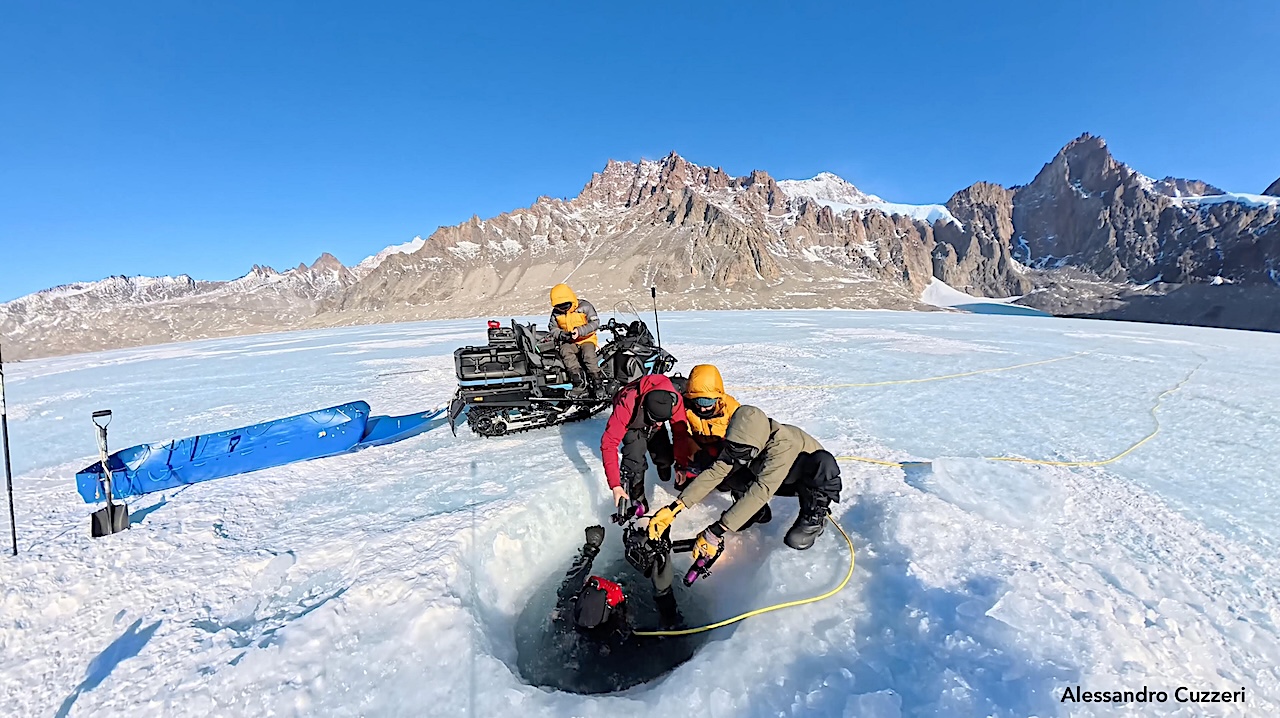
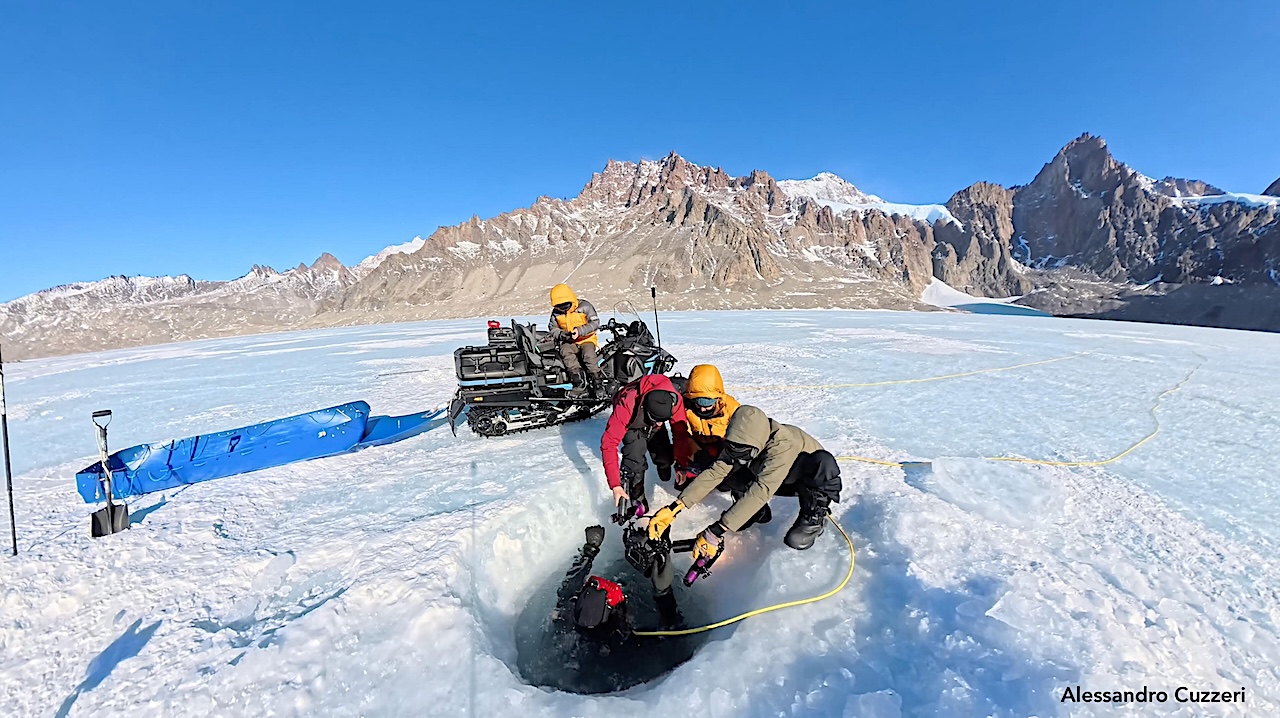
Dale Andersen in an ice hole preparing to dive in Lake Untersee, Antarctica in February 2026 — Alessandro Cuzzeri
Hi Keith, The team and I have been home for about two weeks now, settling back into the familiar rhythms of home and work after our time in Antarctica. Our attention has turned to the return of samples and cargo, to the first careful look at the observations and data we gathered during our stay at Untersee, and towards planning the analyses of samples now making their way back to various labs.
Even so, field work does not really end with the journey home. The next field season is already on the horizon, only seven months away, and this pause becomes both practical and reflective – a time to take stock of what we accomplished, to begin sorting through results, and to look ahead. Work like this unfolds as a continuum, each field season building on the last while guiding our way back to Untersee as we refine our understanding of that remarkable ecosystem.
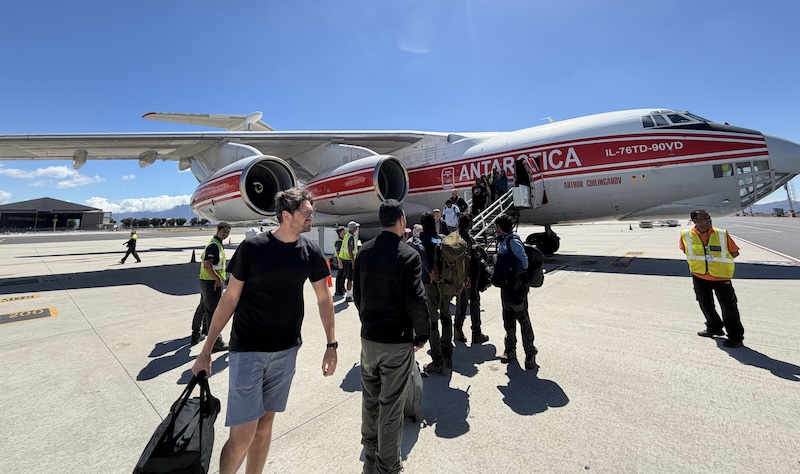
Returning to Cape Town, South Africa on 25 February 2026 — Dale T. Andersen
For many years, we have used Antarctica as a place to think about isolation, logistics, human factors, life-support constraints, enabling technologies such as remotely operated vehicles and telepresence, and the realities of conducting meaningful research far from easy rescue or resupply. Those lessons have shaped and informed many of our efforts to use Antarctic field research as a model for planetary exploration and for scientific and operational investigations relevant to the Moon and Mars.
Our studies within these relatively rare ice-free oases are scientifically compelling in their own right, but they also offer something more. They provide settings for thinking about planetary exploration in grounded, practical ways. Our work has shown that these perennially ice-covered lake environments can serve as useful models for understanding similar lakes and oceans that may once have existed on Mars, or within the oceans of the icy moons of Juipter or Saturn, while Antarctic field camps more broadly provide places where humans and machines – scientific instruments, robotics, and related systems – can be tested together in remote, demanding conditions while carrying out real science.
Over the years, through our exobiology-related research in these Antarctic oases, we’ve tried to carry those lessons forward – not only through the science itself, but through what these places reveal about exploration, communication, resilience, and the discipline needed to work together as a team in remote settings.
Looking back at those final images from beneath the ice, I was also reminded that important lessons do not always come from scientific instruments or samples alone. Sometimes they arrive in the form of a simple moment – a swim beneath the ice, following a thin, yellow line back to the surface.
Cheers,
Dale
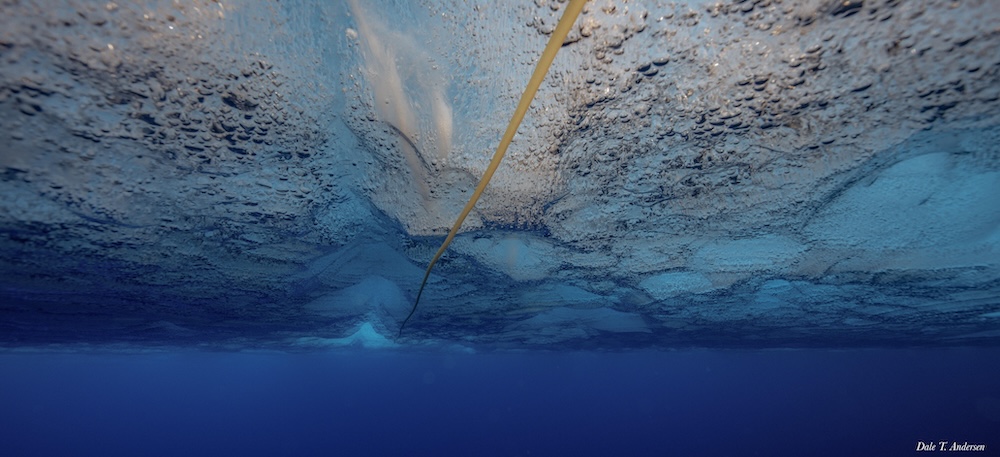
“Just beneath Untersee’s ice, my tether runs ahead toward the distant glimmer of the dive hole” — Dale T.Andersen
Beneath the Ice, But Not Alone
Just beneath Untersee’s ice, my tether runs ahead toward the distant glimmer of the dive hole, the only passage back from the blue and solitary world below. As I swim, I hear the measured rhythm of my own breathing and, now and then, the voices of colleagues on the surface carried through a thin, yellow line into the earpieces of my Kirby Morgan Exo-26 full-face mask. They ask for an update, reminding me to check my air pressure. A glance at my air-integrated dive computer, a few quick words in reply, and all is well. Soon, after a brief three-minute safety stop beneath the dive hole, I will return to the surface through the three and half meters (about twelve feet) of ice.
While working in the dark water below the ice, the tether is more than just dive gear. It is direction, contact, reassurance – a slender line between wandering too far away and finding the way back to the surface.
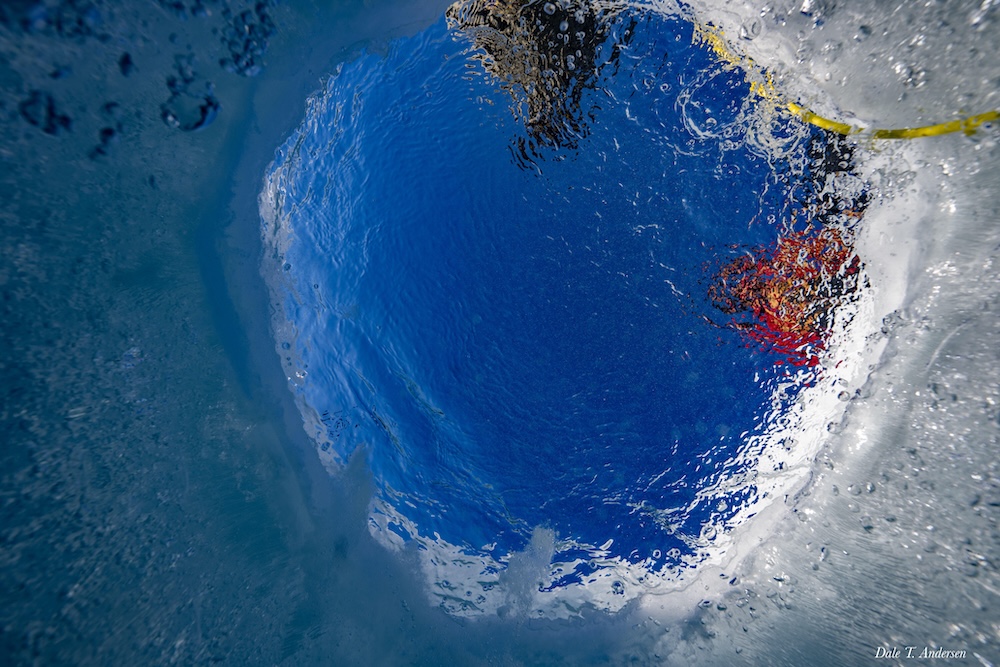
Looking up at the Antarctica sky from a dive hole in Lake Untersee — Dale T. Andersen
And, as I unhurriedly return behind that yellow thread, I am reminded that all life is tethered in some way – by the people, values, and quiet bonds that hold us steady, especially during those moments when we find ourselves in remote, isolated settings on distant shores, or in those quieter, yet sometimes tumultuous, places within ourselves. Not a tether that stifles exploration or hinders progress, but one that reminds us where we are, what matters most, and how to find our way back to a better place when distance, silence, or uncertainty begin to blur the edges and wear away at our confidence. It is, once again, a line – a strong but unseen tether – shaped by the voices of family, friends, and colleagues, and by affection and trust, reaching across space and time to steady us and draw us home.
2025/26 Lake Untersee Antarctic Field Season Team Members
- Dale Andersen, Ph.D. Carl Sagan Center, SETI Institute, Mountain View, CA
- Birgit Sattler, Ph.D. University of Innsbruck, Innsbruck, Austria
- Allessandro Cuzzeri, Graduate Student (Ph.D. candidate) University of Innsbruck, Innsbruck, Austria
- Denis Lacelle, Ph.D. University of Ottawa, Canada
- Efe Kemal Koc, Graduate Student (M.Sc.) University of Ottawa, Canada
- Klemens Weisleitner, Ph.D.Polar and alpine microbial ecologist, Professional photographer, Innsbruck, Austria
Keith’s note: Astrobiologist Dale Andersen headed back in Antarctica at Lake Untersee in January-February 2026 for another field season of research.
Dale and I have been proving research updates – from Antarctica – since 1996. We think we actually had the first webserver (located in my old condo) updated from Antarctica. More details here: Dale Andersen’s 1996 Antarctic Field Research Photo Albums
Astrobiology










Related Posts
Stay Informed With the Latest & Most Important News

Advertisement
-
 01Two Black Holes Observed Circling Each Other for the First Time
 -
 02From Polymerization-Enabled Folding and Assembly to Chemical Evolution: Key Processes for Emergence of Functional Polymers in the Origin of Life
 -
 03Astronomy 101: From the Sun and Moon to Wormholes and Warp Drive, Key Theories, Discoveries, and Facts about the Universe (The Adams 101 Series)
 -
 04True Anomaly hires former York Space executive as chief operating officer
 -
 05Φsat-2 begins science phase for AI Earth images
 -
 06Hurricane forecasters are losing 3 key satellites ahead of peak storm season − a meteorologist explains why it matters
 -
 07Binary star systems are complex astronomical objects − a new AI approach could pin down their properties quickly