
Now Reading: New Astrobiology Special Collection Explores Emerging Scientific Evidence For Land-based Origins Of Life
-
01
New Astrobiology Special Collection Explores Emerging Scientific Evidence For Land-based Origins Of Life

New Astrobiology Special Collection Explores Emerging Scientific Evidence For Land-based Origins Of Life

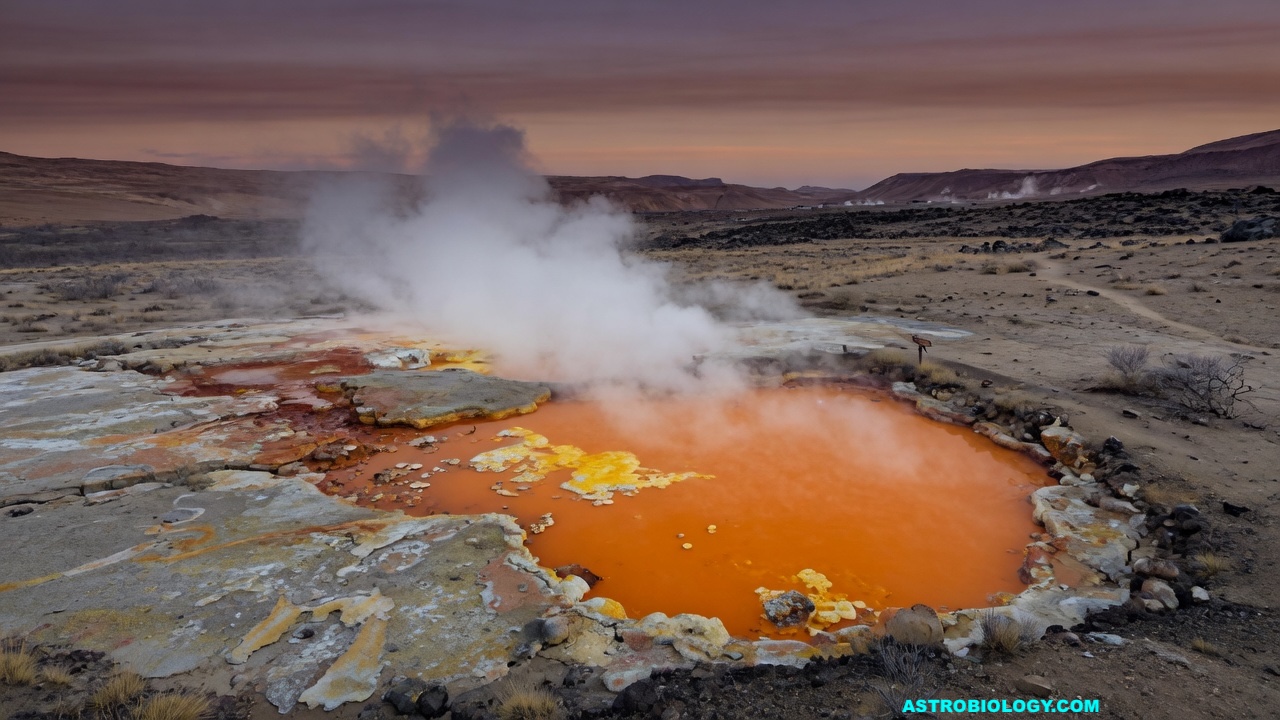
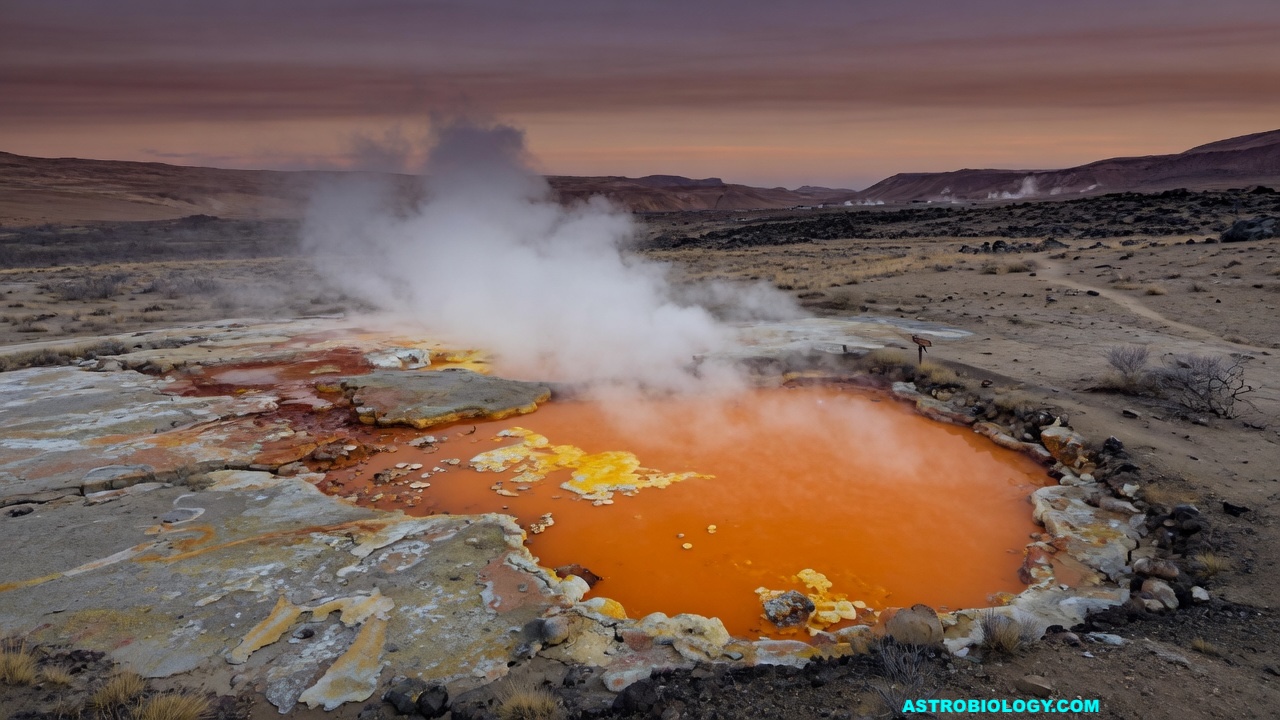
Hydrothermal spring on early Earth — Grok via Astrobiology.com
The scientific study of life’s origins is undergoing a major transition, from a decades-long focus on deep-sea hydrothermal vents toward increasing investigation of hot springs and other chemically dynamic environments on land.
A new special collection and issue of the journal Astrobiology brings together leading researchers across geology, chemistry, planetary science, molecular biology, and systems chemistry to examine growing evidence that life may have emerged within networks of terrestrial environments on early Earth.
Titled “An Origin of Life on Land,” the collection explores how volcanic landscapes, freshwater hydrothermal systems, evaporative environments, crater and soda lakes, and transiently saline shorelines may collectively have provided the chemical complexity and environmental cycling necessary for nonliving chemistry to transition into evolving protocell populations that evolved into the first microbial ecosystems.
The issue revisits and substantially expands upon the idea first hinted at by Charles Darwin in his famous 1871 “warm little pond” letter, integrating decades of new laboratory experiments, geological discoveries, planetary science observations, and field studies of terrestrial analog environments.
A central concept threading through the collection is “urability,” a term proposed in 2022 by guest editors Bruce Damer and David Deamer to describe the broader set of environmental conditions (urable factors) required for life to emerge on a planet or moon.
“Liquid water alone is probably insufficient for life to originate,” said David Deamer. Bruce Damer added: “The question is not simply whether water exists, but whether a world contains environments capable of concentrating organics, sustaining chemical evolution, and driving increasing molecular complexity over time.”
The editors propose that early Earth likely hosted multiple “urable zones,” localized environments that support different stages of prebiotic chemistry and protocell evolution. While hydrothermal fields undergoing wet-dry cycling represent one promising class of urable zones, the issue does not argue for a single exclusive setting for life’s origins.
Instead, the collection advances an emerging systems-level view in which life may have arisen through interactions among diverse environments that support fluctuating chemical conditions across volcanic landmasses.
Among the themes explored in the issue are:
- wet-dry cycling as a mechanism for promoting polymer formation and protocell assembly,
- lipid membranes as organizing and concentrating structures for prebiotic chemistry,
- the roles of meteoritic and atmospheric organic sources,
- geochemical diversity, including chemical fluxes, in freshwater acidic and alkaline systems,
- geological evidence of early microbial communities thriving in 3.5-billion-year-old terrestrial hydrothermal deposits in Western Australia,
- and models in which RNA, peptides, membranes, minerals, pigments, and environmental cycles co-arise and evolve together as integrated systems.
Several papers argue that compartmentalized environments were likely essential for early evolution. One contribution proposes that multilamellar lipid matrices formed during evaporation cycles may have dramatically increased the probability of rare but functional molecular combinations emerging. Such a progenitor could overcome one of the central problems in origin-of-life science: how chemistry crossed the combinatorial threshold into systems capable of information storage, catalysis, adaptation, and reproduction.
Researchers are now moving beyond isolated chemical reactions toward laboratory systems capable of generating large populations of evolving “protocells,” membrane-bound chemical assemblies that may exhibit primitive forms of metabolism and information transfer. Within a generation, automated experimental platforms may be able to observe open-ended chemical evolution directly, offering the first empirical insight into how nonliving chemistry transitions into biology.
Contributions in the issue include studies on:
- geochemical complexity in terrestrial hot spring systems,
- stability of nucleic acids during wet-dry cycling in Icelandic hot springs,
- protocell assembly and primitive metabolism,
- 3D-printed experimental platforms for prebiotic chemistry,
- nanopore sequencing approaches to probing early molecular systems,
- and historical debates surrounding precellular evolution and systems chemistry.
The special collection arrives during renewed momentum in origin-of-life research driven by sample-return missions from asteroids such as Bennu, which confirm ancient extraterrestrial delivery of organic compounds, along with increasing evidence for ancient hydrothermal activity on Mars, increasing rates of discovery of potentially habitable exoplanets, and advances in synthetic protocell and systems chemistry research.
A centerpiece of the collection is the introductory article, “Revisiting Darwin’s Warm Little Pond in the 21st Century: Land-Based Scenarios for Life’s Origins,” by Bruce Damer and David Deamer, which synthesizes evidence that suggests fluctuating terrestrial environments may have been especially favorable for the emergence of increasingly complex chemical systems.
Contributing First Authors
- B.F. Damer and D.W. Deamer, BIOTA Institute / University of California Santa Cruz
- M. Van Kranendonk et al., Curtin University
- P. Šimonis et al., Vilnius University
- C.R. Walton, et al., University of Cambridge
- I. Gözen, Göteborg, Sweden
- C. Karabasoglu et al., Chimie Paristech PSL, Paris, University of Oxford
- R.A. Black, University of Washington
- U. Bandyopadhyay et al., Indian Institute of Science Education and Research Pune
- A. Siddique et al., University of New South Wales
- J.A. Campillo-Balderas et al., National Autonomous University of Mexico
Significance of the Work
While many open questions remain, the collection reflects a broader shift underway in origin-of-life research, from isolated molecular reactions in dilute laboratory solutions toward integrated planetary systems capable of sustaining cycles of concentration, selection, environmental distribution and selection, and emergent complexity of protocell populations.
The implications extend far beyond Earth. This work informs where life might emerge on planets and moons such as Mars and Enceladus, as well as on potentially habitable (and urable) exoplanets, while helping refine one of science’s most consequential questions: under what conditions can life begin, and how common might living worlds be in the universe?
Astrobiology,










Related Posts
Stay Informed With the Latest & Most Important News
Previous Post
Next Post


Advertisement
-
 01Two Black Holes Observed Circling Each Other for the First Time
 -
 02From Polymerization-Enabled Folding and Assembly to Chemical Evolution: Key Processes for Emergence of Functional Polymers in the Origin of Life
 -
 03Astronomy 101: From the Sun and Moon to Wormholes and Warp Drive, Key Theories, Discoveries, and Facts about the Universe (The Adams 101 Series)
 -
 04True Anomaly hires former York Space executive as chief operating officer
 -
 05Φsat-2 begins science phase for AI Earth images
 -
 06Hurricane forecasters are losing 3 key satellites ahead of peak storm season − a meteorologist explains why it matters
 -
 07Binary star systems are complex astronomical objects − a new AI approach could pin down their properties quickly