
Now Reading: Seeking other Earths: Will this new telescope find them?
-
01
Seeking other Earths: Will this new telescope find them?


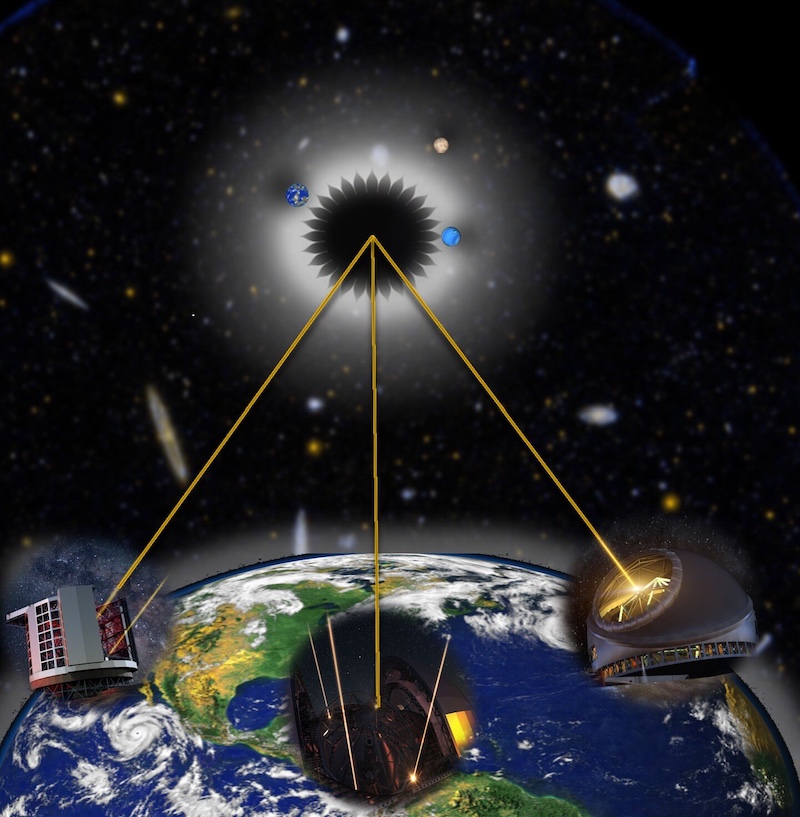

- Earth-sized exoplanets are hard to find because they’re so small and so far away from us. Is there a better way to search for them?
- A hybrid of both ground- and space-based telescopes could be used, an international team of researchers now says.
- Large ground-based telescopes, together with space-based starshades, could help astronomers directly observe more Earth-sized exoplanets.
You deserve a daily dose of good news. For the latest in science and the night sky, click here to subscribe to our free daily newsletter.
Our much-loved EarthSky Community Photos is back, after a bot swarm brought it down a day ago. Please keep sharing your beautiful photos with us.
A new way to find Earth-like exoplanets
Astronomers have been detecting a growing number of Earth-sized exoplanets in recent years. But analyzing their atmospheres or even imaging them is much more difficult because they are small and so far away. Astronomers use ground-based and space telescopes to find these worlds, but both have limitations. Is there a better way? An international team of researchers said on March 6, 2026, that they propose using a hybrid observatory setup – the Hybrid Observatory for Earth-like Exoplanets (HOEE) – with features of both types of telescopes. Essentially, it would be a ground-based telescope with a space-based starshade. A key goal would be to find exoplanets that are similar to our own planet.
The starshade would block the light coming from the star, allowing astronomers to use the telescope on the ground with the needed angular resolution and sensitivity to directly detect Earth-sized exoplanets.
Laurence Tognetti wrote about the new starshade concept for Universe Today on March 9, 2026.
Ahmed Soliman, the lead author of the new study, is a scientist and technologist at NASA’s Jet Propulsion Laboratory.
The researchers published their peer-reviewed concept in Nature Astronomy on February 27, 2026.

Limitations of ground-based and space-based telescopes
Space-based telescopes, such as the James Webb Space Telescope and the upcoming Nancy Grace Roman Space Telescope, use internal coronagraphs instead of a starshade to help block the light of the stars they are observing. This helps greatly with trying to detect exoplanets. One drawback, however, is that this technique is best for larger, gas giant-type planets such as Jupiter. But there isn’t enough contrast to easily detect smaller rocky planets similar to Earth.
Ground-based telescopes have their own limitations. Turbulence in Earth’s atmosphere and instrumental contrast issues also hinder the search for smaller planets. As Soliman told Universe Today:
Many people think only large space telescopes like Nancy Grace Roman Space Telescope, James Webb Space Telescope or the proposed Habitable Worlds Observatory can search for life beyond our solar system, but they aren’t aware of what our NASA NIAC funded study – Hybrid Observatory for Earth-like Exoplanets (HOEE) – can do.
Current space telescopes such as the James Webb Space Telescope and the soon-to-fly Nancy Grace Roman Space Telescope use internal coronagraphs for direct imaging, but their contrast is not deep enough to directly detect true Earth-like planets in habitable zones. Existing ground-based telescopes also lack the required contrast and resolution. A hybrid system that combines a space-based starshade with large ground telescopes would greatly improve starlight suppression and angular resolution, making direct detection of Earth-like exoplanets possible.

The best of both worlds: hybrid telescope concept
So, is there a better way? The researchers propose a unique solution: using aspects of both ground-based and space-based telescopes.
The HOEE study suggests using ground-based telescopes with orbiting starshades to block the stars’ light. That way, the starshades block the light, which ground-based telescopes lack, while the ground-based telescopes have the angular resolution and sensitivity needed. It’s basically the best of both worlds.

Testing the concept
To test the idea, the research team used analysis related to the upcoming Extremely Large Telescope (ELT), Thirty Meter Telescope (TMT) and the upcoming Giant Magellan Telescope (GMT). The team included Nobel laureates John C. Mather and Michel Mayor, who discovered the first exoplanet orbiting a sunlike star.
The testing was successful and showed that the hybrid concept should work. The combination of both types of telescopes would produce the contrast needed to directly detect Earth-sized exoplanets.
Right now, this is still a concept, not an actual space mission. But if it is used, Soliman said it could find dozens of Earth-sized planets. And, remarkably, it could identify those planets in only minutes. Plus, it could find potential biosignatures, if they exist, in only a matter of hours. This would be under moderate weather conditions on Earth and for planets within the habitable zones of their stars, where water might exist.
There is also a similar project under development by the Jet Propulsion Laboratory to design a giant starshade that would be placed in front of a space telescope to block the light from the star it is observing.
Bottom line: Finding Earth-sized or potentially Earth-like exoplanets is not easy. A new proposal suggests combining an orbital starshade with large ground-based telescopes.
Read more: Earth-like ocean planets plentiful for red dwarf stars?
Read more: Habitable water worlds don’t have to be Earth-like
The post Seeking other Earths: Will this new telescope find them? first appeared on EarthSky.










Related Posts
Stay Informed With the Latest & Most Important News
Previous Post
Next Post
Advertisement
-
 01Two Black Holes Observed Circling Each Other for the First Time
 -
 02From Polymerization-Enabled Folding and Assembly to Chemical Evolution: Key Processes for Emergence of Functional Polymers in the Origin of Life
 -
 03Astronomy 101: From the Sun and Moon to Wormholes and Warp Drive, Key Theories, Discoveries, and Facts about the Universe (The Adams 101 Series)
 -
 04True Anomaly hires former York Space executive as chief operating officer
 -
 05Φsat-2 begins science phase for AI Earth images
 -
 06Hurricane forecasters are losing 3 key satellites ahead of peak storm season − a meteorologist explains why it matters
 -
 07Binary star systems are complex astronomical objects − a new AI approach could pin down their properties quickly