
Now Reading: exoALMA. XXIV. Formaldehyde Emission in Protoplanetary Disks of exoALMA Compared with Their Properties and Dynamical State
-
01
exoALMA. XXIV. Formaldehyde Emission in Protoplanetary Disks of exoALMA Compared with Their Properties and Dynamical State

exoALMA. XXIV. Formaldehyde Emission in Protoplanetary Disks of exoALMA Compared with Their Properties and Dynamical State

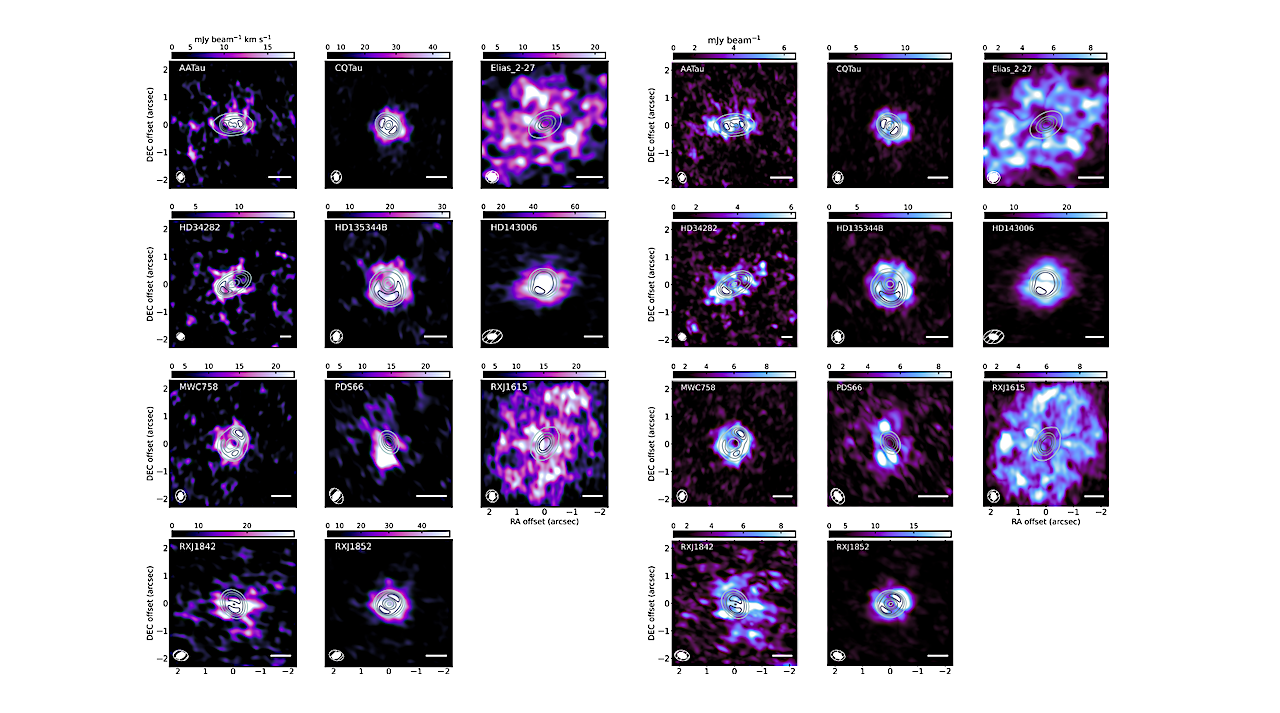
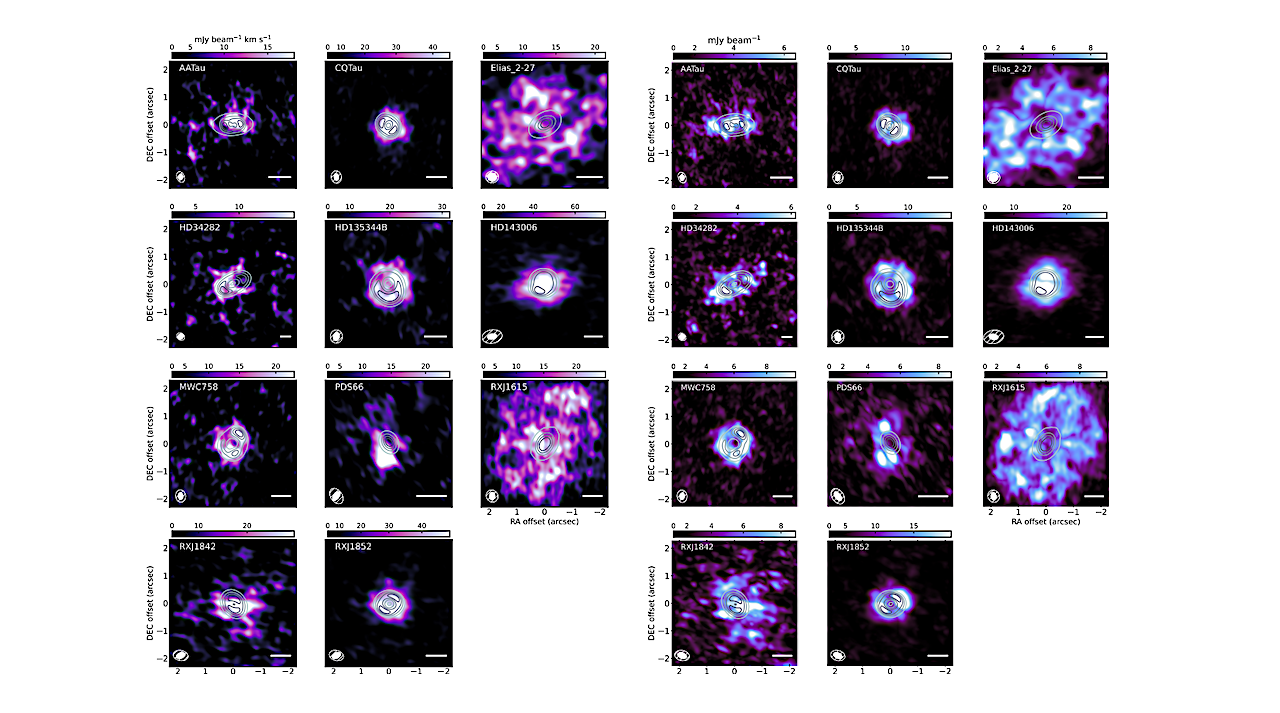
Left: integrated emission maps of the H2CO 4(0,4)-3(0,3) line for the observed sources. Right: peak intensity emission for the same line. Continuum emission at 0.8 mm contours is overlaid to compare with the formaldehyde emission in the disks. Beams are illustrated on the bottom-right with solid white for continuum images and dashed lines for line emission. The bottom-left bar represents a respective 100 au physical scale for each source. For most disks, there are no clear correspondences between the dust continuum contours and the integrated maps.
The presence of asymmetries and substructures in protoplanetary disks, revealed by both dust and gas emission, highlights the potential interplay and the broader connection between chemistry and dynamics in disk evolution.
We explore multiple relationships using the nonparametric Kendall-τ correlation to examine formaldehyde (H2CO) emission with relation to stellar and disk properties for a subset of disks from the exoALMA sample.
We also retrieve the H2CO column density and excitation temperature using four transitions, measured in radial bins of 100 au, and quantify the level of asymmetry in the resolved peak intensity of the H2CO emission. From our correlation analysis, we find no correlations with sufficient statistical significance. However, we identify tentative relationships that can be tested with larger samples.
In particular, we report a proposed correlation (2.1σ) between stellar effective temperature and the formaldehyde excitation conditions, suggesting that, to first order, the central star dominates the nature of the H2CO emission over possible dynamical asymmetries traced by dust.
Although a correlation with the stellar luminosity was also expected, a larger sample is required to confirm or refute this trend. A possible correlation with spectral type, together with the broad range of H2CO excitation temperatures within the inner 100 au of the studied disks, hint at possible multiple chemical formation pathways for H2CO, including both gas-phase reactions and ice-surface chemistry on dust grains.
Felipe Alarcón, Stefano Facchini, Leon Trapman, Pietro Curone, Luna Rampinelli, Sean M. Andrews, Jaehan Bae, Marcelo Barraza-Alfaro, Myriam Benisty, Maria Galloway-Sprietsma, Cassandra Hall, John D. Ilee, Giuseppe Lodato, Christophe Pinte, Jochen Stadler, Richard Teague, David J. Wilner, Ke Zhang
Comments: Accepted for publication in ApJL
Subjects: Earth and Planetary Astrophysics (astro-ph.EP)
Cite as: arXiv:2603.13081 [astro-ph.EP] (or arXiv:2603.13081v1 [astro-ph.EP] for this version)
https://doi.org/10.48550/arXiv.2603.13081
Focus to learn more
Submission history
From: Felipe Alarcón
[v1] Fri, 13 Mar 2026 15:30:43 UTC (9,305 KB)
https://arxiv.org/abs/2603.13081
Astrobiology, Astrochemistry,










Related Posts

Stay Informed With the Latest & Most Important News
Previous Post
Next Post



Advertisement
-
 01Two Black Holes Observed Circling Each Other for the First Time
 -
 02From Polymerization-Enabled Folding and Assembly to Chemical Evolution: Key Processes for Emergence of Functional Polymers in the Origin of Life
 -
 03Astronomy 101: From the Sun and Moon to Wormholes and Warp Drive, Key Theories, Discoveries, and Facts about the Universe (The Adams 101 Series)
 -
 04True Anomaly hires former York Space executive as chief operating officer
 -
 05Φsat-2 begins science phase for AI Earth images
 -
 06Hurricane forecasters are losing 3 key satellites ahead of peak storm season − a meteorologist explains why it matters
 -
 07Binary star systems are complex astronomical objects − a new AI approach could pin down their properties quickly