
Now Reading: Golden Dome cost estimate rises to $185 billion as Pentagon expands space layer
-
01
Golden Dome cost estimate rises to $185 billion as Pentagon expands space layer


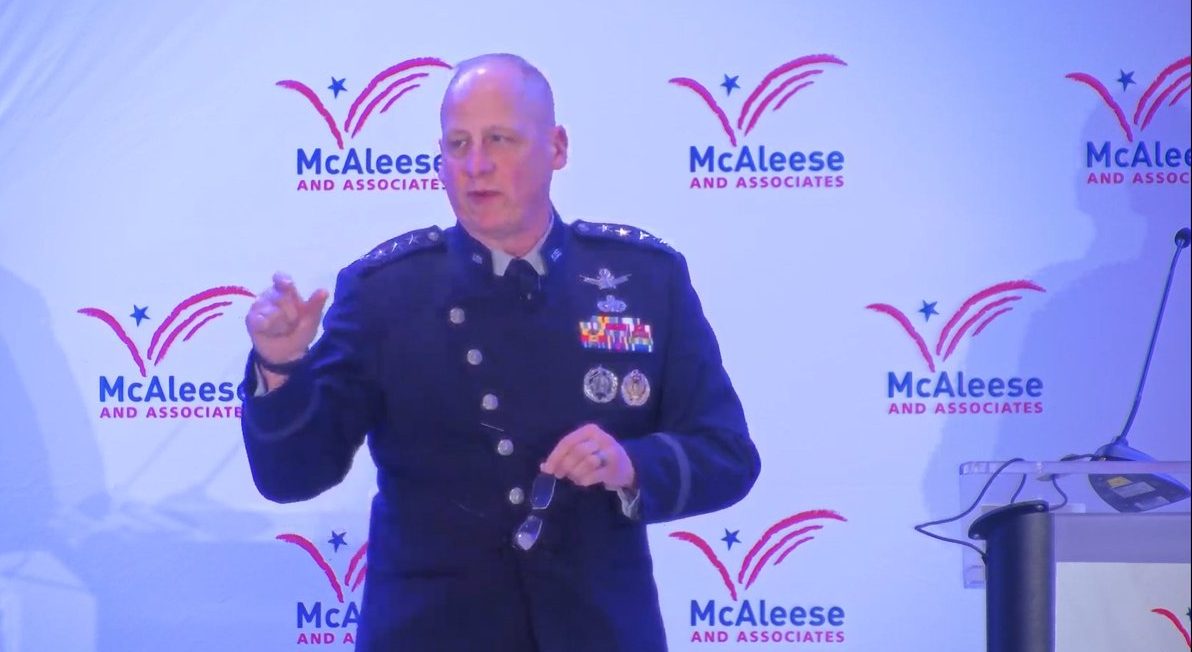

ARLINGTON, Va. — The Pentagon has increased its cost estimate for the Golden Dome missile defense initiative to $185 billion over the next decade, up from a previously reported $175 billion, as the program shifts more funding toward space-based capabilities.
Gen. Michael Guetlein, who leads Golden Dome for America, said March 17 that the additional $10 billion would be used to accelerate procurement of satellites and build out a space-based data network.
“We were asked to procure some additional space capabilities,” Guetlein said at the McAleese Defense Programs Conference. “So we are at $185 billion for the objective architecture, which delivers way out into the 2035 time frame.”
Golden Dome is a proposed U.S. missile defense architecture intended to protect the homeland against ballistic, hypersonic and cruise missile threats by integrating ground-, air- and space-based sensors, interceptors and command-and-control systems into a unified network. The concept includes a large space-based layer of satellites for tracking and targeting, alongside new interceptor technologies.
The program remains in early stages, with broad funding and policy direction in place but limited public detail on its final design.
Guetlein said Congress has so far provided about $25 billion to begin building the system’s foundation. “We have been allocated an enormous amount of national treasure on the order of about $25 billion from Congress, of which we are off and running and building out the foundation for Golden Dome,” he said.
He pushed back on outside estimates that place the program’s potential cost in the trillions of dollars, arguing those figures are based on assumptions about architectures that differ from what the Pentagon is pursuing.
“There’s been numerous cost estimates out there in excess of a trillion dollars,” Guetlein said. “I would say the difference between what they are estimating and what we are building is they’re not estimating what I’m building.”
The added funding is aimed at expanding several space-based efforts, including Air Moving Target Indicator satellites designed to track airborne objects across wide areas, a transport layer that would move data through space via inter-satellite links, and the Hypersonic and Ballistic Tracking Space Sensor constellation being developed by the Missile Defense Agency.
No ‘2028 mandate’
Guetlein also sought to clarify expectations about the program’s timeline, disputing the narrative that Golden Dome must be operational by 2028.
“I do not have a 2028 mandate inside the executive order,” he said, adding that the administration has set a marker for demonstrating an operational capability by the summer of 2028.
A central challenge, he said, is not the underlying technology but the ability to scale production and reduce costs, particularly for interceptors.
Missile defense systems rely on what Guetlein described as “magazine depth,” or the number of interceptors available to respond to an attack. Systems with limited capacity can be overwhelmed if adversaries launch multiple weapons or deploy decoys. Current interceptors cost millions of dollars each and are used to counter far cheaper threats, raising concerns about affordability.
“The cost per kill has to come down,” Guetlein said.
While he said the technology for space-based interceptors exists, it is not yet clear that it can be produced at scale at an acceptable cost.
“What keeps me awake at night is ‘Can I scale? Can the industrial base, which has been optimized for efficiency for generations, suddenly change that equation and start scaling and becoming more efficient, more effective?’” he said.
Guetlein said lowering costs will require innovation from industry and academia, pointing to directed energy weapons as one potential approach because they could engage multiple targets at lower cost per shot than traditional interceptors.
He said his office has engaged extensively with industry, holding one-on-one meetings with more than 400 companies and establishing an industry advisory council that meets quarterly. He has also met with private equity and investment groups.
Another focus is the development of Golden Dome’s command-and-control system, which he described as central to the program’s architecture.
“We recognized on day one that command and control was going to be our secret sauce,” Guetlein said.
The command-and-control network is intended to link sensors, decision-makers and interceptors across air, ground and space domains, fusing data from satellites, radars and other systems into a common operating picture and enabling rapid targeting decisions across combatant commands.
To develop that capability, the Pentagon has assembled a consortium of companies operating under separate contracts but working together. The group initially included six companies and has since expanded to nine, with the addition of Lockheed Martin, Raytheon and Northrop Grumman.
“We now have a team of nine building our command and control capability,” Guetlein said.










Related Posts


Stay Informed With the Latest & Most Important News
Previous Post
Next Post
Advertisement
-
 01Two Black Holes Observed Circling Each Other for the First Time
 -
 02From Polymerization-Enabled Folding and Assembly to Chemical Evolution: Key Processes for Emergence of Functional Polymers in the Origin of Life
 -
 03Astronomy 101: From the Sun and Moon to Wormholes and Warp Drive, Key Theories, Discoveries, and Facts about the Universe (The Adams 101 Series)
 -
 04True Anomaly hires former York Space executive as chief operating officer
 -
 05Φsat-2 begins science phase for AI Earth images
 -
 06Hurricane forecasters are losing 3 key satellites ahead of peak storm season − a meteorologist explains why it matters
 -
 07Binary star systems are complex astronomical objects − a new AI approach could pin down their properties quickly