
Now Reading: Searching For Molecular Signatures In 14 Transiting Exoplanets With SPIRou
-
01
Searching For Molecular Signatures In 14 Transiting Exoplanets With SPIRou


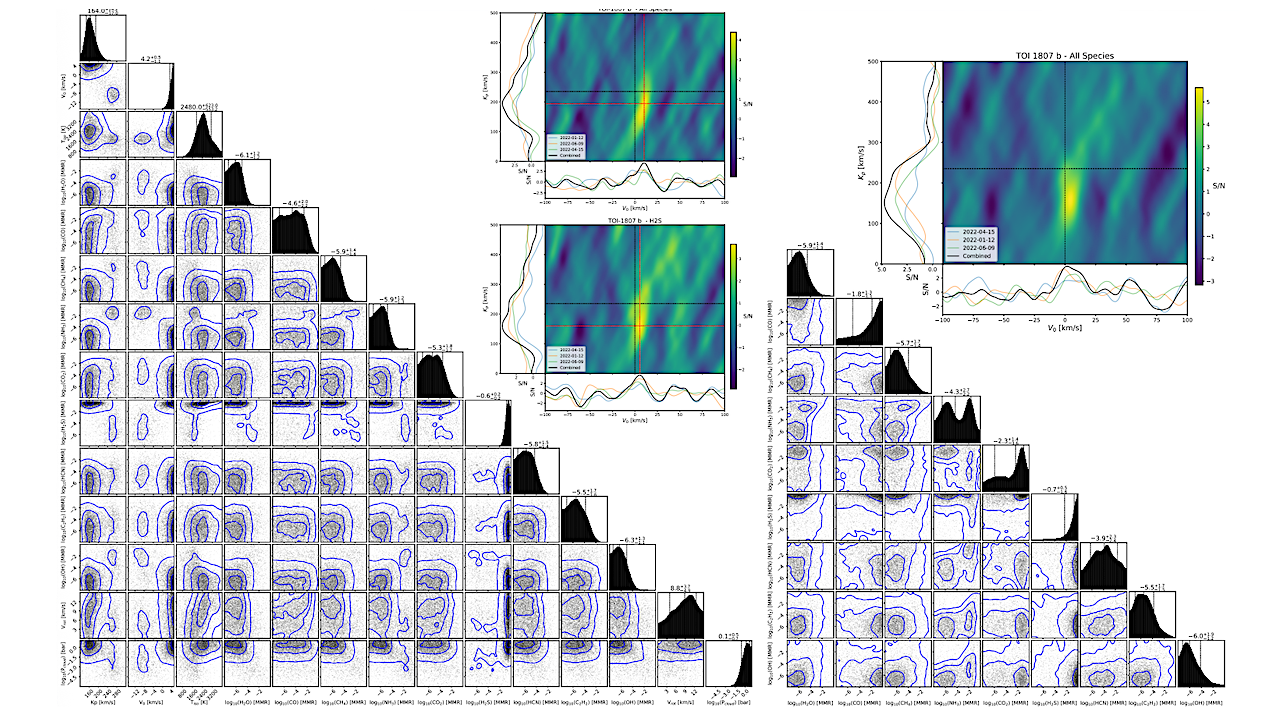
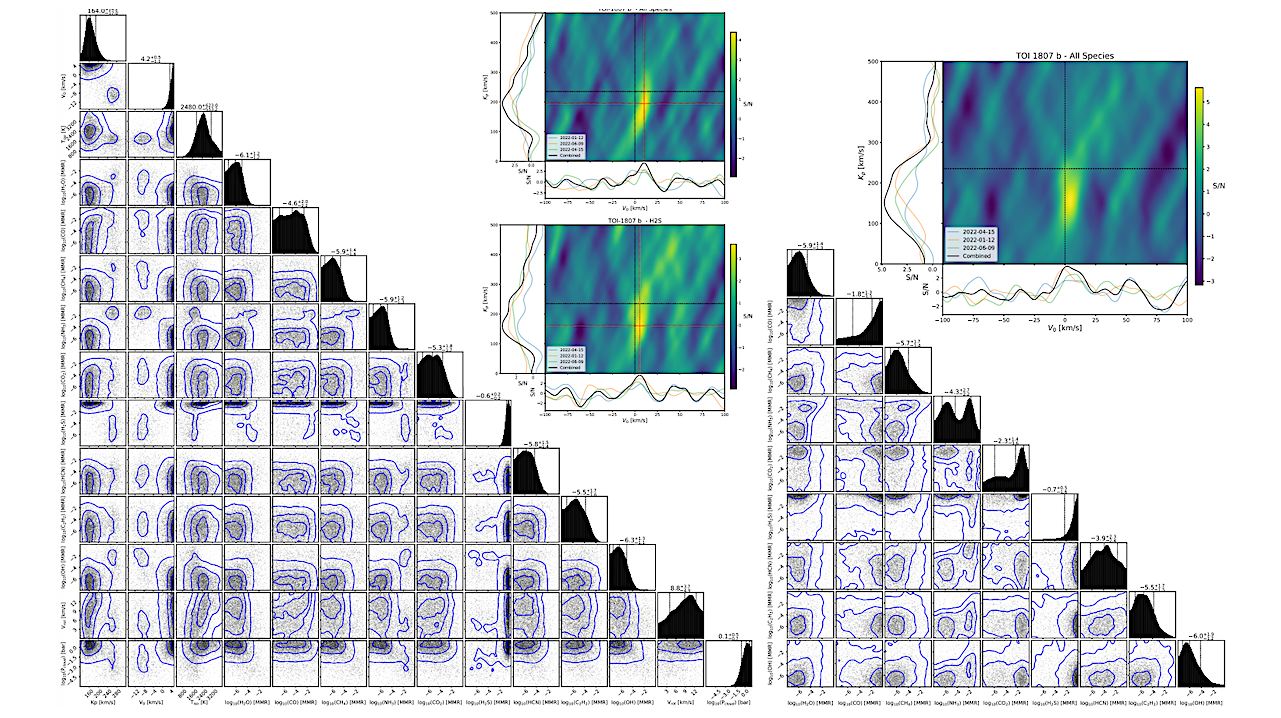
Corner plot from the Full (left) and Upper Limits (right) Runs with associated CCF maps for TOI-1807 b. The blue contours represent the 1-, 2-, and 3-σ confidence intervals. Left: the posteriors converged toward a signature at a lower Kp and higher V0 than the expected planetary signal (black cross in the CCF), corresponding to a 4.4-σ tentative signature when computing a CCF map including all species and with all parameters fixed to their best values (upper CCF figure). This signal is dominated by its H2S contribution, with a 3.7-σ signature in the CCF map computed from an H2S only model (lower CCF figure). The projected CCF at the best Kp and V0 km s−1 found by the retrieval (red cross) is shown in the left and lower CCF figures’ panels for each transit date and for their combination (solid black). Right: posteriors and CCF map obtained from the Upper Limits Run, i.e. by fixing the isothermal profile to ExoREM’s predictions and the mean molecular weight to 2.33 in a cloud-free model. The CCF map was obtained using the best abundances and including all species, with the lower and left panels showing the CCF projected along the theoretical planet’s position (black cross). The signal found in the Full Run case is still visible at a lower S/N. — astro-ph.EP
High-resolution spectroscopy provides unique constraints on exoplanet atmospheric composition and dynamics. The past decade of ground-based campaigns has accumulated extensive public archives, yet many observations remain unanalysed.
We present a homogeneous blind-search analysis of 50 SPIRou transits spanning 14 exoplanets, ranging from super-Earths to ultra-hot Jupiters, combining data from large program and public archived observations.
Using automated data reduction and atmospheric retrieval via Nested Sampling validated by Cross Correlation Function analysis, we confirm previous H2O and CO detections in HD 189733 b, WASP-76 b, and WASP-127 b, report tentative H2S detections in HD 189733 b and TOI-1807 b, tentative detection of GJ 3470 b’s atmosphere, and provide upper limits for non-detections.
This work demonstrates a scalable method for systematic archive analysis, providing a first step toward ground-based support of large space-based atmospheric characterization programs and the study of atmospheric diversity across exoplanet populations from a statistical perspective.
A. Masson, S. Vinatier, B. Bézard, F. Debras, A. Carmona, J. Lillo-Box, N. B. Cowan, V. Yariv, R. Allart
Comments: main body: 12 pages, appendix: 8 pages, with 7 additional online figures and 2 additional archives containing reduced-data (links available in the PDF or through the incoming A&A publication)
Subjects: Earth and Planetary Astrophysics (astro-ph.EP)
Cite as: arXiv:2603.17574 [astro-ph.EP] (or arXiv:2603.17574v1 [astro-ph.EP] for this version)
https://doi.org/10.48550/arXiv.2603.17574
Focus to learn more
Submission history
From: Adrien Masson
[v1] Wed, 18 Mar 2026 10:26:57 UTC (25,568 KB)
https://arxiv.org/abs/2603.17574
Astrobiology,










Related Posts

Stay Informed With the Latest & Most Important News




Advertisement
-
 01Two Black Holes Observed Circling Each Other for the First Time
 -
 02From Polymerization-Enabled Folding and Assembly to Chemical Evolution: Key Processes for Emergence of Functional Polymers in the Origin of Life
 -
 03Astronomy 101: From the Sun and Moon to Wormholes and Warp Drive, Key Theories, Discoveries, and Facts about the Universe (The Adams 101 Series)
 -
 04True Anomaly hires former York Space executive as chief operating officer
 -
 05Φsat-2 begins science phase for AI Earth images
 -
 06Hurricane forecasters are losing 3 key satellites ahead of peak storm season − a meteorologist explains why it matters
 -
 07Binary star systems are complex astronomical objects − a new AI approach could pin down their properties quickly