
Now Reading: Asgard Archaea: Have We Found Our Microbial Aancestors?
-
01
Asgard Archaea: Have We Found Our Microbial Aancestors?


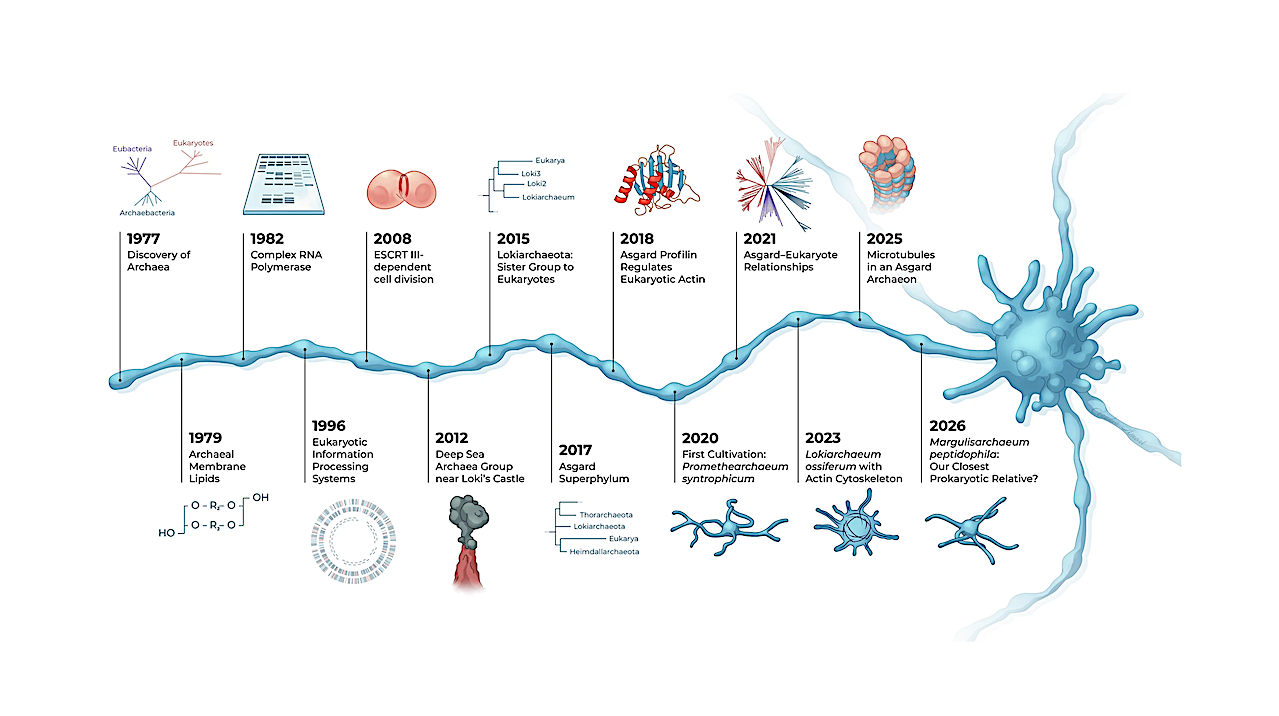

A few highlights from the first recognition of Archaea to the cultivation of the first Asgard representatives and their cellular structures are shown. Symbols indicate the respective methods used. — Springer Nature
The discovery of Asgard archaea about a decade ago has greatly reshaped our understanding of archaeal evolution and the origin of eukaryotes.
Asgards are currently thought to be the closest prokaryotic relatives of eukaryotes and to represent the archaeal host lineage that participated in the endosymbiotic event leading to the first eukaryotic cell.
The presence of numerous eukaryotic signature proteins in Asgard genomes supports this view and provides important insights into the deep evolutionary roots of eukaryotic cellular complexity.
However, the close relationship between archaea and eukaryotes had been observed for decades, based on features that are shared in different molecular processes. This review discusses the discovery of Asgard archaea in the broader context of archaeal molecular and cellular biology and highlights how earlier findings foreshadowed their emergence.
Primarily targeted at newcomers to the field, the review provides an overview of evolutionary innovations across the Archaea domain and discusses molecular and cellular features of cultivated Asgard strains in light of previous archaeal research.
Astrobiology,











Related Posts

Stay Informed With the Latest & Most Important News
Previous Post
Next Post

Advertisement
-
 01Two Black Holes Observed Circling Each Other for the First Time
 -
 02From Polymerization-Enabled Folding and Assembly to Chemical Evolution: Key Processes for Emergence of Functional Polymers in the Origin of Life
 -
 03Astronomy 101: From the Sun and Moon to Wormholes and Warp Drive, Key Theories, Discoveries, and Facts about the Universe (The Adams 101 Series)
 -
 04True Anomaly hires former York Space executive as chief operating officer
 -
 05Φsat-2 begins science phase for AI Earth images
 -
 06Hurricane forecasters are losing 3 key satellites ahead of peak storm season − a meteorologist explains why it matters
 -
 07Binary star systems are complex astronomical objects − a new AI approach could pin down their properties quickly