
Now Reading: Blue Origin joins the orbital data center race
-
01
Blue Origin joins the orbital data center race


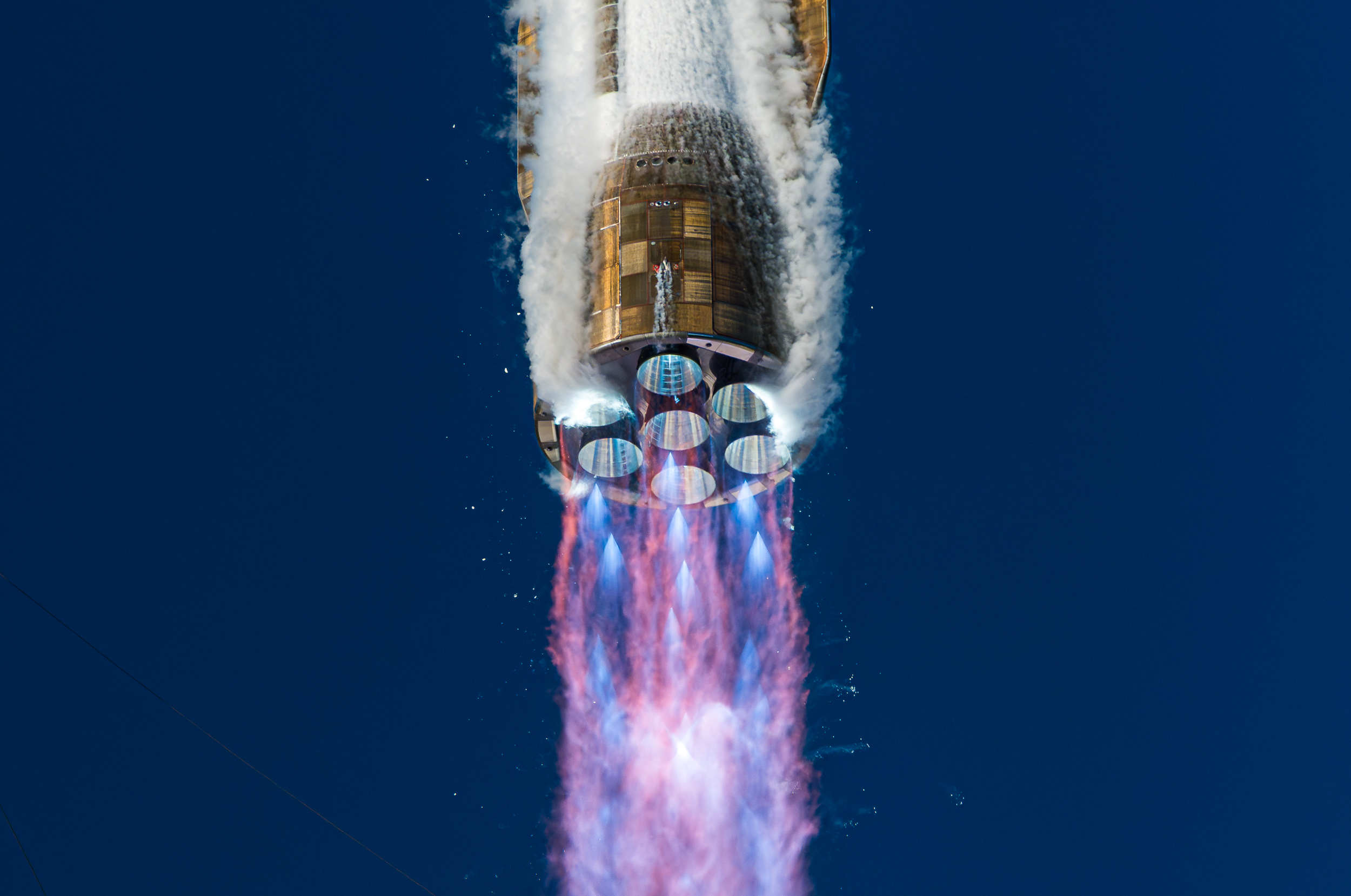

WASHINGTON — Blue Origin is the latest company to propose an orbital data center system, filing plans for a constellation of up to 51,600 satellites.
In a March 19 filing with the Federal Communications Commission, Blue Origin sought authorization to launch and operate Project Sunrise, a constellation of satellites that would provide in-space computing services.
Like other companies that have announced plans for orbital data centers, Blue Origin argues that a satellite constellation is the best approach to meet the growing computing requirements — and thus power demand — of artificial intelligence applications.
“The built-in efficiencies of solar-powered satellites, always-on solar energy, lack of land or displacement costs, and nonexistent grid infrastructure disparities fundamentally lower the marginal cost of compute capacity compared to terrestrial alternatives,” the company states in its filing.
“Blue Origin’s Project Sunrise will serve the broad AI data center market and enable U.S. companies developing and using AI to flourish, accelerating breakthroughs in machine learning, autonomous systems and predictive analytics in support of broad societal benefit,” it added.
Project Sunrise would include up to 51,600 satellites in sun-synchronous orbits at altitudes between 500 and 1,800 kilometers. Each orbital plane would be 5 to 10 kilometers apart in altitude and have between 300 and 1,000 satellites. The company did not discuss how the system would be launched other than saying it is enabled “by the revolutionary capability of New Glenn’s launch capacity.”
Blue Origin did not disclose details about the satellites themselves beyond noting they will primarily communicate through optical intersatellite links with TeraWave, Blue Origin’s broadband constellation the company announced in January. The company is seeking FCC authorization to use Ka-band frequencies primarily for telemetry, tracking and control applications.
The company said it will comply with guidelines to minimize the creation of orbital debris and deorbit its satellites within five years of the end of their lives. It added it would also work with the astronomy community to minimize the brightness of the satellites and their impact on astronomical observations.
Blue Origin is the latest company to propose orbital data center constellations with extremely large numbers of satellites. In late January, SpaceX filed an application with the FCC for a constellation of up to one million orbital data center satellites. The FCC also recently accepted for filing a proposal from Starcloud, a startup focused on developing orbital data centers, for a constellation of up to 88,000 satellites.
The proposals share some design elements. All plan to use, in large part, dusk-dawn sun-synchronous orbits to maximize solar power. They also plan to primarily use optical intersatellite links with broadband constellations.
None of the companies have provided many technical details about their satellites or schedules for their deployment. Blue Origin, in its FCC filing, asked for a waiver from milestone rules that would require half the constellation to be in orbit six years after approval and the full constellation within nine years.
Blue Origin argues that since it is seeking access to Ka-band spectrum on a non-interference basis, the milestones are unnecessary because the company would not be “warehousing” spectrum and preventing others from using it.
The company said in its filing that it welcomes competition with other companies also proposing orbital data centers.
“The demand for space-based compute power is growing. Competition among these systems will drive innovation and enhance service quality,” it stated. “Encouraging diverse participation in the space-based data center market will catalyze advancements in technology and resource efficiency, ultimately leading to more robust and sustainable solutions.”










Related Posts

Stay Informed With the Latest & Most Important News
Previous Post
Next Post





Advertisement
-
 01Two Black Holes Observed Circling Each Other for the First Time
 -
 02From Polymerization-Enabled Folding and Assembly to Chemical Evolution: Key Processes for Emergence of Functional Polymers in the Origin of Life
 -
 03Astronomy 101: From the Sun and Moon to Wormholes and Warp Drive, Key Theories, Discoveries, and Facts about the Universe (The Adams 101 Series)
 -
 04True Anomaly hires former York Space executive as chief operating officer
 -
 05Φsat-2 begins science phase for AI Earth images
 -
 06Hurricane forecasters are losing 3 key satellites ahead of peak storm season − a meteorologist explains why it matters
 -
 07Binary star systems are complex astronomical objects − a new AI approach could pin down their properties quickly