
Now Reading: European-Chinese Smile mission set for launch after successful spacecraft fuelling
-
01
European-Chinese Smile mission set for launch after successful spacecraft fuelling

European-Chinese Smile mission set for launch after successful spacecraft fuelling

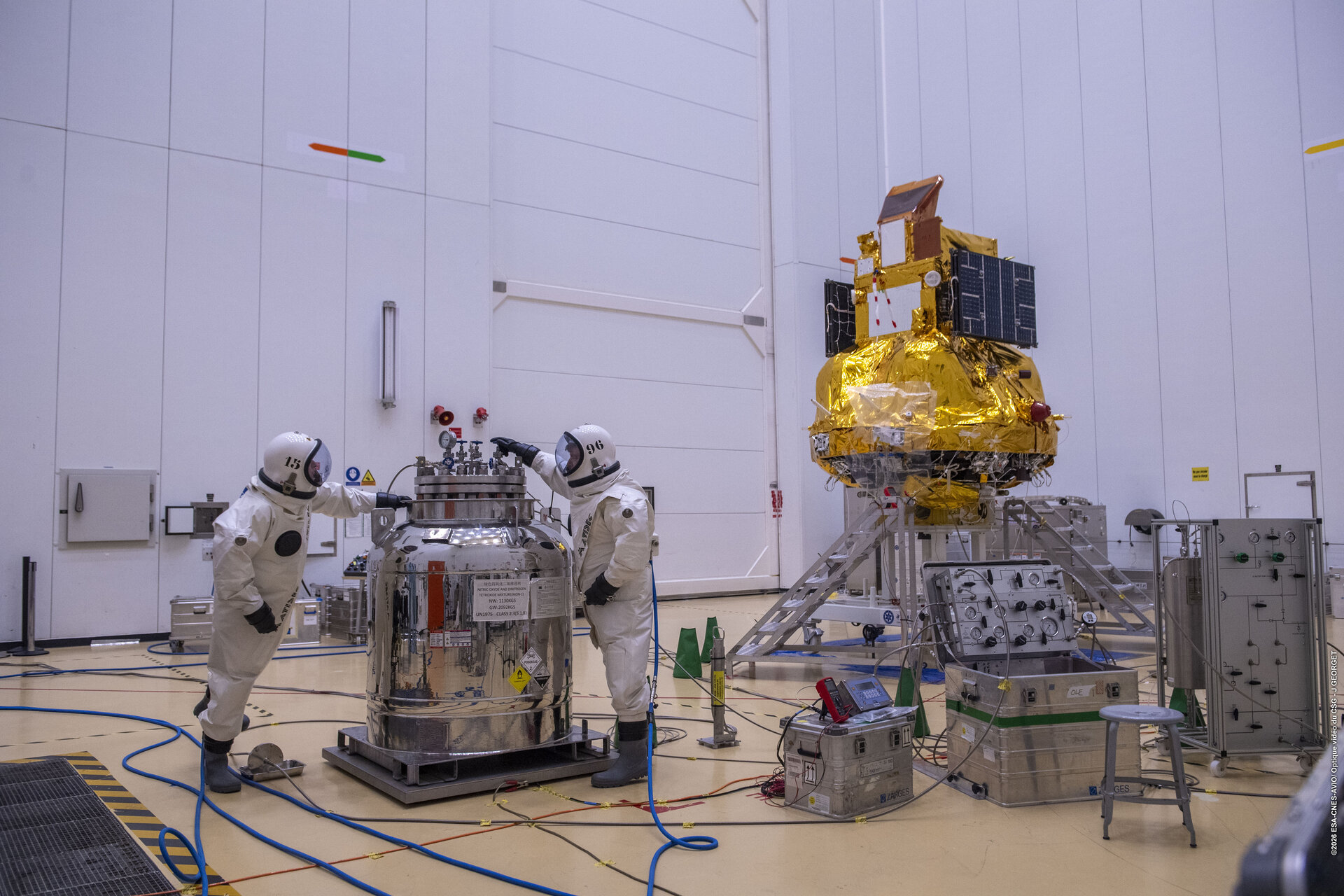

On March 20, preparations for the European-Chinese Smile mission progressed as experts successfully completed the fuelling of the spacecraft, which is set to launch aboard a Vega-C rocket on April 9. Smile, designed with a distinctive bulbous structure beneath its solar panels, contains four fuel tanks, each holding 380 liters of hydrazine fuel combined with an oxidizer. The spacecraft’s total weight is 2,300 kilograms, with a significant portion—1,580 kilograms—dedicated to fuel that will primarily power its engine, capable of generating 490 Newtons of thrust.
The mission aims to use approximately 90% of its fuel in the first month after launch. Following its deployment into a circular orbit around 700 kilometers above Earth, Smile will conduct a series of 11 engine burns over a 25-day period to shape its orbit. This trajectory will take it to a maximum altitude of 121,000 kilometers over the North Pole, allowing it to gather critical data about Earth’s magnetic field in response to charged particles emitted by the Sun. Subsequently, it will lower its orbit to 5,000 kilometers above the South Pole to relay its findings back to Earth. Each complete orbit is projected to last about two days.
Once Smile reaches its intended orbit, it will have sufficient fuel reserves to sustain its position for several additional years, during which it will aim to achieve its ambitious scientific objectives. The fuelling process for any satellite is intricate and requires meticulous attention to detail. This operation involves the careful configuration of equipment and connections, the actual fuelling, followed by pressurization of the tanks.
In a safety-first approach, the technicians involved in this sensitive procedure donned Self-Contained Atmospheric Protective Ensemble (SCAPE) suits. While hydrazine is widely used in spacecraft due to its efficiency and reliability, it poses significant risks as a highly toxic and explosive substance. Consequently, only a limited number of specialists were allowed in the fuelling area, mandated to wear SCAPE suits to shield themselves from potential hazards affecting their health and safety.
The Smile mission, which stands for the Solar wind Magnetosphere Ionosphere Link Explorer, marks a collaboration between the European Space Agency and the Chinese Academy of Sciences. It will deploy four scientific instruments to enhance our understanding of how Earth interacts with solar winds, providing valuable insights into solar storms, geomagnetic phenomena, and the broader science of space weather. For ongoing updates regarding Smile’s launch preparations, the mission team encourages interested individuals to visit their dedicated website.










Related Posts

Stay Informed With the Latest & Most Important News
Previous Post
Next Post


Advertisement
-
 01Two Black Holes Observed Circling Each Other for the First Time
 -
 02From Polymerization-Enabled Folding and Assembly to Chemical Evolution: Key Processes for Emergence of Functional Polymers in the Origin of Life
 -
 03Astronomy 101: From the Sun and Moon to Wormholes and Warp Drive, Key Theories, Discoveries, and Facts about the Universe (The Adams 101 Series)
 -
 04True Anomaly hires former York Space executive as chief operating officer
 -
 05Φsat-2 begins science phase for AI Earth images
 -
 06Hurricane forecasters are losing 3 key satellites ahead of peak storm season − a meteorologist explains why it matters
 -
 07Binary star systems are complex astronomical objects − a new AI approach could pin down their properties quickly