
Now Reading: NASA’s telescopes unveil stunning new insights into Saturn’s dynamic atmosphere
-
01
NASA’s telescopes unveil stunning new insights into Saturn’s dynamic atmosphere


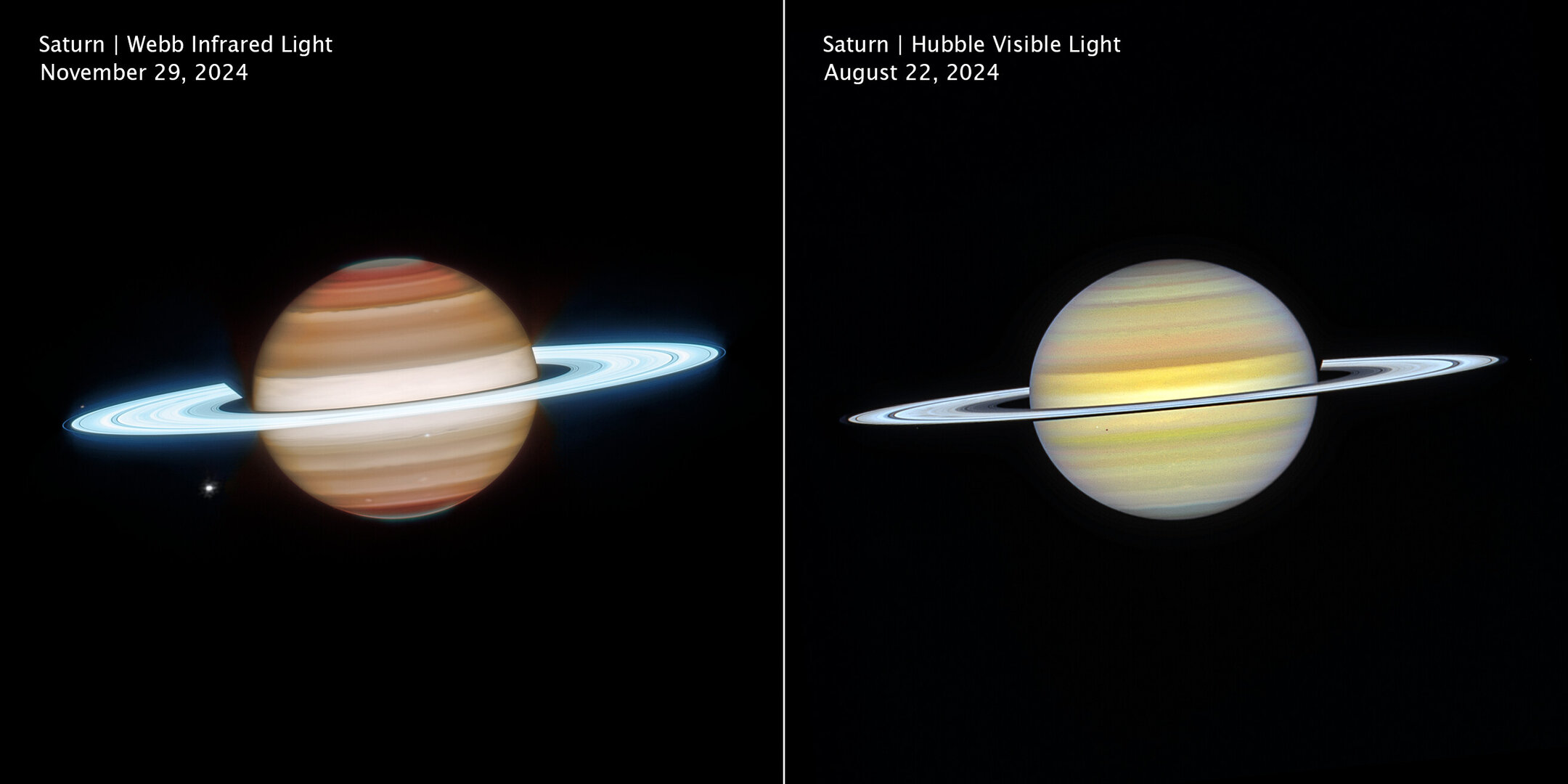

NASA’s James Webb Space Telescope and the Hubble Space Telescope have collaborated to unveil new, detailed images of Saturn, showcasing the gas giant in remarkably distinct ways. By using both infrared and visible light observations, the two observatories are enhancing our understanding of Saturn’s dynamic atmosphere, which is characterized by its complex layers and turbulent weather systems.
The combined efforts of Webb and Hubble allow scientists to explore the various altitudes of Saturn’s atmosphere, as each telescope captures different aspects of the planet’s features. Hubble’s visible light data highlights subtle color variations across Saturn’s expansive cloud coverage, while Webb’s infrared capabilities penetrate deeper into the atmosphere, revealing cloud formations and chemical compositions at multiple levels. This multi-faceted approach enables researchers to effectively “slice” through the atmosphere, providing a comprehensive view of the planet’s atmospheric dynamics.
The Hubble image, taken in August 2024 as part of a decade-long monitoring initiative known as OPAL (Outer Planet Atmospheres Legacy), captures a moment in time for Saturn, while Webb’s image follows a few months later, illustrating the ongoing changes in the planet’s weather. The infrared snapshot from Webb reveals significant atmospheric features, including a persistent jet stream dubbed the “ribbon wave,” which weaves through the northern mid-latitudes, influenced by atmospheric waves not visible to Hubble. A small spot marked in the image is a remnant of the “Great Springtime Storm” that occurred between 2011 and 2012, along with various storms scattered throughout the southern hemisphere.
Intriguingly, both telescopes also depict the edges of Saturn’s iconic hexagon-shaped jet stream at the north pole, first observed by Voyager in 1981. This striking feature remains a subject of interest for scientists, as it exemplifies long-term atmospheric stability on giant planets. Observations indicate that these may be the last high-resolution images of Saturn’s hexagonal pattern until the 2040s, due to the planet’s northern pole entering a lengthy winter period that will plunge it into darkness for 15 years.
Webb’s infrared data strikes a notable visual difference, particularly as Saturn’s poles exhibit a grey-green hue, possibly attributed to high-altitude aerosols that scatter light at those latitudes or potentially linked to auroral activity, which occurs when charged particles interact with Saturn’s magnetic field.
The images also showcase Saturn’s stunning rings, which appear exceptionally bright in Webb’s observations due to their high reflectivity of water ice. Notably, the F ring appears sharp and defined in Webb’s view, while Hubble captures these features with less intensity. The varying perspectives from both telescopes are a result of Saturn’s orbit, which alters our viewpoint over time.
As the planet transitions from northern summer to the 2025 equinox, the new observations highlight the shifting atmospheric conditions that researchers will continue to monitor. Hubble’s cumulative data over the decades, complemented by Webb’s powerful infrared analysis, enhances the scientific community’s ability to track atmospheric changes, storm developments, and seasonal cycles on Saturn, contributing to a deeper understanding of the planet’s complexities.










Related Posts

Stay Informed With the Latest & Most Important News
Previous Post
Next Post

Advertisement
-
 01Two Black Holes Observed Circling Each Other for the First Time
 -
 02From Polymerization-Enabled Folding and Assembly to Chemical Evolution: Key Processes for Emergence of Functional Polymers in the Origin of Life
 -
 03Astronomy 101: From the Sun and Moon to Wormholes and Warp Drive, Key Theories, Discoveries, and Facts about the Universe (The Adams 101 Series)
 -
 04True Anomaly hires former York Space executive as chief operating officer
 -
 05Φsat-2 begins science phase for AI Earth images
 -
 06Hurricane forecasters are losing 3 key satellites ahead of peak storm season − a meteorologist explains why it matters
 -
 07Binary star systems are complex astronomical objects − a new AI approach could pin down their properties quickly