
Now Reading: The Lazuli Space Observatory: Architecture & Capabilities
-
01
The Lazuli Space Observatory: Architecture & Capabilities


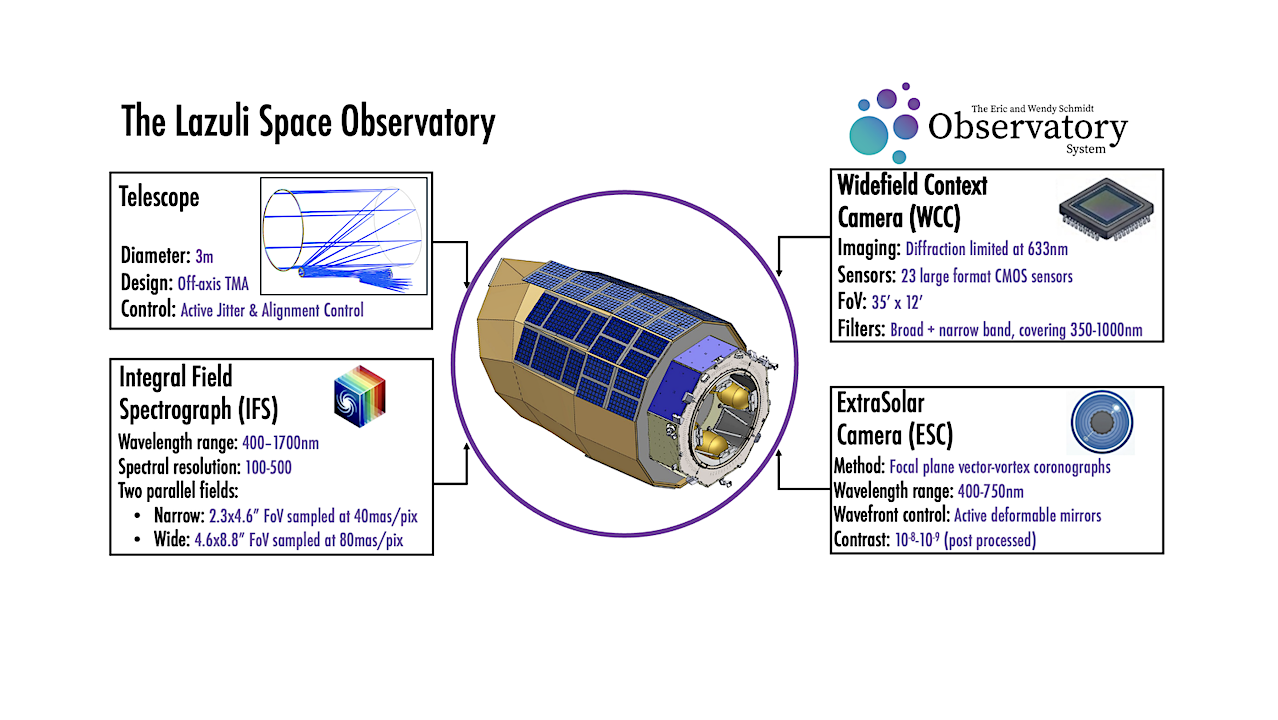
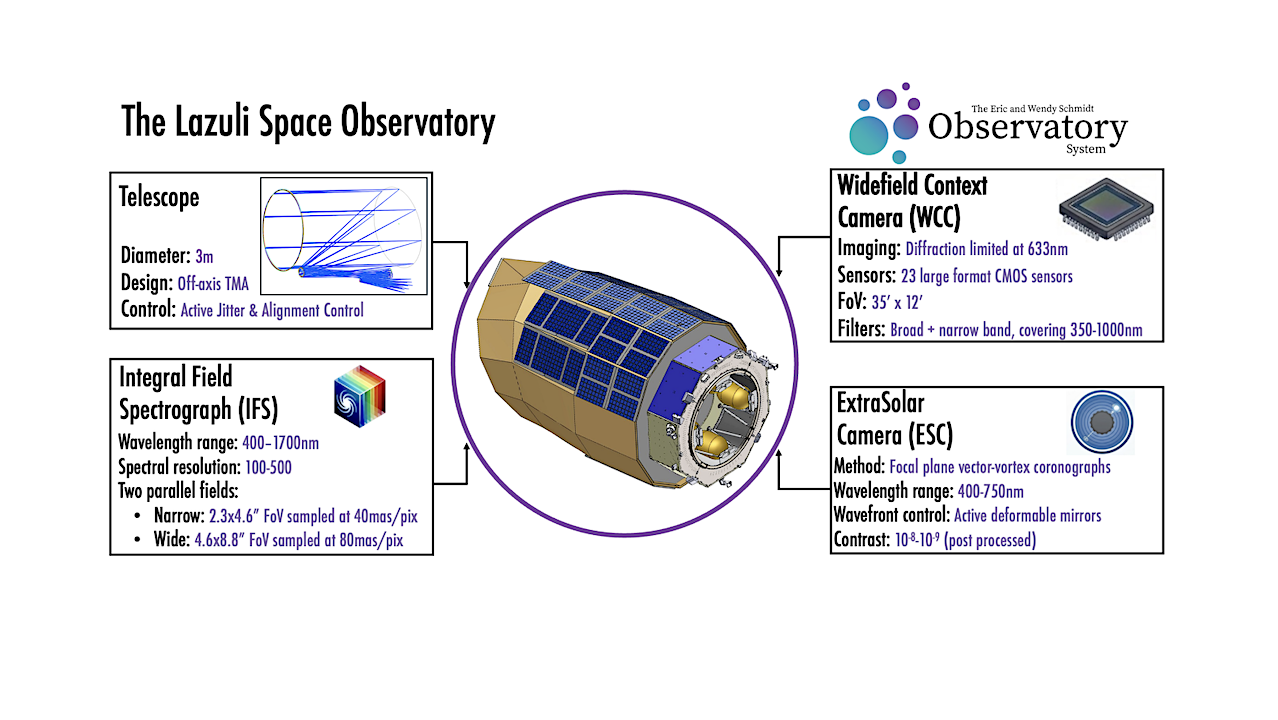
Overview of the 3 m Lazuli Space Observatory and its three instruments, the Widefield Context Camera (WCC), the Integral Field Spectrograph (IFS), and the ExtraSolar Coronagraph (ESC). Main properties and characteristics of the telescope and the instruments are highlighted. — astro-ph.IM
Editor’s note: The Lazuli Space Observatory is part of the Eric and Wendy Schmidt Observatory System, the proposed Lazuli Space Observatory is a 3-meter telescope designed to capture fast-changing cosmic events through wide-field imaging, spectroscopy and rapid response observations.
The Lazuli Space Observatory is a 3-meter aperture astronomical facility designed for rapid-response observations and precision astrophysics across visible to near-infrared wavelengths (400-1700 nm bandpass). An off-axis, freeform telescope delivers diffraction-limited image quality (Strehl >0.8 at 633 nm) to three instruments across a wide, flat focal plane.
The three instruments provide complementary capabilities: a Wide-field Context Camera (WCC) delivers multi-band imaging over a 35′ × 12′ footprint with high-cadence photometry; an Integral Field Spectrograph (IFS) provides continuous 400-1700 nm spectroscopy at R ∼ 100-500 for stable spectrophotometry; and an ExtraSolar Coronagraph (ESC) enables high-contrast imaging expected to reach raw contrasts of 10−8 and post-processed contrasts approaching 10−9.

Operating from a 3:1 lunar-resonant orbit, Lazuli will respond to targets of opportunity in under four hours–a programmatic requirement designed to enable routine temporal responsiveness that is unprecedented for a space telescope of this size.
Lazuli’s technical capabilities are shaped around three broad science areas: (1) time-domain and multi-messenger astronomy, (2) stars and planets, and (3) cosmology. These capabilities enable a potent mix of science spanning gravitational wave counterpart characterization, fast-evolving transients, Type Ia supernova cosmology, high-contrast exoplanet imaging, and spectroscopy of exoplanet atmospheres.
While these areas guide the observatory design, Lazuli is conceived as a general-purpose facility capable of supporting a wide range of astrophysical investigations, with open time for the global community. We describe the observatory architecture and capabilities in the preliminary design phase, with science operations anticipated following a rapid development cycle from concept to launch.

a) A simulated transmission spectrum of a WASP-39 b-like exoplanet using PICASO (Batalha et al. 2019) and slicersim (Rigault et al. 2026). The Lazuli IFS spectra (blue data points) span the information-rich optical wavelengths sensitive to hazes, Na and K to the near-infrared water-dominated absorption bands. This complements the infrared capabilities of JWST and Ariel and enables seamless combinations of panchromatic spectra from the visible to near-infrared. b) Exoplanet systems fainter than the subarray saturation limit (dashed vertical line) will be accessible for transmission spectroscopy, including terrestrial, sub-Neptune and giant exoplanets. — astro-ph.IM
Arpita Roy, Stuart Feldman, Pete Klupar, John DiPalma, Saul Perlmutter, Ewan S. Douglas, Greg Aldering, Gabor Furesz, Patrick Ingraham, Gudmundur Stefansson, Douglas Kelly, Fan Yang Yang, Thomas Wevers, Nicole Arulanantham, James Lasker, Mickael Rigault, Everett Schlawin, Sander R. Zandbergen, S. Pete Worden, Ramya Anche, Heejoo Choi, Ian J. M. Crossfield, Kevin Derby, Jerry Edelstein, Mike Eiklenborg, Suvi Gezari, Paul Giuliano, Justin Hom, Taylor J. Hoyt, Hyukmo Kang, Daewook Kim, Keerthi Kunnumkai, Leander Lacroix, Jared R. Males, Thomas J. Maccarone, Kian Milani, Timothy N. Miller, Kelsey Lynn Miller, Pierre Nicolas, Antonella Palmese, Jason Pero, Laurent Pueyo, Stephanie Rinaldi, David J. Sand, Christian Schneider, Sanchit Sabhlok, Arfon Smith, Irina I. Stefan, Saraswathi Kalyani Subramanian, Kyle Van Gorkom, Andre F. Wong, Jaegun Yoo, Md Abdullah Al Zaman, the Lazuli Science Team
Comments: 33 pages, 15 figures, 1 table
Subjects: Instrumentation and Methods for Astrophysics (astro-ph.IM); Cosmology and Nongalactic Astrophysics (astro-ph.CO); Earth and Planetary Astrophysics (astro-ph.EP); High Energy Astrophysical Phenomena (astro-ph.HE); Solar and Stellar Astrophysics (astro-ph.SR)
Cite as: arXiv:2601.02556 [astro-ph.IM] (or arXiv:2601.02556v1 [astro-ph.IM] for this version)
https://doi.org/10.48550/arXiv.2601.02556
Focus to learn more
Submission history
From: Thomas Wevers
[v1] Mon, 5 Jan 2026 21:12:43 UTC (11,942 KB)
https://arxiv.org/abs/2601.02556
Astrobiology, Astronomy, exoplanet,










Related Posts

Stay Informed With the Latest & Most Important News
Previous Post
Next Post


Advertisement
-
 01Two Black Holes Observed Circling Each Other for the First Time
 -
 02From Polymerization-Enabled Folding and Assembly to Chemical Evolution: Key Processes for Emergence of Functional Polymers in the Origin of Life
 -
 03Astronomy 101: From the Sun and Moon to Wormholes and Warp Drive, Key Theories, Discoveries, and Facts about the Universe (The Adams 101 Series)
 -
 04True Anomaly hires former York Space executive as chief operating officer
 -
 05Φsat-2 begins science phase for AI Earth images
 -
 06Hurricane forecasters are losing 3 key satellites ahead of peak storm season − a meteorologist explains why it matters
 -
 07Binary star systems are complex astronomical objects − a new AI approach could pin down their properties quickly