
Now Reading: China sends radar mapping and GNSS augmentation sats into orbit with pair of launches
-
01
China sends radar mapping and GNSS augmentation sats into orbit with pair of launches

China sends radar mapping and GNSS augmentation sats into orbit with pair of launches

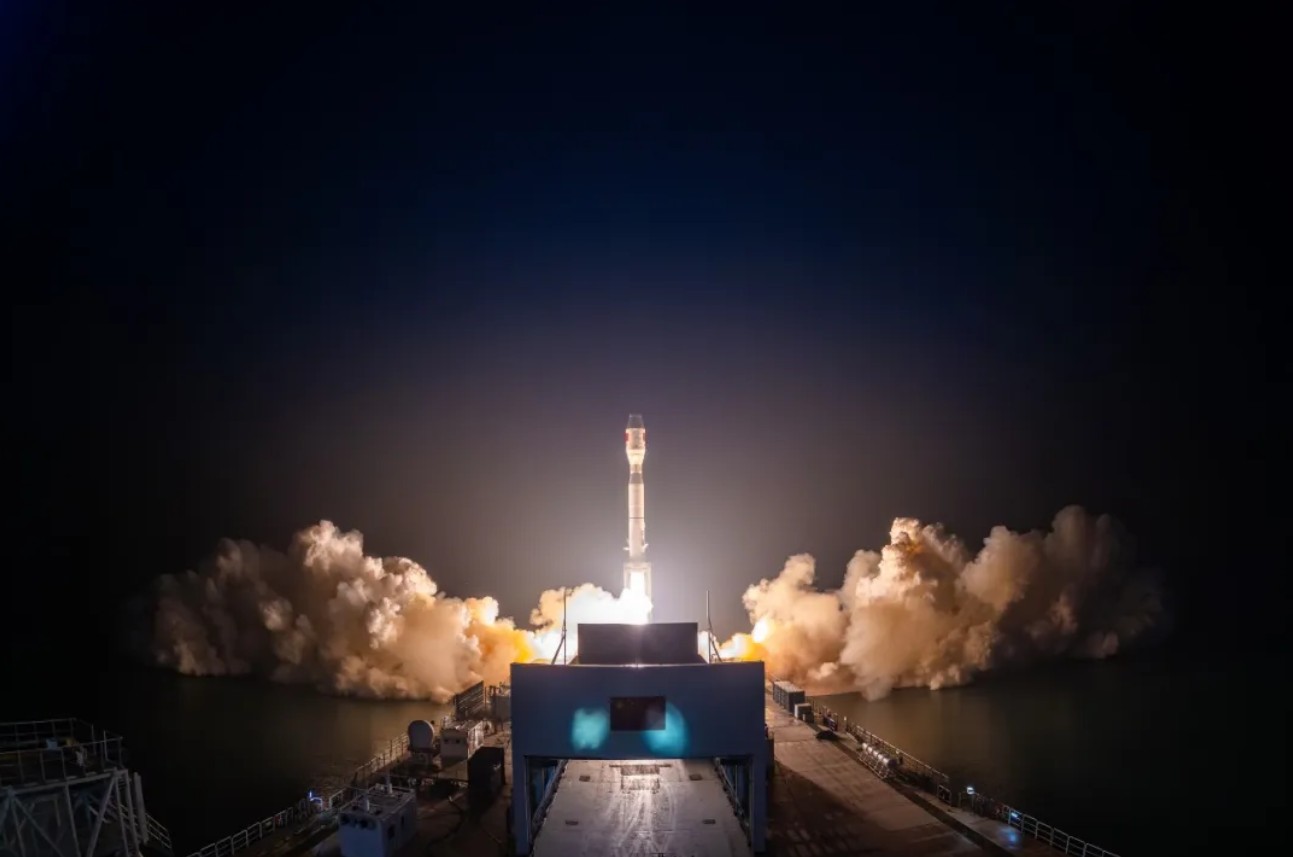

HELSINKI — China conducted a pair of launches in recent days, adding new satellites to the SuperView and CentiSpace low Earth orbit infrastructure constellations.
A Long March 2D hypergolic rocket lifted off at 6:51 p.m. Eastern (2251 UTC) March 25 from Taiyuan Satellite Launch Center in northern China. The China Aerospace Science and Technology Corporation (CASC) declared the mission a success within an hour of launch, revealing the payloads to be a pair of synthetic aperture radar satellites for the SuperView remote sensing constellation.
The SuperView Neo-2 series (Siwei Gaojing-2) satellites 05 and 06 are designed to deliver “all-weather, all-day, high-resolution radar imagery with a resolution better than 1 meter,” according to a CASC statement. The data will enable the rapid production and delivery of high-precision digital elevation model (DEM) products, radar orthophoto products, deformation monitoring products and services based on time-series radar interferometry.
The constellation is operated by China Siwei, a subsidiary of CASC, and developed by CASC’s Shanghai Academy of Spaceflight Technology (SAST). The first satellites, SuperView-1 (01) and (02), were launched by a Long March 2D in December 2016, but inserted into lower-than-intended orbits, impacting mission lifetimes.
China also has the national Gaofen (CHEOS) Earth observation system, the military Yaogan series and Jilin-1 commercial optical constellation from CGST.
Jielong-3 launch
The Long March 2D mission followed a sea launch of a Jielong-3 solid rocket days earlier. The Jielong-3 (Smart Dragon-3) lifted off at 11:49 a.m. Eastern (1549 UTC) March 22 from a converted barge off the coast of Haiyang, Shandong province, in the Yellow Sea.
CASC announced launch success, revealing the payloads to be the CentiSpace-2 group (Weili Kongjian group 02) of low Earth orbit (LEO) navigation enhancement satellites. The 10 satellites were launched for commercial company Future Navigation, full name Beijing Future Navigation Technology Co., Ltd.
U.S. Space Force later tracked the satellites into near-circular low Earth orbits at around 645 kilometers altitude inclined by 55 degrees.
The project has had strong state involvement. The constellation’s pilot technology verification satellite, Xiangrikui-1, launched in 2018, was developed by the Innovation Academy for Microsatellites of the Chinese Academy of Sciences (IAMCAS), while the 29th Research Institute of China Electronics Technology Group Corporation (CETC), a major state-owned defense and electronics conglomerate, is also involved. Funding rounds include key investors in the form of state-backed investment vehicles and the Beidou Industry Fund, which is explicitly tied to and intended to boost China’s national GNSS ecosystem.
The satellites are designed to augment GNSS signals, including Beidou and GPS, by providing stronger, LEO signal layers for higher-precision positioning. The CentiSpace constellation is planned to consist of around 160-190 satellites in LEO at various altitudes and inclinations with integrated ground architecture. Stated applications include autonomous driving, precision agriculture, Geographic Information Systems (GIS) and assisting in emergency response and disaster management.
The launch was the 10th of the Jielong-3, four-stage solid rocket, with the first launch taking place in December 2022. All launches have taken place from the Yellow Sea and all have been successful. The rocket is 31 meters long and has a payload capacity of 1,500 kilograms to 500-kilometer sun-synchronous orbit (SSO), according to CASC.
China Rocket which, under CASC, operates the Jielong-3, is now also advertising rideshare opportunities for launches variously to SSO and LEO in November 2026, and Q2 and Q4 2027.
China’s 2026 launch record
The launches were China’s 15th and 16th orbital launch attempts of 2026 and the seventh since March 12 when the country ended a month-long launch hiatus following the Chinese New Year.
China has not published a ballpark target for launches in 2026, but the country appears set to attempt to pass the 100-launch mark in a calendar year for the first time, having made 92 launch attempts in 2025. Further commercial and Long March launch activity is expected before the end of the month.
Launches are expected in the coming days from Jiuquan Satellite Launch Center in the Gobi Desert, while preparations for the debut of the reusable Long March 10B rocket appear underway at the coastal Wenchang spaceport on Hainan island.










Related Posts
Stay Informed With the Latest & Most Important News
Previous Post
Next Post




Advertisement
-
 01Two Black Holes Observed Circling Each Other for the First Time
 -
 02From Polymerization-Enabled Folding and Assembly to Chemical Evolution: Key Processes for Emergence of Functional Polymers in the Origin of Life
 -
 03Astronomy 101: From the Sun and Moon to Wormholes and Warp Drive, Key Theories, Discoveries, and Facts about the Universe (The Adams 101 Series)
 -
 04True Anomaly hires former York Space executive as chief operating officer
 -
 05Φsat-2 begins science phase for AI Earth images
 -
 06Hurricane forecasters are losing 3 key satellites ahead of peak storm season − a meteorologist explains why it matters
 -
 07Binary star systems are complex astronomical objects − a new AI approach could pin down their properties quickly