
Now Reading: Creating near-term lunar settlements: lessons from space history
-
01
Creating near-term lunar settlements: lessons from space history


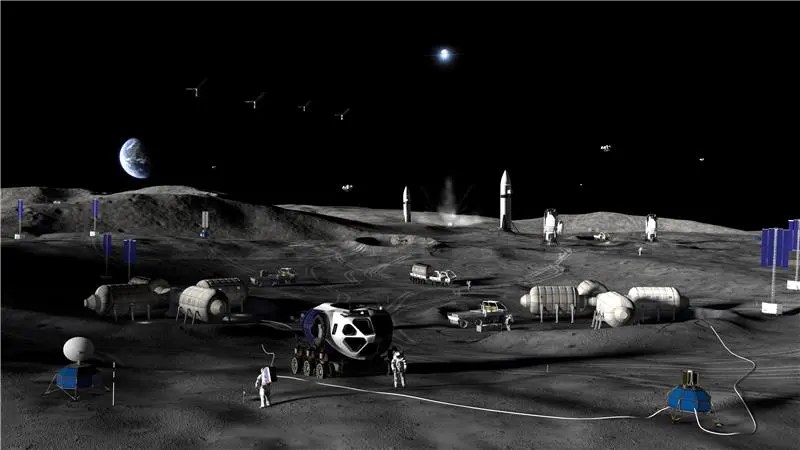

March 16, 2026, was the 100th anniversary of Robert Goddard’s first flight of a liquid fueled rocket. It reached an altitude of 41 feet. 31 years later, in 1957, Sputnik began a lonely beep as the first satellite in orbit. In 1969, 12 years after Sputnik and 43 years after Goddard’s first flight, Neil Armstrong walked on the moon. It’s been 57 years since the first Apollo landing and we don’t yet have a group of folks living and working on the moon or Mars (although people have lived for more than a year in the International Space Station in low Earth orbit). Frankly, we’re not even close to living on the moon. Something has gone remarkably wrong. Something needs to change dramatically if living and working on the moon is going to become real.
What can the government or industry do to make lunar settlements happen in the near-term and why should they do it? It can be done — and it can be done in the near-term in a way that generates lots of near-term return on investment to the benefit of both mankind as a whole and the companies and countries that do it. The history of small satellites tells us how.
In contrast to lunar settlements, small satellites in low Earth orbit (LEO) have flourished. There are now about 10,000 satellites in LEO with over 400 constellations planned or being deployed, to the point that LEO may soon become unusable because of the hundreds of thousands to millions of satellites being deployed — and the resulting debris. A good part of this growth is due to the commercialization of LEO and the growth of profit-making systems.
Today lunar settlements are thought of primarily in terms of science and space exploration. But for nearly 60 years, that has not been adequate justification to actually make lunar settlements happen. Something needs to change. Can commercialization be a driver for living and working on the moon?
What it takes to make any large project occur is motivation and money, and we can create both by adding commercial “social programs” to the list of lunar activities. By social programs, I mean people-oriented activities, such as lunar tourism, lunar burial, popular training and formal education, sports and entertainment and advertising and marketing. Consider, for example, lunar tourists jumping over buildings, enjoying romance in 1/6th Earth gravity, or literally watching the Earth turn above a 100 million year-old lunar landscape.
Can commercialization of lunar settlements really cut costs and raise lots of money for the companies that do it? Yes, it can, by limiting ourselves to very economical lunar enclosures. ents really cut costs and raise lots of money for the companies that do it? Yes, it can. Costs are reduced dramatically by doing most of the work inside a very economical lunar enclosure. This has the advantage of letting us use normal everyday equipment, like cell phones, computers and washing machines. Instead of spending billions of dollars inventing stuff for the moon, we can have manufacturers pay millions to use their products on the moon. You could buy a Ford Luna electric car, a moon bike, or a Universal burger (likely vegetarian, so it may not be too tasty).
The moon would be truly unique for advertising and marketing. The key issue here is that the audience for all of this is over 8 billion people worldwide and the near-term income is estimated at over $100 billion/year. The entire population of the world may not know about Paris or New York, but they all know the moon.
We have the technology to make this happen today. To create the motivation we need two things, funded either by the government or by a company or companies that want to make lots of near-term ROI. First, we need business models of the dozen or so key business areas that will generate the near-term income (lunar tourism, lunar burial, helium extraction, sports and entertainment, mining and minerals, science, manufacturing, weddings and ceremonies, advertising and marketing and more) This is challenging because these businesses are truly global in scope and different audiences will require different perspectives.
The second element is to build and test a 2- or 3-meter diameter model of an economical lunar enclosure to show the world, and particularly investors, that it can be done and what it would be like. Aluminum and glass are already being made out of simulated lunar regolith. Almost anything is more compelling if you can see it and feel it and understand from real data how long it takes to build and what it costs.
These two actions can and should be done now and can be done in a relatively short time. The lunar settlement can preserve humankind and begin the exploration of the solar system. It’s lots of fun, and it makes lots and lots of money. Seems like a pretty good deal.
James R. Wertz is the president of Microcosm, an adjunct professor of astronautics at USC where he teaches a graduate course in Lunar Settlements, and the editor of a number of books in space technology, including Space Mission Analysis and Design, Space Mission Engineering, and Reducing Space Mission Cost.
SpaceNews is committed to publishing our community’s diverse perspectives. Whether you’re an academic, executive, engineer or even just a concerned citizen of the cosmos, send your arguments and viewpoints to opinion (at) spacenews.comto be considered for publication online or in our next magazine. If you have something to submit, read some of our recent opinion articles and our submission guidelines to get a sense of what we’re looking for. The perspectives shared in these opinion articles are solely those of the authors and do not necessarily represent their employers or professional affiliations.










Related Posts
Stay Informed With the Latest & Most Important News


Advertisement
-
 01Two Black Holes Observed Circling Each Other for the First Time
 -
 02From Polymerization-Enabled Folding and Assembly to Chemical Evolution: Key Processes for Emergence of Functional Polymers in the Origin of Life
 -
 03Astronomy 101: From the Sun and Moon to Wormholes and Warp Drive, Key Theories, Discoveries, and Facts about the Universe (The Adams 101 Series)
 -
 04True Anomaly hires former York Space executive as chief operating officer
 -
 05Φsat-2 begins science phase for AI Earth images
 -
 06Hurricane forecasters are losing 3 key satellites ahead of peak storm season − a meteorologist explains why it matters
 -
 07Binary star systems are complex astronomical objects − a new AI approach could pin down their properties quickly