
Now Reading: Watch NASA’s new Mars helicopter rotor break the speed of sound (video)
-
01
Watch NASA’s new Mars helicopter rotor break the speed of sound (video)


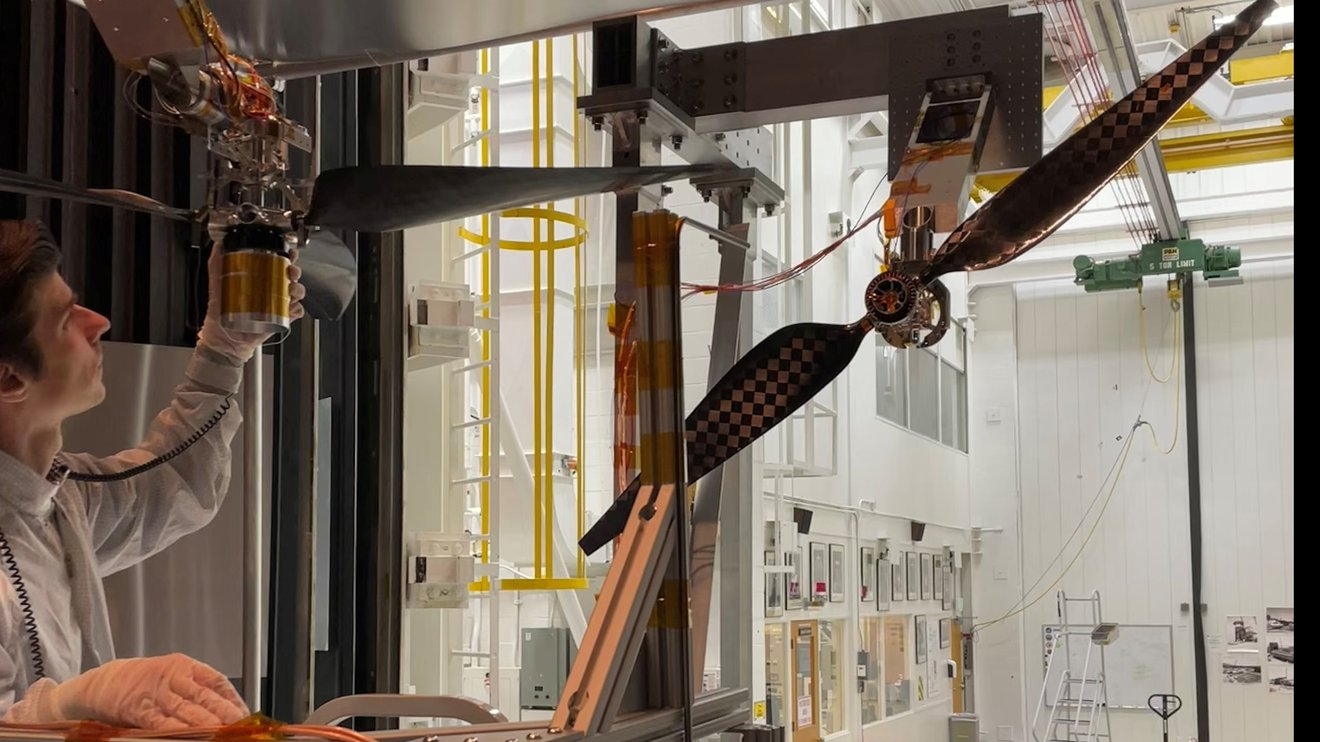
NASA is testing the limits of future Mars aircraft as it works to develop a next-generation fleet of helicopters that will fly through the thin atmosphere of the Red Planet.

The first-ever aerodynamic flight on Mars was performed on April 19, 2021 by NASA’s Ingenuity helicopter, a prototype designed to determine if a helicopter could be effective in such a thin atmosphere. The little rotorcraft far exceeded mission managers’ expectations, completing a total of 72 flights over the course of nearly three years.
Ingenuity was not built to operate as a full science vehicle, but NASA’s next Mars helicopters are being designed to do just that. “NASA had a great run with the Ingenuity Mars Helicopter,” Al Chen, JPL’s Mars Exploration Program manager, said in a May 7 JPL statement. “But we are asking these next-generation aircraft to do even more at the Red Planet.”
Teams at JPL mounted a three-bladed rotor inside the modified chamber, which also blasted the blades with wind to simulate flight conditions. They spun the rotor at increasing speeds until its tips eventually reached Mach 1.08 without signs of damage.
Engineers also tested a longer, two-bladed rotor for SkyFall, a mission concept designed to send three next-generation Mars helicopters to the Red Planet in December 2028. The increased length of the two-bladed version allowed the rotor to reach the same near-supersonic speeds with fewer rotations per minute. Those tests collected data that are being integrated into the SkyFall mission team’s design specifications, according to the same statement.
“The successful testing of these rotors was a major step toward proving the feasibility of flight in more demanding environments, which is key for next-gen vehicles,” Shannah Withrow-Maser, an aerodynamicist at NASA’s Ames Research Center in Silicon Valley, said in the statement.
The successful tests point toward a new class of Mars exploration vehicle, capable of carrying instruments over terrain that rovers may struggle to reach and that orbiters may be too far away to study.










Related Posts

Stay Informed With the Latest & Most Important News
Previous Post
Next Post
Previous Post
Next Post

Advertisement
-
 01Two Black Holes Observed Circling Each Other for the First Time
 -
 02From Polymerization-Enabled Folding and Assembly to Chemical Evolution: Key Processes for Emergence of Functional Polymers in the Origin of Life
 -
 03Astronomy 101: From the Sun and Moon to Wormholes and Warp Drive, Key Theories, Discoveries, and Facts about the Universe (The Adams 101 Series)
 -
 04True Anomaly hires former York Space executive as chief operating officer
 -
 05Φsat-2 begins science phase for AI Earth images
 -
 06Hurricane forecasters are losing 3 key satellites ahead of peak storm season − a meteorologist explains why it matters
 -
 07Binary star systems are complex astronomical objects − a new AI approach could pin down their properties quickly