
Now Reading: Machine Learning As A Transformative Tool for (Exo-)Planetary Science
-
01
Machine Learning As A Transformative Tool for (Exo-)Planetary Science


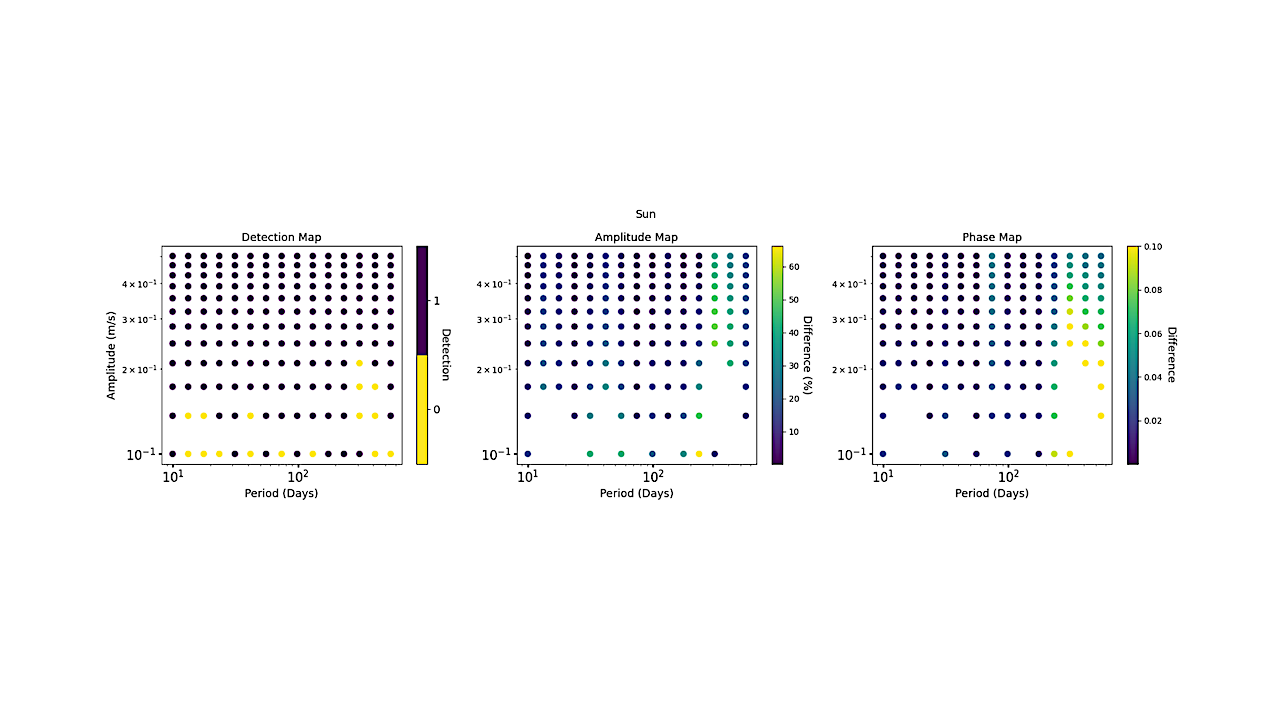
Exoplanet detection limits from the neural network framework in the case of HARPS-N solar spectra. Left: Detection limit map in the period-amplitude domain. The red dots indicate the successful detection by the trained NN with a false alarm probability (FAP) > 0.1%. Middle: Amplitude comparison between the injected and recovered signals in the period-amplitude domain. The amplitude difference for most of the recovered signals are 20%. The large difference at low amplitude (0.1 m/s) is likely due to noise in the data. Right: Phase comparison between the injected and recovered signals in the period-amplitude domain. The phase difference for most of the recovered planets is 0.04. The large differences at long periods is likely due to a poorer sampling of the phase for long-period planetary signals.–astro-ph.EP
The exploration of planetary bodies in our Solar system and beyond relies on the processing and interpretation of large, spatio-temporally inconsistent, and heterogeneous datasets.
Recent advances in machine learning (ML) provide unprecedented opportunities to address many fundamental challenges posed by these heterogeneous and hyper-dimensional datasets. This review chapter highlights innovative ML methodologies that were developed and used by NCCR PlanetS members to address three overarching challenges in (exo)planetary science.
The first challenge is sequence modelling, which encompasses the intricate analysis of one-dimensional data such as time series of radial velocities and light curves, among other examples.
Secondly, there is pattern recognition that involves studying correlations, leveraging convolutional neural networks for feature extraction, mapping and cross correlation among other examples., anomaly detection through variational autoencoders, and unsupervised clustering of mass spectrometric data.
Lastly, there are generative models and emulation-based Bayesian analysis, which encompass the development of predictive models for planetary interior structure, employing Deep Neural Networks to understand planet formation mechanisms.
These innovative ML methodologies herald a paradigm shift in the processing of data and numerical models that represent inherent challenges in planetary and exoplanetary science, paving the way for revolutionary discoveries and ideas in this field.
J. Davoult, V. T. Bickel, C. Haslebacher, Y. Alibert, D. Angerhausen, C. Cantero, J. A. Egger, R. Eltschinger, Y. Eyholzer, E. O. Garvin, S. Gruchola, A. Leleu, S. Marques, Y. Zhao
Comments: Chapter accepted for publication in the NCCR PlanetS Legacy Book: Benz, W. et al. (Eds), The National Center for Competence in Research, PlanetS: A Swiss-wide network expanding planetary sciences. Springer (2026)
Subjects: Earth and Planetary Astrophysics (astro-ph.EP)
Cite as: arXiv:2604.09152 [astro-ph.EP] (or arXiv:2604.09152v1 [astro-ph.EP] for this version)
https://doi.org/10.48550/arXiv.2604.09152
Focus to learn more
Submission history
From: Jeanne Davoult PhD
[v1] Fri, 10 Apr 2026 09:39:14 UTC (12,913 KB)
https://arxiv.org/abs/2604.09152
Astrobiology, AI,










Related Posts


Stay Informed With the Latest & Most Important News
Previous Post
Next Post




Advertisement
-
 01Two Black Holes Observed Circling Each Other for the First Time
 -
 02From Polymerization-Enabled Folding and Assembly to Chemical Evolution: Key Processes for Emergence of Functional Polymers in the Origin of Life
 -
 03Astronomy 101: From the Sun and Moon to Wormholes and Warp Drive, Key Theories, Discoveries, and Facts about the Universe (The Adams 101 Series)
 -
 04True Anomaly hires former York Space executive as chief operating officer
 -
 05Φsat-2 begins science phase for AI Earth images
 -
 06Hurricane forecasters are losing 3 key satellites ahead of peak storm season − a meteorologist explains why it matters
 -
 07Binary star systems are complex astronomical objects − a new AI approach could pin down their properties quickly